
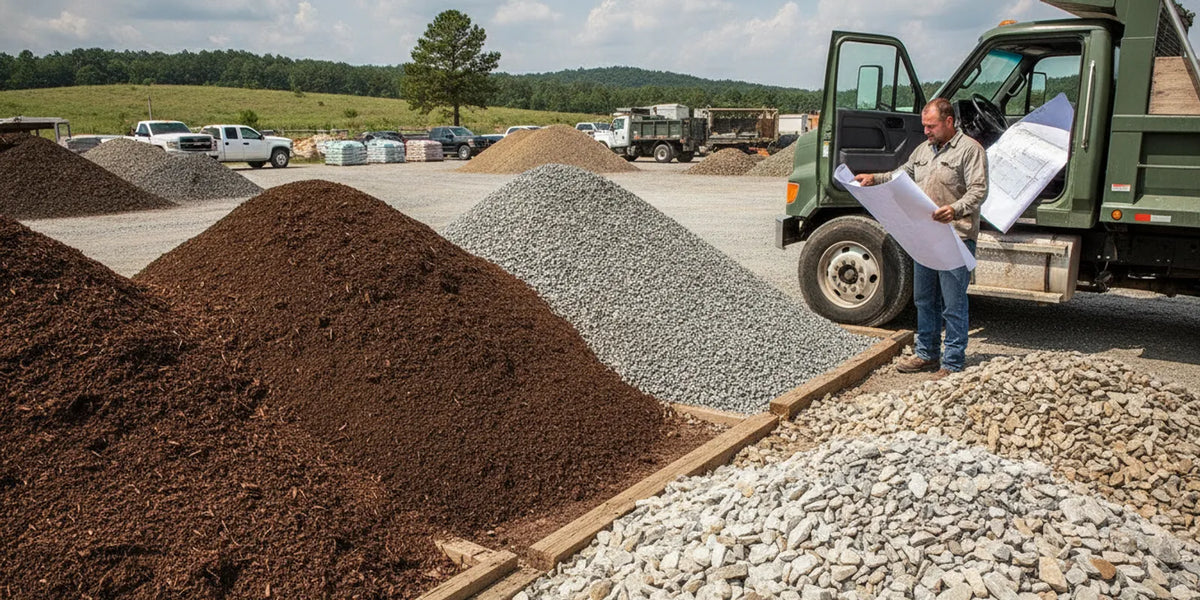
Finding the right bulk landscape materials Denver North Carolina buyers can order or arrange for delivery takes more than choosing a color or product name. Contractors, landscapers, property owners, and homeowners also need to confirm the material, quantity, warehouse, fulfillment method, jobsite access, and whether the request is a product purchase or a separately quoted project service.
Contact Sagamore Companies about your project
This guide explains how to plan a bulk material order in Denver, how pickup and delivery differ, what information affects a quote, and which questions to answer before scheduling. Sagamore Companies serves the Denver area through a regional landscape-material supply model, but availability and fulfillment remain address- and product-specific. A useful plan keeps the retail purchase path separate from placement, installation, and other project services.
What should you confirm before buying bulk landscape materials in Denver?
Start with the job rather than the product label. A driveway repair, planting bed, drainage area, commercial property renovation, and new lawn may all need different materials. The same word, such as “stone” or “soil,” can describe products with different sizes, textures, drainage properties, and intended uses.
Before requesting a price or adding a product to a cart, write down the following:
- Project use: Identify whether the material is for planting, grading, drainage, a path, a driveway, erosion control, a play area, or another purpose.
- Measured area: Record length, width, and the depth you expect to install. Irregular areas can be divided into smaller rectangles or measured in sections.
- Estimated quantity: Convert the measurements into cubic yards for many soil and mulch orders or tons for many aggregate orders. Keep the calculation separate from the final order until the product and unit are confirmed.
- Jobsite address: A Denver mailing address does not by itself establish delivery eligibility, stock, or the cost of fulfillment.
- Access conditions: Note the entrance, driveway width, overhead obstructions, turning room, slopes, soft ground, gates, and the location where a truck may unload.
- Timing: State when the material is needed, while understanding that a requested date is not a guaranteed delivery window until the order or project is confirmed.
- Labor scope: Decide whether you need material only, delivery, slinger placement, or a separately quoted installation service.
These details help prevent a common mistake: treating a product listing as if it were a complete project quote. A material price and a delivery charge may not include labor, placement, taxes, site preparation, or other project-specific costs. Checkout and written quote terms should control the final assumptions.
Which bulk materials might fit a Denver, North Carolina project?
Sagamore Companies presents a regional selection of landscape materials that can include mulch, topsoil, compost, fill materials, gravel, decorative stone, sand, and related lawn or landscape products. The correct choice depends on the work and on what is available through the location-qualified store path at the time of purchase.
Mulch for planting beds and finished landscape areas
Mulch is commonly selected for the surface of planting beds and other finished landscape areas. Buyers may compare color, texture, material type, and depth. A contractor should also consider how the mulch will be moved from the delivery point to the beds. A load that can be tipped near a driveway may still require additional labor to distribute through a narrow side yard.
When a customer needs installation in Ohio, Sagamore Companies describes coordination with trusted contractors subject to a five-yard minimum. That description should not be transferred to Denver or treated as included with Carolina material delivery. For a Denver project, confirm whether the request is for delivery to the customer's chosen landscaper or for another specifically quoted service. Do not assume that material delivery includes spreading, raking, edging, or bed preparation.
Topsoil, compost, and soil blends
Soil products can serve different purposes. Screened topsoil may be considered for grading or planting preparation, while compost is generally used as an amendment rather than as a complete structural fill. A contractor should identify whether the site needs a finish layer, planting soil, a fill material, or a soil amendment before comparing products.
Ask what the product is intended to do, how it is screened or blended, and whether the quantity is sold by the yard or another unit. If a project has specifications from a landscape architect, municipality, builder, or engineer, share those requirements before selecting a substitute. A product name alone may not demonstrate compliance with a project specification.
Gravel, stone, and aggregate
Gravel and stone selection can depend on size, shape, color, drainage needs, compaction, traffic, and appearance. A driveway base, walking path, decorative border, and drainage feature may call for different aggregate characteristics. Ask whether the proposed product is intended for the use you have in mind and whether the sold unit is a ton, pallet, or another measure.
Decorative stone is often evaluated by appearance and coverage, but access and containment matter too. A sloped site may need a different installation plan than a flat bed. For a commercial site, confirm whether the project documents specify gradation, material source, or installation thickness. These questions are more useful than comparing two product names without their intended application.
Sand and specialty landscape materials
Sand may be used in masonry, concrete-related, drainage, or landscape applications, but those uses are not interchangeable. Confirm the product description and intended application before ordering. Smaller lawn and garden items may be useful for a repair, but they do not replace a bulk order when the project requires several yards or tons.
The Denver store path may display products qualified for the Carolina region. That does not mean every Ohio product, Carolina product, or seasonal item is available at every location. Treat the store selector and product page as the starting point for confirmation, not as a promise of universal inventory.
How do you estimate the quantity without overordering?
Quantity planning should be simple enough to check and detailed enough to expose errors. For a rectangular area, multiply length by width by depth in feet, then divide by 27 to estimate cubic yards. Convert the depth to feet before calculating; a two-inch layer is 2/12 of a foot, not two feet. For irregular beds, calculate separate sections and add them together.
For example, a bed that is 30 feet long and 8 feet wide with a 3-inch layer has an approximate volume of 60 cubic feet, or about 2.22 cubic yards before any allowance for uneven ground or settling. That arithmetic is an estimate, not a product recommendation or a final order quantity. The right amount can change when the material, depth, compaction, site preparation, or delivery unit changes.
For aggregate sold by the ton, the conversion is not identical to a cubic-yard estimate because weight depends on the material and its density. Use the supplier's quantity guidance or calculator when available, then ask for confirmation if the project has a specified tonnage. Do not convert yards to tons using an assumption copied from a different stone or soil product.
What should the quantity worksheet include?
- Area measurements for each zone.
- Planned installed depth.
- Product name and selling unit.
- Whether the area is level, sloped, or irregular.
- Any existing material that will remain in place.
- Space needed for seams, low spots, settling, or later touch-up.
- The delivery point and the distance from that point to the work area.
Share the worksheet with the person preparing the order or quote. If the material will be used across several properties, separate each address and delivery point. Combining quantities can make a total look efficient while hiding different access conditions, product needs, or fulfillment charges.
Should you choose pickup or delivery in Denver?
Pickup can make sense when the buyer has a suitable truck, the quantity fits the vehicle, and the material can be safely transported. Delivery may be more practical for a bulk order, a contractor handling several jobs, or a property where loading and unloading with personal equipment would be difficult. Neither option is automatically better; the right choice depends on quantity, equipment, distance, timing, and the jobsite.
When can pickup be practical?
Pickup offers control over the trip and may be convenient for a small contractor order or a homeowner with an appropriate vehicle. Confirm the selected warehouse, product stock, pickup process, vehicle requirements, loading limits, and hours before traveling. A store selector can help identify a location, but the current status and inventory should be confirmed for the specific item.
Do not assume that a product displayed online is loaded and waiting at the Denver location. Regional products, seasonal materials, and different selling units may have separate availability. A pickup plan should also account for tarp requirements, safe weight limits, and the fact that loose material can shift during transport.
When can delivery be practical?
Delivery can reduce the need to arrange a suitable hauling vehicle and may move a larger amount in one trip. It does not remove the need to prepare the site. The customer should identify a stable unloading surface, keep the route clear, and tell the supplier about restrictions that may affect access.
Delivery charges and estimates can vary with product, quantity, route, warehouse, date, and fulfillment method. Checkout establishes the shipping estimate for a qualifying retail order, while project services and unusual access conditions may require a separate quote. Do not present an online product price as the delivered total until shipping and other applicable charges are shown.
What is the difference between delivery and slinger placement?
Ordinary delivery places material at a truck-accessible unloading point. Slinger placement uses conveyor equipment to move eligible materials farther across a jobsite or into a more difficult area. It is a separately scoped equipment-assisted service, not an automatic feature of a material order.
Slinger suitability depends on access, reach, material, placement area, overhead conditions, ground conditions, and the requested quantity. Sagamore Companies describes reach and capacity examples for its slinger service, but examples should not be treated as a guarantee for every Denver address. Ask for a project-specific assessment and quote if material must be placed beyond the ordinary dump location.
What access details affect a Denver delivery or placement quote?
Truck access is one of the most important details to settle before ordering bulk landscape materials. The delivery vehicle needs a route from the public road to the unloading area, and the driver needs enough room to maneuver safely. A site that appears open from the street may have a low branch, narrow gate, soft shoulder, retaining wall, or overhead utility line that changes the plan.
Provide the following information with the address:
- Street address and the preferred entrance.
- Driveway width, gate width, and tight turns.
- Surface type and whether the route is paved, gravel, grass, or unfinished.
- Slopes, soft ground, bridges, culverts, retaining walls, and other load-bearing concerns.
- Overhead wires, tree branches, roof edges, and other vertical obstructions.
- Where the truck can stop and where the material should be unloaded.
- Whether traffic, pedestrians, parked vehicles, or neighboring properties limit the work area.
- Photographs or a site sketch when the route is difficult to describe.
Never ask a driver to enter a route that has not been evaluated for the vehicle and load. The supplier may need to change the unloading point, decline a route, or recommend a separately assessed placement method. A quote based on incomplete access information may need to change once the site is understood.
For commercial properties, include delivery windows, gate procedures, security requirements, loading-dock conflicts, and the name of the person who will receive the load. For a subdivision, apartment property, school, or municipal site, identify whether a permit, traffic plan, or property manager approval is needed. These details help separate a straightforward material delivery from a coordinated project service.
Related products

Warm, natural tones add visual texture to outdoor projects.
View product

How should you check inventory and service-area eligibility?
Denver is listed as a pickup location for Sagamore Companies at 3176 N-NC Bus 16, Denver, NC 28037. That listing supports a Denver-area shopping path, but it does not establish that every item is stocked there or that every surrounding ZIP code qualifies for delivery. Confirm the current warehouse, product, unit, and route before promising a customer or crew that the material is available.
Use the location-qualified store process when purchasing a retail product. Review the product name, region, unit, quantity, and available fulfillment option. If a product is not shown, appears unavailable, or does not produce a clear shipping estimate, contact the company rather than substituting an unverified item or assuming another warehouse can fulfill the order.
Service-area qualification is especially important when a project involves a truck, slinger, concrete, screening, snow, salt, or another project service. These services have different equipment, dispatch, access, and job-size requirements. A retail delivery radius should not be used as evidence that an installation crew or specialized truck serves the same area.
For a contractor managing several Denver-area jobs, confirm each address separately when the products, quantities, or access conditions differ. A single conversation may cover the account, but the operational details still belong to each job. Ask whether the material can be consolidated, whether the delivery points require separate charges, and whether the requested timing is feasible without describing it as guaranteed.
How do material orders differ from project-service quotes?
A material order is usually centered on product selection, quantity, fulfillment, and payment through the location-qualified store and checkout path. A project-service request requires more information because the work may involve equipment, labor, site conditions, access, scheduling, and responsibility for the completed scope.
Keep these paths distinct:
| Need | Best starting path | Information to prepare | What to confirm |
|---|---|---|---|
| Bulk mulch, soil, compost, gravel, or stone | Location-qualified product page, cart, and checkout | Product, unit, quantity, address, and fulfillment choice | Current stock, shipping estimate, taxes, and any separate charges |
| Material pickup | Store selector and warehouse confirmation | Product, vehicle, pickup date request, and quantity | Warehouse, loading process, stock, and pickup requirements |
| Slinger placement | Project quote or contact request | Material, quantity, route, reach, access, and placement area | Equipment suitability, scope, route, timing, and quoted price |
| Concrete supply or installation | Service-specific quote or contact request | Address, quantity, mix needs, site preparation, and finish scope | Whether the quote covers supply, placement, preparation, or installation |
| Commercial processing or seasonal service | Commercial project inquiry | Material type, site, volume, frequency, access, and operating requirements | Qualification, service territory, equipment, and written scope |
This distinction matters because a delivery is not the same as placement, and concrete supply is not the same as turnkey concrete installation. If the project requires grading, spreading, forming, pouring, finishing, or cleanup, list those tasks explicitly. Do not rely on a product order to communicate labor expectations.
What should contractors include in a Denver material request?
A complete request saves time and creates a more useful comparison between options. Include the job name, exact address, customer or property type, desired material, approximate quantity, preferred unit, requested fulfillment method, and target date. Add photographs or a simple plan when the delivery route or placement area is unusual.
Contractors should also state whether the material is being purchased for one phase or several. A topsoil delivery for grading may need to arrive before mulch, stone, or planting material. If the order is part of a larger schedule, explain the sequence without asking the supplier to guarantee a date before the project has been qualified.
Ask for the quote to identify:
- Product and grade, blend, color, or size.
- Quantity and selling unit.
- Warehouse or source location when relevant.
- Pickup or delivery method.
- Delivery or equipment charges.
- Labor or placement scope, if any.
- Taxes and other applicable charges.
- Quote expiration or conditions that may affect the total.
- Access assumptions and any customer preparation responsibilities.
- What happens if actual quantity used differs from the estimate.
When comparing quotes, compare the same scope. One proposal may cover material delivered to the driveway, while another may include conveyor placement. One may price a product by the yard, while another uses tons. A lower line item is not a meaningful saving if it leaves out the labor or equipment needed to finish the work.
How can property owners prepare the site before material arrives?
Clear the unloading area and the route leading to it. Move vehicles, trailers, bins, low branches, portable play equipment, and other obstacles. Mark irrigation heads, invisible fences, septic features, drain inlets, utility covers, and areas that should not receive material. Tell the supplier about any condition that is not obvious from the street.
Choose the unloading location with the finished project in mind. A truck may be able to place a load at the driveway entrance, but moving several yards by wheelbarrow can be a major labor task. Conversely, unloading directly beside a planting bed can damage edging, pavement, turf, or underground features if the surface is not suitable.
Do not assume a truck can drive onto wet grass or an unfinished shoulder. Rain can change ground conditions between the quote and delivery. If the route becomes unsafe, the unloading location may need to change. A contingency plan could include a different drop point, a smaller vehicle, or separately qualified placement, but the supplier must confirm what is practical.
For a commercial site, assign one person to meet the driver or coordinate access. Make sure that person knows the approved drop area and can report a problem before the load is discharged. For a homeowner order, keep children and pets away from the vehicle and unloading area. These preparations do not guarantee a delivery outcome, but they reduce preventable confusion.
What costs should be separated when planning a bulk order?
Start with the product price shown for the selected region and unit. Then identify delivery, taxes, labor, placement, equipment, site preparation, and other charges that may apply. The total for a material order can differ from the product line item, and a project quote can contain costs that do not appear in a retail cart.
Prices can change by product, region, warehouse, date, quantity, and fulfillment method. A price seen on an older page, in an example, or for another location should not be presented as a current Denver delivered price. Use the current location-qualified product and checkout estimate for a retail order. Request a written, project-specific quote for placement, installation, concrete, processing, or commercial service.
For estimating purposes, build a worksheet with separate lines for:
- Material quantity and unit price.
- Delivery or pickup-related charges.
- Placement equipment or labor, if requested.
- Installation labor and site preparation, if separately quoted.
- Taxes and any project-specific fees.
- Contingency for measured quantity changes, subject to the customer's approval process.
This format makes it easier to explain a proposal to a customer and to decide whether the scope is complete. It also protects against the assumption that a product price includes work that was never requested or quoted.
What questions should you ask before placing the order?
A short confirmation call or message can resolve the details that matter most. Ask questions that tie directly to the address and project rather than broad questions about what the company “usually” does.
- Is the selected product currently available through the Denver, North Carolina location?
- Is the product sold by the yard, ton, pallet, bag, or another unit?
- Can the requested quantity be picked up, delivered, or both?
- What is included in the shown product price?
- What shipping or delivery estimate appears at checkout?
- Are taxes, labor, placement, or equipment charges separate?
- Can the delivery vehicle reach the proposed unloading point?
- Does the material need a separately quoted slinger placement service?
- Is the requested date a preference or a confirmed appointment?
- What site preparation must the customer complete?
- If the request is for installation, which tasks are included in the written scope?
- Who should approve a change if access or quantity differs on the day of service?
For a contractor, add questions about multiple job addresses, invoice requirements, recurring orders, and whether the same product is available for each project. For a homeowner, focus on quantity, unloading location, product use, and the distance from the drop point to the finished area. For a property manager or public buyer, include access controls, receiving procedures, documentation, and any procurement requirements.
How should you plan a multi-material project?
Many Denver projects use more than one material, and sequencing can affect both the quantity and the delivery plan. A new planting area may need fill or grading material first, soil or compost next, and mulch or decorative stone last. A driveway or path may require a base aggregate before a finish stone. Write the sequence down before requesting a delivery date so the supplier can understand which load is needed first.
Keep the products for each phase separate in your worksheet. Do not combine topsoil, compost, mulch, and aggregate into one generic “landscape material” line. Each product may use a different selling unit, coverage assumption, unloading method, and placement requirement. Separate lines also make it easier to identify which material is available at the Denver warehouse and which may need another fulfillment arrangement.
Consider the space needed for temporary stockpiles. If two loads arrive before the crew is ready to place them, the property may not have a safe or suitable place for both. A pile can block a driveway, cover drainage features, interfere with pedestrians, or mix with another product. Ask whether deliveries should be staged in a different order and whether each drop point is acceptable.
For a contractor, provide a simple phase schedule without presenting it as a guaranteed appointment request. For a property owner, ask the landscaper which material must be on site first and who will move it from the unloading point. If a project has a hard opening, inspection, or tenant deadline, identify that constraint early. The supplier can then determine which details need qualification before a commitment is made.
What should you do if the product or delivery plan changes?
Changes are easier to manage when they are documented before the truck is dispatched. A substitute product may have a different color, unit, coverage rate, weight, or intended use. A different unloading point may affect access and equipment suitability. A changed quantity may require a different vehicle or a second trip. Treat each change as a new confirmation rather than assuming the original plan still applies.
If the product is unavailable, ask which comparable options are actually approved for the intended use. Do not replace a specified aggregate or soil with a visually similar product without checking with the person responsible for the project. For a homeowner, that may be the landscaper; for a commercial project, it may be the contractor, designer, engineer, or property manager.
If weather or site conditions make the route unsafe, pause and contact the supplier. Moving a load to a different location without agreement can create damage, extra labor, or a scope dispute. Confirm any revised charge, access assumption, or timing in writing before the new plan is accepted.
A clear change process protects both sides. It gives the buyer a chance to approve a revised total and gives the supplier accurate information about the product, route, and work. It also keeps a retail order from being treated as an open-ended installation commitment.
Where can you learn more about products and services?
Use the store and warehouse selector to begin a location-qualified product search. The soil collection and aggregate collection can help you compare the types of materials presented for purchase, but the exact product, unit, stock, and shipping estimate still need confirmation for Denver.
For planning background, review the mulch guide or the soils guide. If the work requires equipment-assisted placement, read about slinger truck services and use a project inquiry rather than treating the service as part of ordinary checkout. For a broader service request, the services overview explains the separate categories that may need qualification.
These pages are useful starting points, not substitutes for address-level confirmation. Product pages and service pages answer different questions, and the details that control a commercial project may not be shown in a retail listing.
Request a Denver material or project quote
What is the next step for bulk landscape materials in Denver?
For a product order, select the Denver-area store path, confirm the material and unit, calculate the quantity, review the checkout shipping estimate, and prepare the unloading area. For slinger placement, concrete, installation, processing, or another commercial service, send the address, material or service need, quantity, access details, and requested timing for a separate project review. With those details in hand, you can compare pickup, delivery, and project options without assuming that availability or installation is the same at every address.
