
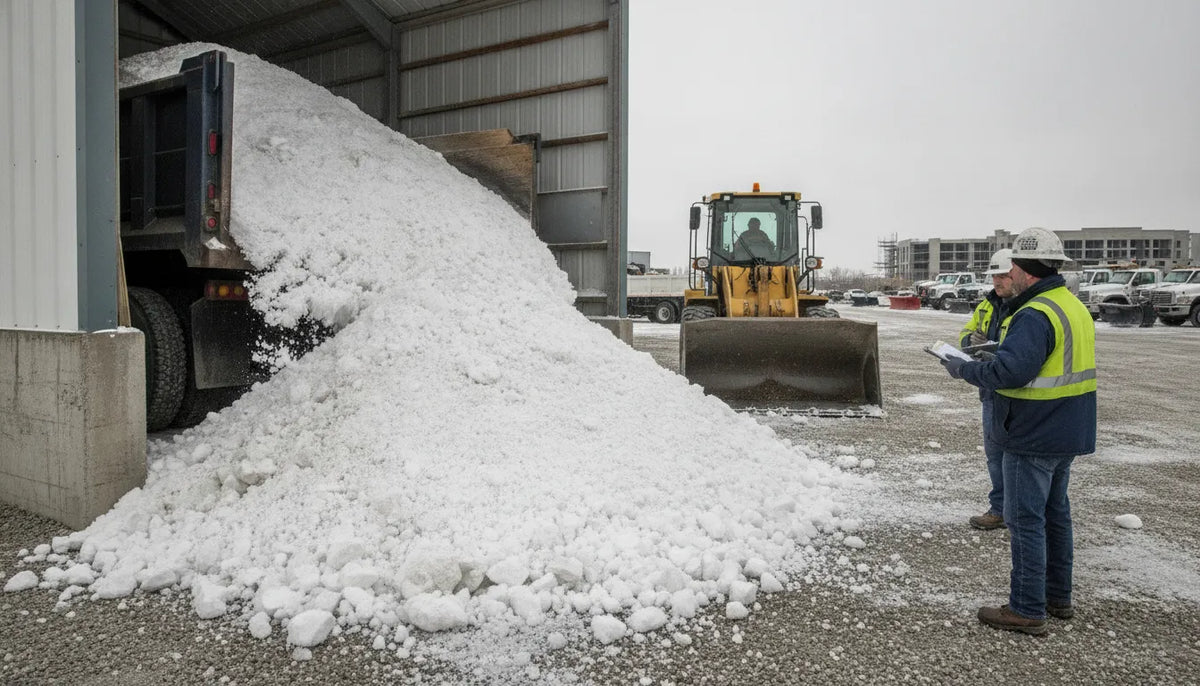
Planning bulk salt contractor supply Akron OH operations means choosing the right deicer, estimating a useful quantity, and making sure a delivery can reach your storage area safely. For snow contractors, property managers, landscapers, public works teams, and other commercial buyers in Northeast Ohio, the most useful quote starts with the job details, not a generic price per load.
Have the address and the product ready before you call. Call (330) 656-5720 to request Akron bulk salt pricing and availability for that specific site.
What bulk salt contractor supply in Akron OH includes
Winter work can require more than one type of deicer. Sagamore Companies' Northeast Ohio salt supply page identifies bulk road salt, bagged rock salt and ice melt, bagged calcium chloride, pallet and volume purchasing, and slinger delivery into accessible salt bins. Current inventory, packaging, pricing, and delivery options depend on the product, date, warehouse, quantity, and destination.
That distinction matters when you are building a storm plan. A contractor servicing several commercial lots may need bulk sodium chloride for routine applications, while a crew handling entrances, sidewalks, or other priority pedestrian areas may ask about bagged calcium chloride. A property manager with limited storage may need pallet quantities instead of a bulk load. These are different supply decisions even when every product is casually called “salt.”
Start with the bulk road salt and calcium chloride supply guide for the current product categories and commercial ordering path. If your buying need is specific to an Akron-area job, the Akron bulk salt supply page can serve as the local project starting point when available.
Bulk rock salt, bagged deicer, or calcium chloride?
Material selection should follow the surfaces you service, your application equipment, your storage setup, and the conditions your crews face. No deicer is a substitute for a complete winter operations plan, and no material should be represented as available for every address or effective in every condition. Ask for the product specification, packaging, current availability, and recommended handling details when you request pricing.
| Material or format. | Common contractor use. | Questions to answer before ordering. |
|---|---|---|
| Bulk road salt / bulk rock salt. | Parking lots, roadways, drive lanes, and larger commercial deicing operations. | How many applications are planned, what equipment will spread it, and can a truck reach the storage area? |
| Bagged rock salt or ice melt. | Crews servicing multiple locations, smaller storage areas, and jobs that need portable units. | What bag sizes and pallet quantities are available, and where will bags stay dry? |
| Bagged calcium chloride. | Applications where a fast-acting deicer is being considered, including colder conditions or priority pedestrian areas. | Which brand, bag size, quantity, and handling instructions fit the site and crew? |
| Pallet or volume purchase. | Planned seasonal stock for contractors, facilities, and other professional buyers. | Does the requested volume match available inventory, storage capacity, and the delivery method? |
Bulk rock salt is sodium chloride and is commonly selected for routine coverage of larger paved areas. It may fit a contractor that already has a loader, spreader, or other application process and wants to stage material for several events. Bagged products can simplify distribution between crews or properties. Calcium chloride may be selected where the buyer wants a different product profile. The quote should still name the actual product and packaging. Do not assume that every “ice melt” is the same.
How to estimate the amount you need
Contractors rarely have one perfect number before a quote. A useful estimate combines the areas you expect to service and the number of applications in your plan. Also include the surface, your spreading equipment, material already on hand, and how often you expect to replenish. Send a range with clear assumptions. Do not order from a broad line such as “a few parking lots.”
Collect the operating details.
- Service area: List approximate square footage or lane miles for the lots, drives, sidewalks, and other paved areas covered by the contract.
- Application pattern: Explain whether you are planning pre-treatment, post-storm treatment, repeated applications, or a combination.
- Equipment: Note whether crews use tailgate spreaders, walk-behind equipment, loaders, salt spreaders, or another setup. The equipment affects both the product format and the way it must be staged.
- Existing inventory: Subtract usable material already in your bin, shed, or pallet storage. Include any product that is caked, contaminated, or otherwise not ready for application.
- Replenishment plan: Decide whether you want one delivery, a scheduled restock, or a pickup option if inventory and timing allow.
Do not treat a quoted quantity as a guaranteed storm outcome. Actual use changes with weather, site conditions, application practices, traffic, and the requirements in each customer contract. Your supplier can help clarify product and fulfillment options, while your operations team remains responsible for the application plan and jobsite decisions.
Storage planning for bulk salt
Storage affects product condition, loading time, and whether a delivery can be placed where your crew needs it. Before ordering, inspect the proposed bin, dome, shed, or covered storage area. Confirm that the surface is suitable for the expected load, the area is protected as required by your operation, and runoff or drainage concerns have been addressed by the site owner and your team.
Use a covered, accessible storage location
A covered location can help protect salt from precipitation and reduce avoidable handling problems. Leave enough room for the equipment that will load or distribute the material. Keep the approach clear of parked vehicles, low branches, gates that cannot open fully, and other obstacles. If multiple products will be stored, plan how crews will keep them identified and separated so the wrong material is not loaded onto a spreader or sent to a customer location.
For bagged salt or calcium chloride, confirm that pallets can be unloaded onto a stable, accessible surface and that bags will remain protected from damage and unnecessary moisture. For bulk material, tell the supplier whether the load will go into a bin, a covered bay, or another designated location. A photo, sketch, or short access description can help identify questions before a truck is dispatched.
Delivery access and slinger placement
A conventional delivery and a slinger placement are not the same service. Sagamore's salt supply information says slinger equipment can convey bulk salt directly into an accessible covered salt bin or storage area when site access and conditions allow. That can reduce loader work and unnecessary handling, but it requires a site review for access, clearance, and safe placement.
Share the following before requesting a delivered load, so the yard can judge access before a truck is assigned.
- The delivery address and the location of the storage bin or receiving area.
- The approach a truck would use, including gates, turns, overhead clearance, and surface constraints.
- The distance from the truck position to the receiving point and any access limits around the bin.
- Whether the site will be occupied by other vehicles, crews, or customers during delivery.
- Your preferred timing, while recognizing that availability and scheduling must be confirmed rather than promised.
Do not assume that a truck can place material at any point on a property or that delivery includes spreading, stacking, or snow-removal labor. Supply, placement, and winter service are separate scopes. If you need operational help beyond material delivery, describe that need separately so the correct team can review it. Sagamore's slinger truck service information provides a separate starting point for conveyor placement questions.
Pickup versus commercial delivery
Pickup may make sense when you have suitable trucks, loading access, and a nearby storage plan. Commercial delivery may be more practical when a bulk load must reach a fixed salt bin. It also helps when crews need to avoid an extra handling step, or when the quantity is too large for a normal pickup. The right choice depends on current availability, the destination, site access, and the equipment available to your team.
When comparing the options, ask for the product price and the fulfillment terms separately. Delivery, taxes, labor, placement, and other charges may be separate from the material price. Checkout or the commercial quote should establish the applicable shipping or delivery estimate. A price seen on an older page, a previous storm, or a different warehouse is not a universal current rate.
For a contractor with several Northeast Ohio accounts, it can be useful to compare the total handling plan rather than only the material line item. A delivered load may save an internal trip but require an accessible receiving area. Palletized bags may be easier to distribute but require more storage footprint and crew handling. Ask for the option that matches the actual jobsite instead of choosing on a unit price alone.
What to include in an Akron salt quote request
A complete request gives the supplier enough information to check inventory, price the correct product, and identify delivery constraints. Include the items below, and skip any detail you do not know yet rather than guessing a number.
- Buyer and operation: Your company name, contact, and whether you are a snow contractor, landscaper, property manager, municipality, facility, or another commercial buyer.
- Material: Bulk road salt, bulk rock salt, bagged salt or ice melt, calcium chloride, or a request for help comparing the available choices.
- Quantity: Estimated tons, loads, bags, pallets, or a range, plus the amount already on hand if relevant.
- Fulfillment: Pickup or delivery, and whether you are asking about slinger placement into a covered bin.
- Location: The Akron-area delivery address, warehouse or pickup preference, and any ZIP or service-area questions.
- Access: Storage type, approach conditions, overhead clearance, gates, and the location where the material must be placed.
- Timing: Your desired date or replenishment window. Treat it as a request to confirm, not a guaranteed delivery time.
For general service questions, the landscape material and site-services overview can help you separate material supply from other project scopes. For a quote or a conversation about a specific property, use the Sagamore contact page and include the details above.
Keep salt supply separate from snow-service contracting
Buying winter material and hiring a contractor to plow or manage a property are related decisions, but they are not the same request. A buyer may need bulk salt for its own crews, a delivered load for a public works operation, or a product quote before finalizing a customer contract. Another buyer may need a separate snow-service conversation. Keep the scope clear so the response addresses the right need.
If you are evaluating a broader winter service rather than material supply, review the commercial snow-plow service information separately. If your team is sourcing salt for its own route, return to the product, quantity, storage, and delivery questions in this guide. Sagamore can confirm the current path for the request, but availability and project pricing remain dependent on the specific product, date, address, warehouse, and site conditions.
Akron bulk salt buyer checklist
- Identify the surfaces and customer accounts your crews will service.
- Choose whether bulk rock salt, bagged deicer, calcium chloride, or more than one format belongs in the plan.
- Estimate quantity using area, applications, equipment, current inventory, and replenishment needs.
- Inspect the covered storage area and document the truck approach, clearance, and receiving point.
- Ask whether pickup, commercial delivery, or slinger placement is available for the requested product and address.
- Request current pricing and availability for the exact quantity, packaging, warehouse, delivery method, and date.
- Keep material supply, placement, and snow-service labor as separate scopes in the quote.
Frequently asked questions
Does Sagamore sell bulk salt to Akron snow contractors?
Yes. The salt page says Sagamore serves professional snow and ice contractors who buy bulk salt, bagged salt, ice melt, and calcium chloride. Akron is one of the Northeast Ohio areas to ask about. The yard, the product, and the delivery radius still have to be confirmed for the address. A city name alone does not reserve material.
Can crews pick up bulk salt near Akron?
Pickup may be available at a listed Northeast Ohio yard, including Hudson at 2001 E. Barlow Road, when the product and quantity are in stock. Call 330-656-5720 before a truck leaves. Do not plan a pickup at the Macedonia address unless staff confirm that location is open. The site says that location is closed.
Can a delivery place salt in the bin?
Often, yes, when the bin is covered and a slinger truck can reach it safely. Placement depends on access, overhead clearance, and site conditions. It is a separate line from the salt itself. Ordinary delivery only unloads where the truck can stop.
Does a salt order include snow plowing?
No. Salt supply, delivery, and bin placement are material orders. Plowing and ice management are commercial snow services. Ask for that work on its own so the scope and the price stay separate. A contractor can buy salt and still hire plowing. Those are two requests.
Request Northeast Ohio bulk salt pricing
Akron contractors can get a more useful answer by sharing the product, quantity, storage setup, access conditions, and desired timing before the first call. Sagamore Companies supplies bulk road salt, bagged deicers, and calcium chloride for professional buyers in Northeast Ohio, subject to current inventory and site qualification.
When the quantity and site notes are ready, call (330) 656-5720 to discuss your Akron-area salt supply and quote request, or send the project details through the contact route.
