
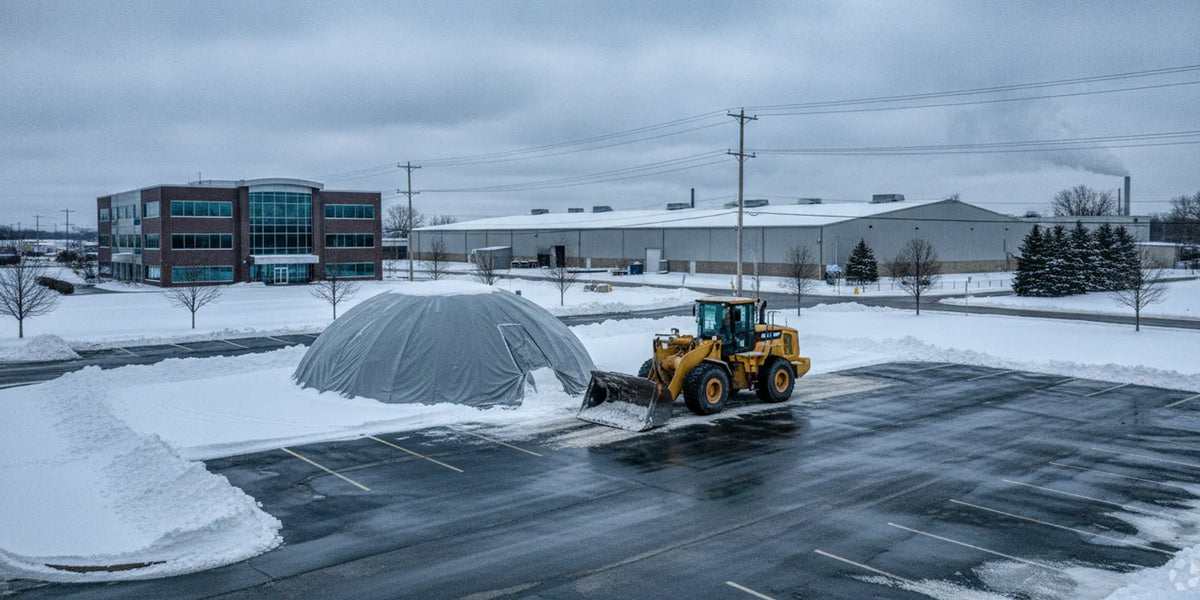
Planning bulk salt procurement in Ohio starts with more than choosing a supplier. A commercial property needs a realistic estimate of seasonal use, a safe place to store material, workable delivery access, and a clear plan for who applies salt when conditions change. Those decisions can help property managers, contractors, and public works teams avoid rushed orders and mismatched expectations. For a broader view of winter planning, read our guide to commercial snow, ice, and bulk salt planning.
Discuss your bulk salt or winter service needs
There is no single seasonal quantity or purchasing method that fits every site. A compact office lot has different needs from a large retail center, industrial yard, or public facility. Weather, pavement layout, traffic, application practices, storage capacity, and service responsibilities all affect an order. Treat an early estimate as a planning range, then confirm current product availability, delivery terms, and project scope for the property.
Estimate seasonal salt needs
Begin with the areas that actually require treatment. A property map is more useful than a rough guess based on building square footage. Separate the pavement into practical zones, such as parking areas, entrances, loading docks, sidewalks, ramps, and priority pedestrian routes. Note which surfaces are routinely treated and which are handled only in specific conditions.
For each zone, record the approximate area and why it matters. A main entrance or steep ramp may need closer attention than a low-traffic parking area. A loading area may need access maintained during operating hours. A walkway may require a different application method from a broad vehicle lane. These distinctions help the team plan material and labor without assuming that every square foot receives the same treatment.
Use site records as a starting point
Past use is usually the best starting point when records are available. Review prior invoices, delivery tickets, application logs, and remaining stock after winter. Separate material purchased from material applied, since inventory left in storage is not the same as seasonal consumption. Note whether the prior winter included unusual storms, extended cold periods, or changes to the treated area.
Useful records include quantities delivered and their units, delivery dates, emergency or supplemental orders, beginning and ending inventory, areas treated, and the people or contractors responsible. Include any operating changes that explain unusually high or low use. If the property changed its access routes, lot layout, tenants, or service scope, record that alongside the quantities.
Use consistent measurement units when reviewing records and discussing an order. Bulk material may be quoted or documented by weight or another stated unit. Do not assume that a truckload, pile size, or bucket count represents a fixed amount. Ask the supplier to confirm the unit of sale, delivered quantity, and documentation provided with the load.
If records are incomplete, do not present a guess as a precise requirement. Create a provisional range based on treated zones, operating needs, storage capacity, and what the site can accept. Refine it with the winter contractor or supplier. A useful early estimate identifies a possible initial order, the space it needs, and the conditions that would trigger replenishment.
Build a usable planning estimate
A practical estimate can be built in stages without pretending that a spreadsheet can predict the weather. First, define the planned treatment area. Second, review the quantities actually received and applied during previous seasons. Third, note what changed: added pavement, a new tenant schedule, revised service boundaries, a different contractor, or a change in how inventory was tracked. Fourth, select an initial purchasing range and decide when to review it again.
For example, imagine a commercial site with a large vehicle lot, a smaller delivery apron, and two pedestrian entrances. The team should not simply combine every paved area and assume treatment will be uniform. It can list the entrances and apron as priority zones, record the broad lot separately, and mark any surfaces handled only under specified site conditions. The contractor can then review that scope and the property’s prior records. The result is a clearer conversation about expected material use than a single unqualified number.
Keep an assumptions column next to each estimate. Note whether the quantity is based on a prior season, a supplier’s quote, a contractor’s forecast, or an approximate inventory check. If the property has no reliable history, state that plainly. This protects a planning estimate from being mistaken for a firm order and makes it easier to revise when better information becomes available.
Use the same method at each review point. If the site changes its treated routes midway through winter, record the date and reason. If leftover stock is moved or shared with another property, record that too. At season end, compare the starting inventory plus deliveries with the ending inventory, then investigate any gap rather than quietly carrying an unexplained number into next year’s budget. The goal is a defensible purchasing range, not false precision.
Account for operations and uncertainty
Weather is only part of demand. A site open around the clock may have different operating requirements from an office that closes overnight. Shift changes, customer arrivals, deliveries, and emergency routes can affect treatment decisions. Shade, runoff, slope, and recurring traffic patterns can also make conditions vary across one property. Share these observations with the people planning winter operations.
Think through the route from the public road to the entrances people use. Include accessible routes, service drives, fire lanes, and loading areas where applicable. Identify where snow is pushed, water drains across pavement, or vehicles repeatedly compact snow. These details do not create a treatment prescription by themselves, but they help a provider understand the site.
Seasonal use is uncertain. A mild period can leave unused inventory, while a demanding stretch can consume stock sooner than expected. Set checkpoints rather than trying to predict every event. Name the person who monitors inventory, choose a date to review stock before the main winter period, and agree on how a refill request is made. A reorder trigger must leave time for approval, order confirmation, and delivery planning; do not assume immediate fulfillment unless confirmed for the specific order.
Consider both extremes. Too little material can lead to rushed procurement. Too much can exceed storage capacity or complicate handling. An initial order followed by planned replenishment may be more workable than buying a full season’s supply at once, but the choice depends on supplier availability, delivery terms, site constraints, and the property’s risk tolerance. Product selection, amount, timing, and application should follow product directions and site procedures.
Make the review interval practical for the way the property is managed. A large campus with several storage points may need a separate check for each area, while a smaller facility may be able to review one designated stockpile. The person checking should know how to estimate the remaining quantity consistently and where to record it. If a visual estimate is all that is possible, label it as approximate. If inventory is measured by container, scale, or another method, use the same method each time and record any limitations.
Set a decision point before the inventory becomes urgent. The trigger can combine a stock level with a calendar review or an operational event, but the site should not treat a single marker as a guarantee that a refill can arrive immediately. The purchaser still needs to confirm current availability, order size, delivery access, and timing. A written escalation path can identify who can authorize an order if the primary contact is unavailable, without transferring purchasing authority to a person who has not been approved.
Compare bulk salt procurement options
Commercial buyers may evaluate bulk delivery, packaged material, or a combination of purchasing and contracted application. Compare more than the price per unit. Each choice changes how material is received, stored, handled, and applied. Include delivery charges, equipment and labor responsibilities, storage, and replenishment in the decision.
Bulk road salt can suit a property with appropriate storage and equipment, or a contractor set up to receive and apply it. Bagged material can be useful for smaller areas or locations with distinct handling needs, though it still requires storage and labor. A winter service provider may coordinate material as part of a broader scope, but the agreement should say what is included and who is responsible for procurement.
| Approach | What to assess | Questions to confirm |
|---|---|---|
| Bulk material delivery | Receiving space, unloading access, equipment, inventory tracking, and delivery terms | What quantity and unit are quoted? Where can the truck unload? Which charges and conditions apply? |
| Bagged material | Handling labor, sheltered storage, packaging disposal, and areas of use | What package sizes are available? Who moves material to the application point? |
| Material coordinated through a winter service provider | Contract scope, material responsibility, application records, and replenishment approval | Is material included or billed separately? Who orders it? How is use reported? |
| Combined approach | Which zones need bulk supply and which suit smaller quantities | How will inventory and responsibilities stay consistent across the site? |
Use the comparison as a screening tool, not a promise that every approach is available at every address. A supplier or service provider must confirm the location, product, stock, order size, delivery method, and project requirements. A quote should state whether it covers material only or also transport, unloading, placement, application, and related services.
Compare the complete delivered arrangement
Make sure quotes cover the same product and basis of sale. Ask how quantity is measured, whether the quote is for bulk or packaged material, and which warehouse or service area applies. Confirm whether freight, taxes, unloading, labor, equipment, placement, and other charges are separate. A product price by itself is not necessarily the total cost to have usable material on site.
Review the assumptions. A quote may depend on a minimum order, a particular truck type, a clear unloading area, a delivery route, or a date range. Confirm whether the amount applies to the stated scope or may change based on actual quantity, delivery conditions, or additional work. For services, distinguish supply from application and storm response; one should not be assumed to include the other.
Availability and delivery estimates can change with season and location. Ask how the order will be confirmed and what information is needed to schedule it. Do not plan around a general statement about rapid or same-day delivery unless timing has been confirmed for the property and order. Keep the confirmed terms with the purchasing approval so operations staff know what to expect.
When several quotes are being reviewed, place them on a like-for-like worksheet. Include the product description, quoted unit, amount, delivery or pickup method, stated delivery charge, taxes if listed, unloading responsibilities, and any equipment or labor the property must provide. Add a separate notes field for assumptions and exclusions. If a quote leaves an item open, mark it as unresolved instead of treating a missing charge or service as included.
Consider the full operating arrangement as well as the initial purchase amount. A bulk order may require a suitable receiving point and a way to move stock to application equipment. Packaged material may require repeated handling and a place to keep it dry and accessible. A contractor-managed arrangement may reduce some property-side tasks but requires a clear scope and records. These are not automatic advantages or disadvantages; they are responsibilities to assign and cost to verify.
Choose an approach by site scenario
A site with a designated stock area, established equipment, and staff who track deliveries may be able to evaluate bulk supply directly. A smaller property with limited space may first compare packaged material or a service scope that specifies material handling. A multi-building campus might use a combined plan if distinct areas have different access or operating needs. Those are planning examples, not a statement that a particular format is available or appropriate for every property.
For a property considering contractor coordination, review how material moves through the process. Who takes delivery? Who controls the stock? Does the contractor use the property’s material, supply its own, or bill separately? How will use be documented and reconciled? If providers change during the season, define how remaining inventory and access instructions will be handed over. A smooth transition depends on records and defined responsibilities, not just a pile of material on site.
For a direct buyer, think through what happens between purchase approval and use. The buyer must confirm product and quantity, arrange delivery or pickup, prepare the receiving area, inspect the delivery documentation, maintain inventory, and coordinate whoever applies the product. If one of those steps belongs to another department or vendor, name the contact and confirm the handoff before the order is placed.
Decide who owns the material
Determine whether the property team or a winter service provider will own inventory management. If the property buys material directly, assign responsibility for ordering, receiving, storage inspections, and records. If a contractor supplies material, define how the property will review quantities and charges. If responsibility is shared, document the handoff so that neither party assumes the other has ordered or replenished stock.
A contractor may apply material without purchasing it, or supply material under a separate billing arrangement. Read the service scope rather than relying on a general description. Clarify what happens when stored material is depleted, who approves purchases, how additional quantities are priced, and what records are provided. Multiple properties may need separate inventory and delivery plans if their access, operating hours, or providers differ.
Inventory ownership also includes the record after use. Agree whether the property expects application logs, withdrawal notes, delivery tickets, or another record of material movement. Decide where the records will be kept and who can review them. If a vendor’s invoice lists a quantity but the site has a different record, establish a process to reconcile the difference while details are still available. This is especially useful when the purchasing contact, site manager, and service crew are not the same people.
Plan storage and site access
Storage is part of procurement, not an afterthought. Before ordering, identify where material will be placed and how it will be protected, accessed, inspected, and replenished. The arrangement should fit the quantity and the equipment used to move it. Account for drainage, vehicle circulation, nearby landscaping, and separation from other stored products.
Do not assume that a vacant corner is automatically appropriate. Review the property’s environmental, safety, operational, and local requirements. Use a designated area and follow supplier instructions and applicable rules for storage and handling. If drainage or sensitive areas are a concern, consult the responsible site professional before choosing the location.
Check delivery access before ordering
Walk the route with people who know the site. Note gate widths, overhead obstructions, turning space, surface condition, slopes, loading areas, and time restrictions. Identify where a delivery vehicle can stop without blocking emergency access, pedestrian routes, customers, or other operations. Share the details before confirming a delivery.
A useful site review covers the delivery entrance, route and unloading point; vehicle clearance and turning room; surface or weight restrictions; the location and direction of unloading; winter accessibility; any gates, permits, escorts, appointments or restricted hours; and the person who will direct the driver. Photographs or a marked-up plan can help explain the site, but do not replace an assessment when one is needed.
Point out conditions that may not be obvious on a map, such as temporary construction, parked equipment, seasonal barriers, or a route that becomes difficult in winter. Confirm unloading instructions before dispatch. Have a backup plan if the intended point is blocked. Decide whether there is another approved area, whether the delivery should be rescheduled, and who can make that decision. Do not put material in a drainage area or obstruct a route just to avoid rescheduling.
Turn the walk-through into a delivery note that can be sent with the request. Identify the entrance to use, a contact name and phone number, any check-in process, the route to the receiving point, and the location where the driver should stop. Mark any height, width, weight, or time restrictions that the site already knows about. If the site cannot confirm a restriction, say so and ask what details are needed before dispatch rather than assuming the vehicle will fit.
Think about the delivery day, not just a clear-weather inspection. A parked trailer, snowbank, temporary barrier, or active work area may change the usable route. Decide who checks that the route is open before the delivery and who can communicate a change. If the unloading point is unavailable, the driver should not be expected to choose an alternate location without approval. A documented alternate may be useful, but it must be approved for the property and suitable for the delivery method.
Make storage workable all season
Choose storage with the people and equipment that will use it in mind. A pile that is hard to reach can slow loading when crews prepare for a storm. A location too close to traffic or pedestrian routes can create conflicts. Leave room for equipment and preserve designated access and emergency routes.
Name someone to check the condition and approximate quantity at regular intervals, especially before winter activity and after significant use. Record deliveries and replenishment requests. If material moves between locations or containers, update the record. Follow the product’s storage instructions, and address moisture, contamination, and access issues. Do not treat a visible pile size as an exact measurement unless a suitable method is used.
For multiple materials or handling methods, label storage areas and clarify who can access them. Keep purchasing records, delivery tickets, and inventory notes together. If a service contractor uses the stock, agree how applications or withdrawals will be recorded. A shared record can reduce duplicate orders and help review seasonal use.
Include storage capacity in the quantity decision. Estimate the usable area and access needed rather than looking only at the footprint of a pile or container. Space may also be needed for equipment to approach, turn, load, or move material. Confirm that the intended location does not conflict with routine deliveries, snow storage, pedestrian circulation, or other property uses. If a location has multiple users, agree who controls it and how access is kept clear.
Before the first delivery, make a short receiving checklist for the person on site. It can include confirming the order reference and unloading point, checking that the designated area is ready, recording the delivery date and quantity from the provided documentation, noting any visible discrepancy, and sending the record to the purchasing contact. The checklist does not replace supplier documentation or local procedures. It makes sure the property captures the information needed to track inventory and resolve questions promptly.
Coordinate salt with snow and ice service
Discuss salt procurement and winter service together, even when different companies handle them. The property needs to know who monitors conditions, decides when treatment is needed, supplies material, applies it, and documents the work. Otherwise, the property can have inventory but no agreed application plan, or a provider can arrive without needed material or access.
Review the snow and ice agreement. Separate plowing, snow relocation, ice treatment, material supply, and application rather than assuming they are bundled. Ask which areas are included, what conditions trigger work, and how the provider communicates with the property. Response timing and performance should come from the written agreement, not from a general service description.
Sagamore Companies describes commercial snow and ice services for Northeast Ohio properties. Eligibility and project details require confirmation for the address and scope. Review the commercial snow plowing and ice service information and request a project-specific discussion where appropriate.
Set roles for purchasing and application
Put responsibilities in writing. The property manager, maintenance team, procurement contact, and contractor may each own part of the process. Decide who checks conditions under site procedures, authorizes treatment or additional purchases, orders salt, receives the load, maintains the stockpile and access area, applies material, records the work, and reports low inventory or changed conditions.
Agree on a primary contact and backup. Make sure the supplier and service provider know who can approve a change. If the property has several sites, identify a contact for each location; a central office may not be able to confirm local access. Decide how application records will be shared. A practical record can identify date, treated area, material used, and the person or crew responsible. Consistent records help compare estimates with use and plan future purchasing.
Align the material plan with weather operations
Procurement is arranged ahead of a specific event, while treatment decisions depend on conditions at the property. Having salt on site is not a guarantee that a surface will be clear or safe. Weather, pavement conditions, traffic, application practices, and site operations affect the result. Follow the property’s procedures and communicate when conditions change.
Before winter, review how crews will reach the stockpile during snow operations. Confirm whether the unloading site remains accessible after plowing, whether snow storage could block material movement, and whether equipment can maneuver safely. If a contractor will use the property’s stock, arrange access and handling before the first visit. Update the plan when construction closes a route, tenants change traffic patterns, or a new provider uses different equipment.
Walk through a few operational scenarios with the people responsible. What happens if the stockpile is low before a scheduled delivery? Who contacts the supplier, and who can authorize an alternate quantity or delivery point? What if a storm plan moves snow into the normal access route? Who updates the contractor if a gate is locked or a tenant changes operating hours? Answering these questions ahead of time can expose gaps without making assumptions about any provider’s response time.
Agree on a method for communicating changes that affect the work. A site contact might report a blocked access lane, a relocated pile, a changed treatment boundary, or a low-stock reading. The service provider should know which contact can approve scope or purchasing changes. Keep operational updates separate from an emergency assumption: the site should use its established safety and emergency procedures for urgent conditions rather than relying on a procurement plan to address them.
At the end of a storm or service period, capture enough information to improve the next decision. Record the areas handled, the material drawn from inventory if known, access problems, and any differences from the planned work. Review those notes with the contractor and property team. The review can inform inventory estimates and site preparations, but it does not establish a guaranteed treatment result or replace product directions and site-specific procedures.
What to include in a commercial request
A well-prepared request helps a supplier or service provider determine whether the job fits its offering and what information is still needed. It also helps the buyer receive a quote for the actual requirement, rather than a price detached from delivery and site conditions. Gather the essentials before reaching out, even if some details are estimates.
Prepare property and product details
Include the property address and the person who can answer site questions. State whether the request is for material supply, delivery, application, snow service, or a combination. Describe the intended material and quantity, identifying estimates as estimates. If you do not know the appropriate quantity, explain the use and ask what information is needed to assess it.
Share treated areas and operating requirements. Mention priority entrances, loading areas, pedestrian paths, access restrictions, and site concerns. Provide the preferred storage or unloading point and describe the delivery route. Offer photographs or a site map if available. Also include the planned service or delivery period, restrictions on delivery hours, storage capacity, and whether equipment or labor is available to handle material.
Ask the supplier to confirm the product description, unit, quantity, delivery method, estimated shipping or delivery charges, applicable taxes, and any minimum or access conditions. For a service quote, ask for covered areas, material responsibility, application scope, approval steps for extra work, and records provided. Have exclusions stated plainly.
Turn the information into a clear request
A concise request can be organized into five parts: the property, the requested work, the estimated amount or scope, the delivery or service conditions, and the questions that still need an answer. For example, a buyer might state that the request concerns a commercial property in Ohio, identify whether the need is bulk material or a snow and ice service discussion, list the treated zones, describe the available storage and unloading area, and ask the provider to confirm the appropriate product, unit, delivery terms, and project eligibility. This format gives the recipient enough context to identify missing information without implying that the estimate is already approved.
Attach a simple property sketch if it helps show gates, routes, unloading points, storage areas, and priority zones. Label the drawing with the date and a contact who can explain it. Avoid relying on a photograph alone where dimensions, overhead clearance, weight limits, or turning room matter. If those details are unknown, say so and ask whether a site review or more information is needed before the order can be scheduled.
Separate confirmed facts from questions. Confirmed facts might include the service address, the proposed storage location, or the person who can meet a delivery. Open questions might include the final quantity, current stock, delivery date, or whether a particular vehicle can access the site. This distinction helps prevent an early inquiry from being mistaken for a purchase order or a confirmed delivery arrangement.
Review the quote before approval
Compare the proposal with the property plan. Confirm the address and unloading site, quantity and unit, and whether the delivery or service scope matches the request. Check that material is distinguished from transport, labor, placement, and application. Verify assumptions about dates, vehicle access, stock availability, and site readiness.
Ask what happens if the requested quantity is unavailable, the route is blocked, or the property changes the order. Clarify who can approve changes and how additional charges are communicated. For recurring purchases, determine whether each delivery requires separate confirmation and whether pricing or availability must be checked again. Keep the final quote, order confirmation, delivery records, service scope, and inventory notes together.
Before approval, read the terms as an operations handoff, not only as a purchasing record. The site team should be able to identify the delivery location, the expected material and unit, who will receive it, what equipment or labor is needed, and who should be contacted if a stated condition changes. If the quote and site plan use different names for areas or routes, reconcile them before the order. A small clarification at this stage can prevent avoidable confusion when the delivery or service is being arranged.
For a recurring plan, note what must be reconfirmed each time. Product availability, delivery timing, access conditions, quantities, and charges may require current confirmation. Keep a dated copy of each approved order or service amendment. Do not treat a previous season’s quote as a current offer unless the provider has confirmed that its terms still apply.
To request a project-specific discussion, contact Sagamore Companies with your property and delivery details. Material availability, delivery eligibility, service scope, and charges require confirmation for the specific order and site.
Request a bulk salt or winter service quote
Common questions about bulk salt procurement in Ohio
How much bulk salt should a commercial property order?
There is no universal quantity. Review prior use, treated areas, operating requirements, remaining inventory, and the site’s ability to receive and store material. If records are limited, request a provisional quantity based on property details, then establish an inventory checkpoint and replenishment process.
Should we buy salt in bulk or use packaged material?
Compare the size of treated areas, storage space, delivery access, handling equipment, labor, and who applies the material. Bulk can suit sites with appropriate receiving and storage; packaged material may fit smaller-scale or distinct handling needs. Confirm availability, cost basis, and delivery or handling charges before deciding.
Does a bulk salt delivery include application?
Do not assume it does. A material order and an ice-management service are different scopes. Confirm whether a quote covers supply and delivery only or also unloading, placement, labor, equipment, and application.
What should we check before scheduling a delivery?
Confirm the address, order quantity and unit, delivery terms, access route, unloading point, vehicle restrictions, site contact, and storage readiness. Tell the supplier about gates, overhead clearance, restricted hours, or temporary obstructions before scheduling.
Can a supplier guarantee a delivery time or winter result?
Do not rely on a general statement as a guarantee. Ask for the specific delivery or service terms for the address and order, and review them in writing. Weather and site conditions affect winter operations, so a quote should define scope without promising an unconfirmed outcome.
A clear procurement plan connects the amount ordered to site needs, safe storage, workable delivery access, and defined service responsibilities. Confirm the details for your property before committing to material or winter work.
