
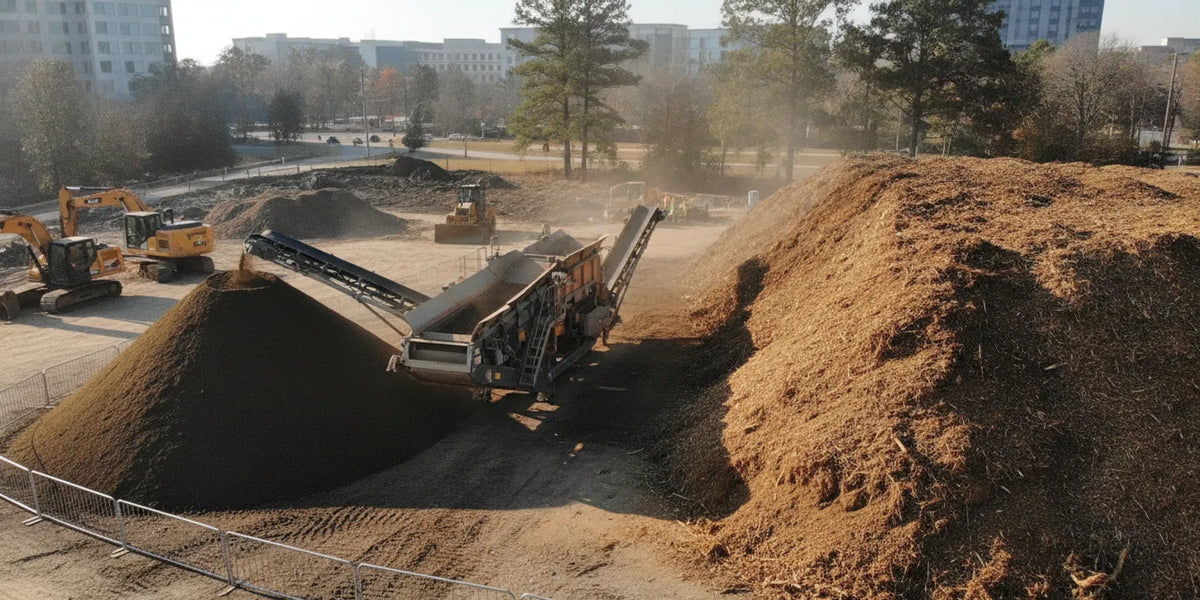
Planning commercial screening and grinding Charlotte North Carolina projects starts with a clear account of the material, desired output, and jobsite. A short label such as soil, brush, or construction debris is not enough to determine the right process or quote. Material condition, estimated volume, contamination, access, storage space, schedule, and the plan for finished and rejected material all matter.
Sagamore Companies serves as a regional landscape-material supplier and site-services provider for retail and commercial buyers. Its commercial processing offering covers project-specific screening and grinding for soils, wood or green waste, and certain construction materials. The practical next step is a qualification conversation, not an assumption that a listed service includes every machine, material, location, production rate, or disposal arrangement.
What does commercial screening and grinding include?
Screening and grinding are processing methods, not interchangeable names for general cleanup. Screening separates material by size. Grinding reduces or reshapes suitable material with mechanical equipment. A project may need one method, both methods in sequence, or neither until a site review clarifies the desired result.
Screening separates material by size
Screening passes material across a mesh or deck so smaller particles move through while larger pieces continue along a different path. A commercial buyer might consider screening when a soil stockpile contains rocks, clumps, roots, or oversized pieces, or when a mixed aggregate needs size separation. The useful question is not simply whether a pile can be screened. It is which fractions should be retained, what size range is acceptable, and what happens to material that does not meet that range.
Screening can produce more than one output pile. The oversize fraction may require another processing step, separate storage, relocation, or hauling. Fine material may be useful on the same property, while another fraction may have to be tested or managed differently. Those decisions should be part of the quote discussion. If the buyer needs two distinct products, the request should name both outputs and identify where each can be stockpiled.
Grinding reduces suitable material
Grinding can reduce suitable wood, green waste, and some other project materials into a more manageable or reusable form. The right equipment and method depend on the feedstock. Clean brush is a different assignment from a pile containing soil, metal, treated wood, concrete, or unknown debris. A grinder is not a substitute for sorting, hazardous-material review, or an agreed disposal plan.
Ask what the finished material should look like and where it will go. If output will be used as a landscape input, stored for later use, loaded for transport, or transferred to another processor, that end use may change the acceptable size and cleanliness. A quote should describe the intended process and boundaries rather than imply that every output is automatically suitable for every application.
Which materials should you identify before requesting a quote?
A useful inquiry begins with a clear material description. “Construction material” is a starting category, not a complete specification. Share where the material came from, what is mixed into it, how long it has been stored, and what you believe is in the pile. Photos can help, but they do not replace a site-specific review when the contents are uncertain.
- Soil and dirt: Note whether the stockpile is topsoil, fill, excavated soil, clay-heavy soil, screened soil, or a mixture. Describe visible rocks, roots, concrete, asphalt, trash, and moisture.
- Wood and green waste: Separate clean brush, limbs, logs, stumps, leaves, and mixed yard debris in your description. Include approximate piece size and whether soil is attached.
- Construction material: Identify concrete, asphalt, aggregate, masonry, soil, wood, and other components as specifically as possible. State whether the material is already sorted or mixed.
- Unknown or suspect material: Explain what is unknown instead of calling it clean. Lead paint, treated wood, insulation, chemicals, tanks, trash, and other regulated or unsuitable items may require a different handling decision.
- Wet or frozen material: Describe current conditions. Moisture can affect movement, screening, stockpile stability, and the resulting product.
Do not combine separate material types in one volume estimate unless they will actually be processed together. A pile that looks uniform from a distance may contain several feedstocks. Separating it before equipment arrives can improve planning, but whether sorting is included must be confirmed in the scope.
Describe what you know and what you do not know
For each pile, make two short lists: confirmed contents and uncertain contents. For example, a contractor might report that a stockpile is mostly excavated soil, with visible roots and a few concrete fragments, while noting that the pile has not been inspected internally. That is more useful than labeling it “clean soil.” Record who supplied the information and when the pile was last moved or added to. If new material is added after the quote, tell the provider before work begins because the original description may no longer apply.
Photographs should show the whole stockpile as well as close views of representative material. Include an object of known size when practical, but do not use a photograph to claim a precise measurement. A wide view shows scale and location; close views can reveal moisture, debris, or oversized pieces. If photographs represent only one part of a mixed pile, say so. An accurate caveat is better than allowing a sample image to stand in for the entire feedstock.
How does material condition change the project plan?
Condition affects more than the machine selected. It can change production, handling, staffing, storage, cleanup, and the number of passes. A clean, dry, accessible pile is not equivalent to a wet mixed pile with buried debris. A commercial quote is strongest when it states which condition has been assumed and what happens if the actual pile differs.
Contamination and sorting
Before the quote, describe visible contamination and the steps already taken to remove it. Metal, wire, plastic, glass, concrete, asphalt, treated lumber, and household waste can change what processing is appropriate. If a material stream includes unacceptable items, the project may need pre-sorting, separate hauling, or a revised scope.
Never present a processing request as clean material simply because the majority of the pile appears usable. A written description that lists known exceptions gives the commercial team a better basis for qualification. If testing, documentation, or disposal approval is needed, ask about that before scheduling. If the pile may contain regulated material, involve the responsible environmental or safety professional rather than relying on visual sorting alone.
Moisture, size, and density
Wet soil may pack together rather than separate cleanly. Large logs, stumps, and root balls may require different handling from branches. Dense concrete or asphalt pieces may require size reduction before another processing step. Frozen piles can behave differently from the same material in warmer conditions.
Give the approximate largest piece and the condition of the stockpile. If you do not know, take photographs that show scale and say that the measurement is unverified. It is better to qualify an estimate than to build a schedule around an unsupported assumption. Also describe whether piles are loose, compacted, layered, or buried beneath other material. Those details help clarify what equipment must reach and whether the feedstock can be presented consistently.
How to manage a change in material description
Set a simple field procedure for surprises. Name the person authorized to pause work, contact the project decision-maker, and approve a revised scope. If a bucket exposes wire, an unexpected layer of debris, or a material that looks unlike the sample, the crew should not be expected to infer the buyer’s intended response. The project team should decide whether to isolate it, remove it, request further review, or revise the processing plan.
Put the change procedure in writing before mobilization: who receives notice, what evidence is useful, whether work continues on unaffected piles, and how any added handling is approved. This is not a prediction that a change will occur. It is a way to avoid turning a field discovery into an unplanned decision with no clear owner.
How should you estimate volume?
Volume is one of the most important inputs for a commercial screening and grinding quote. A rough pile count is useful for the first conversation, but it should be labeled as rough. The team may need a site visit, survey, weigh tickets, truck counts, loader counts, or other information before confirming quantity. Be clear whether the estimate describes loose material, compacted material, incoming loads, or anticipated finished output.
Use dimensions when the pile is reasonably shaped
For a roughly rectangular stockpile, multiply length by width by average height to estimate its bounding volume. A triangular or conical pile requires a different approximation. Do not use the highest point as the average height. Measure several points and explain how the average was determined. This basic estimate is a planning aid, not a certified survey or guaranteed billable quantity.
For irregular piles, divide the area into smaller shapes and estimate each portion. If the pile has settled, spread, or contains voids, state that the calculated figure is approximate. A pile’s loose volume may not equal the volume after grinding, screening, compaction, or moisture changes. If there are several piles, label them individually in photographs and on a sketch rather than giving one total with no breakdown.
Separate feedstock from output volume
The incoming pile and the finished piles are not necessarily the same size. Screening can create multiple fractions. Grinding can change the way material stacks. Some material may be removed as contamination, or sent to another destination. Ask whether the quote is based on incoming volume, processed volume, machine time, loads, or another measurement.
If your budget depends on a maximum number of loads or a specific amount of finished product, make that requirement explicit. Also ask who measures each quantity and when. A shared definition prevents a material estimate from being confused with a guaranteed production outcome. Clarify what records will be available, such as load counts or time records, when those are relevant to the agreed billing method.
A worked estimate for an irregular stockpile
Imagine a commercial site with a long soil ridge, a smaller brush pile, and a separate area of mixed aggregate. Instead of presenting one combined number, the project manager can record the ridge’s approximate length, width, and several height points, then estimate each segment separately. The brush pile gets its own dimensions and a note about limb size. The aggregate area gets a separate estimate and a material description. The numbers are still preliminary, but the breakdown exposes uncertainty and helps the provider discuss whether the piles require different processes.
Next, identify whether the estimate is based on the pile as it sits or on expected processed output. If the owner needs a certain quantity retained on site, that is a separate objective from estimating the amount entering the equipment. Mark the destination and measurement assumption for each pile. This small bit of discipline can prevent a late disagreement in which one party means truckloads and another means finished cubic yards.
What should you review about access?
Equipment access is a core part of commercial processing planning. A capable machine still needs a route to the pile, room to operate, and space for incoming and finished material. Charlotte-area projects vary widely, from open commercial sites to constrained redevelopment parcels and active contractor yards. A jobsite description should account for both the route into the work area and the turning and staging space once equipment arrives.
- Entrance: Describe gate width, turning space, overhead clearance, bridges, slopes, and surface conditions.
- Staging: Identify where equipment can be delivered, parked, and moved without blocking public or emergency routes. Confirm whether other site operations use that area.
- Working room: Show the pile location and the area needed for feedstock, processed output, oversize, and rejected material.
- Ground conditions: Note soft ground, drainage concerns, buried utilities, steep grades, pavement limits, and areas that cannot carry heavy equipment.
- Neighbors and operations: Identify occupied buildings, public traffic, school or residential adjacency, work-hour restrictions, noise concerns, and dust-control expectations.
- Safety controls: Explain fencing, restricted zones, spotter requirements, traffic plans, and site rules that affect mobilization.
Send a simple aerial image or site sketch with the pile, access route, property line, nearby structures, and proposed output areas marked. Aerial images can be outdated, so note recent changes. The goal is not to replace a site review. It is to help the quote conversation focus on the real constraints.
Trace the equipment route, not just the gate
Walk the proposed route from the entrance to the work area. Note narrow turns, overhead lines, low branches, loading docks, parked vehicles, ramps, soft shoulders, and any gate that must be opened by a site contact. A gate may be wide enough while the turn just beyond it is not. If a route crosses a public access aisle or shared property, identify the party responsible for coordinating access.
Also show where trucks or support equipment might wait without blocking active operations. If the property has limited room, state which areas must remain open for deliveries, tenants, emergency access, or customer traffic. A site plan that shows these constraints can help the provider determine whether the proposed layout is workable or whether the buyer needs to rearrange operations first.
Separate dust, noise, and operating concerns from assumptions
Commercial buyers should identify site rules and nearby sensitivities early. State known limits on work hours, permitted access, dust management, noise, and traffic control. Do not assume that a provider’s standard approach automatically satisfies a property owner’s, municipality’s, or general contractor’s requirements. The buyer should identify applicable site requirements and ask which controls belong in the quote and which remain the site’s responsibility.
If work must occur in a narrow window, explain why and identify any approval needed to use the area. A schedule constraint is more useful when it is specific: for example, a loading lane must remain available during tenant receiving hours, or a shared access road cannot be blocked. These examples describe information to disclose, not a promise that work can be completed in any particular window.
How does the end use affect screening or grinding?
The intended use of the finished material helps define the process. A buyer seeking a usable soil fraction has different requirements from a contractor seeking to reduce the size of clean wood for later handling. A commercial property may want to reuse material on site, while another project may need to load it for transport. Naming the receiving use lets the team discuss appropriate output goals without treating suitability as automatic.
Reuse on the same property
If you plan to reuse the output on site, identify the placement area and intended function. Possible uses may include general fill, soil amendment planning, erosion-control material, temporary access, or another project-specific purpose, but the processed material should not be represented as suitable for a use that has not been evaluated. The quote should distinguish processing from placement, spreading, testing, engineering, or installation.
Confirm whether the output can remain in a stockpile and whether the site has enough room for separate fractions. If the project depends on a particular gradation, cleanliness, or soil characteristic, state that requirement before work begins. Ask who will decide whether output meets the receiving project’s specification and whether that review requires sampling or documentation. A visual description alone may not satisfy the owner or design professional.
Reuse at another jobsite
Transporting processed material to another location adds coordination. Identify the receiving site, acceptable material specification, required documentation, and expected timing. The receiving party may need a sample, test, load tickets, or advance approval. Do not assume that processing creates a marketable product without confirming its destination requirements.
Coordinate the receiving party and transporter before setting a processing date. Confirm whether the destination can accept the material when it is ready, where trucks will enter, what paperwork accompanies each load, and who authorizes any rejected load. If acceptance is not yet established, the material may need temporary storage at the processing site. That storage takes space and can affect how separate fractions are managed.
Transfer or disposal
If material will leave the site, describe who will load it, where it will go, and whether haul-off is included in the requested scope. Disposal and transfer costs depend on the material and destination. A processing quote should not silently be treated as an all-in haul-off quote. Identify who chooses the destination and who pays any receiving, trucking, or other charges.
Where a pile produces several outputs, document the destination for each one. The buyer may retain one fraction, transfer another, and isolate a third pending review. Such a plan is more practical than a general instruction to “remove everything,” which may not describe the processing scope or the disposal path clearly enough for a proposal.
What are the haul-off and reuse questions to ask?
Haul-off, stockpiling, and reuse should be discussed as separate decisions. A project can involve processing without hauling, hauling without processing, or both. Put the desired path in writing so the scope does not blur as the material changes. For a job with several owners or vendors, list the party responsible for each handoff.
- Will all material stay on site, or will some or all of it leave?
- Who owns the material before and after processing?
- Where will finished product, oversize, and rejected material be placed?
- Is loading included, and who supplies trucks or other transport?
- How many destinations are involved?
- Does the receiving location have acceptance rules, hours, permits, or testing requirements?
- What happens if the pile contains more contamination than described?
- Who makes the final decision on material that cannot be reused?
- Are trucking, tipping, taxes, labor, site restoration, or other charges separate from processing?
These questions are especially important when a contractor is managing material for an owner. The contractor may be responsible for the project schedule while the owner controls the property and receiving destination. Identify the decision-makers and approval path before equipment is mobilized. If the environmental consultant, general contractor, property manager, or receiving facility must approve a change, include that contact in the work plan.
Map the material handoffs
For each pile, write down the starting location, processing step, output location, and final destination. A one-line sequence can reveal missing responsibilities: “soil pile at north access, screened on site, fine fraction stored in marked bay, oversize reviewed by owner, hauling arranged separately.” The details will differ by project, but the sequence makes it easier to spot a fraction with no owner, no storage space, or no destination.
Then confirm which party keeps records at each handoff. The buyer may want load counts, material descriptions, or receiving documentation for its project file. If those records matter, ask what is available and who collects it before work starts. Do not assume a specific record will be produced unless it is included in the agreed scope.
How is screening and grinding different from material delivery?
Material delivery brings a specified product to a jobsite. Screening and grinding process material that is already at the site or otherwise identified for processing. Those are different scopes, with different planning questions and quote requirements. A product order identifies the material to supply; a processing inquiry describes feedstock, method, output, site conditions, and downstream handling.
A delivered aggregate, mulch, soil, or stone order should use the location-qualified product and checkout or delivery workflow. Start with the store and warehouse selector, then confirm the product, region, unit, fulfillment method, and shipping estimate. Prices can vary by product, region, warehouse, date, and fulfillment method, and delivery, taxes, labor, or other charges may be separate.
For a processing assignment, use a project service inquiry instead of treating a product cart as a processing quote. Explain the material, volume, access, end use, and hauling plan. Do not assume that delivery includes screening, grinding, slinger placement, concrete work, sorting, or installation. The correct route depends on whether the need is a supplied product, a separately scoped service, or both.
When a project includes both supply and processing
Some commercial projects have more than one need. A contractor may have an existing pile to process and separately need a delivered material for another phase. Treat those as distinct line items. Identify the location, product, unit, and fulfillment method for the supply request, then separately describe the processing feedstock, output, access, and handling requirements. This separation makes it easier to see which quantities are product purchases and which are site-service assumptions.
If a project also includes material placement, describe where the material must go and how access affects the method. Conveyor work is slinger placement, not ordinary delivery, and it requires a project-specific discussion. The slinger service information is a separate starting point for that scope. Do not assume a screening or grinding quote includes material movement by slinger or any other placement service.
How is screening and grinding different from concrete work?
Concrete supply and concrete installation are also separate from processing. A volumetric concrete service concerns on-site mixing and supply for a qualified project. Turnkey concrete installation concerns a broader, separately scoped project that may include preparation and finishing responsibilities. Neither description should be used as a substitute for a screening or grinding scope.
If a site project includes both material processing and a future concrete pour, list them as separate work packages. The access route, staging area, schedule, and finished-material plan may overlap, but the equipment, preparation, quality requirements, and responsible parties may differ. Review turnkey concrete services separately when concrete installation is part of the project.
For example, a contractor may need to process a stockpile before preparing an area for a slab. The processing scope should specify what happens to the stockpile and each output. The concrete scope should separately identify the work requested and the party responsible for preparation, installation, and other tasks. Sequencing the work does not merge the scopes or make one quote cover the other.
What should a Charlotte commercial quote request include?
A complete quote request reduces back-and-forth and helps the commercial team determine whether the project fits the available service scope. Include the following in the first inquiry whenever possible:
- Jobsite: Address, municipality, site contact, access instructions, and whether the project is in Charlotte or a nearby community.
- Material: Source, composition, known contamination, moisture, largest pieces, and current stockpile condition.
- Quantity: Dimensions, estimated tons or cubic yards if known, number of piles, and the confidence level of the estimate.
- Process: Screening, grinding, or an assessment of which method is appropriate; desired size or output description.
- Timing: Target start date, completion need, site hours, blackout dates, and whether the date is flexible.
- Access: Gate dimensions, route photographs, surface, overhead clearance, turning space, utilities, and staging area.
- Output: On-site reuse, separate stockpiles, transfer, haul-off, receiving facility, testing, or another destination.
- Commercial terms: Owner or general contractor, purchase order process, insurance requirements, billing contact, and any bid form.
- Attachments: Site plan, aerial image, pile photographs, material reports, survey, environmental documentation, or prior load records.
Tell the team what is not yet known. Unknown information is a qualification item, not a reason to fill in a convenient assumption. A transparent request can lead to a more useful site review and a quote that clearly identifies exclusions. If the project has a bid deadline, include the date and state whether a site visit is possible before it. A requested date is not a confirmed schedule until the scope and availability are accepted.
Build a compact project packet
A practical packet can be assembled in a folder with one page per pile or material stream. Give each pile a label, location on the site plan, material description, estimated quantity, current condition, intended process, and proposed output destination. Add a dated overview photograph and closer images. Keep supporting reports or receiving-site requirements with the related pile rather than sending a collection of unlabeled files.
Include a contact sheet with the person who can answer site questions, the person authorized to approve scope changes, and the owner or recipient who decides how output will be handled. These may be the same person, but that should be clear. If access requires a gate code, escort, safety orientation, or advance notice, communicate that through the appropriate project channel rather than leaving it for arrival day.
Before sending the packet, check that all quantities use a stated unit, photos correspond to pile labels, the address is complete, and the requested end result is written in plain language. Avoid asking the quote recipient to infer that “make usable” means a particular size, cleanliness, number of passes, or destination. Spell out the required outcome as an objective to discuss and qualify.
How can contractors compare processing quotes fairly?
The lowest number on a proposal may not represent the same scope as another number. Compare the assumptions line by line. A processing quote should make it possible to see what is included, what is excluded, and what conditions could change the price. If one bidder has priced only processing and another has included loading or trucking, the totals do not describe equivalent work.
| Quote item | Questions to compare | Why it matters |
|---|---|---|
| Material and quantity | What feedstock and measurement does the quote assume? | Different material conditions and volume definitions can produce different labor and equipment needs. |
| Processing method | Is the scope screening, grinding, sorting, multiple passes, or an assessment? | Each method can produce a different output and operating plan. |
| Mobilization | Are delivery, setup, relocation, and demobilization included? | Access and distance can affect equipment movement and schedule. |
| Output handling | Who moves, loads, stores, tests, or hauls finished material? | Processing does not automatically include placement or disposal. |
| Site conditions | What happens if contamination, moisture, access, or volume differs? | Clear change conditions reduce disputes when the actual pile differs from the description. |
| Schedule | Is the date a requested target or a confirmed commitment? | Equipment availability, site readiness, weather, and qualification can affect timing. |
| Billing basis | Is pricing based on time, load, tonnage, volume, or another unit? | A shared measurement helps the owner understand the final invoice. |
Ask for a written scope rather than relying on a phone description. The proposal should identify the project address, material assumptions, expected output, site responsibilities, and exclusions. If the work is part of a larger bid, carry those assumptions into the owner-facing proposal. Do not convert a preliminary budget figure into a fixed commitment without checking its conditions and validity.
Compare exclusions and change conditions
Exclusions deserve the same attention as included work. One proposal may exclude pre-sorting, oversize handling, truck loading, tipping fees, traffic control, testing, or cleanup; another may include some of those activities. Ask what happens if the quantity is above the estimate, the material differs from the description, the site is not ready, or output cannot be placed in the planned area. The goal is not to negotiate every hypothetical. It is to understand the boundaries that could alter the scope.
Check whether the quote describes a result or only a process. If a proposal promises a process, ask what output assumptions accompany it. If it references a desired finished material, clarify the acceptance criteria, measurement method, and whether testing or independent approval is required. This is especially important when an owner’s specification, receiving facility, or designer controls acceptance.
Use a simple comparison exercise
Place the proposals side by side and mark each item as included, excluded, unknown, or not applicable. Compare the feedstock description, quantity basis, process, number of output fractions, mobilization, labor, equipment time, load-out, transportation, destination charges, documentation, and schedule assumptions. For unknowns, request clarification in writing before award. This exercise can expose a scope gap without assuming that the lower or higher proposal is inherently better.
Then ask each provider to confirm whether the same site information was used. A quote based on clean, dry, separated material should not be compared directly with one that allows for mixed feedstock or uncertain access. If the project facts change, distribute the revised information to every party still being considered so the comparison remains fair.
What site preparation can happen before equipment arrives?
Preparation starts with removing avoidable uncertainty. Confirm that the site contact will be present or reachable, access is open, and the processing area is not occupied by unrelated deliveries. Mark utilities and restricted areas according to the site’s safety process. Keep workers, visitors, and vehicles outside the equipment work zone.
Separate known unsuitable material before mobilization when the agreed scope requires clean feedstock. Do not move suspected hazardous or regulated material simply to make a pile look ready. Ask the responsible environmental or safety professional how it should be managed. If the pile has changed since the quote, document the change and request direction before assuming the original scope still applies.
Prepare a location for each output fraction. If there is only one open area, a screening project may not be able to keep products separate without additional handling. Make sure the receiving area is stable and accessible, and verify that stockpiles will not obstruct drainage, fire lanes, sidewalks, roads, or neighboring property. Label the intended area on the site sketch and confirm that it is available for the full period the material may remain there.
Review weather and ground conditions close to the start date. Rain can affect access, dust, material behavior, and finished piles. Weather does not create a guaranteed cancellation or completion rule; it is a reason to confirm readiness and the project plan with the provider. If the work area becomes too soft or flooded, the site contact should communicate that before equipment is dispatched.
Confirm responsibilities during the work window
Before the start, identify who opens the site, directs visitors, keeps unrelated traffic clear, and communicates any interruption. Confirm where crew members should report and which site rules apply. If an active facility must continue operating, define a route that protects its normal access as much as possible and agree who can authorize a temporary change.
Decide how the project team will handle a pause. A pause could follow a change in material, unsafe access, weather, a blocked output area, or another issue. Confirm who can authorize restarting and how schedule or scope changes are recorded. Clear communication does not eliminate field issues, but it can make decisions traceable and help avoid conflicting instructions.
Which Charlotte service-area details should buyers confirm?
Sagamore Companies identifies Charlotte among the hubs associated with commercial screening and grinding and describes broader travel for selected large projects. That does not establish universal availability across Charlotte, every surrounding ZIP code, or every material type. Service area, equipment, dispatch, site access, and project qualification should be confirmed for the address.
Give the complete jobsite address and ask whether the requested material and process fit the project’s location. If the property crosses a municipal boundary or the processing site differs from the company’s billing or receiving address, explain that distinction. A regional service statement is not a promise that every project can be scheduled under the same terms.
For general company background, the About Sagamore Companies page provides context about the business. For a project decision, however, the quote and written scope remain the relevant place to confirm material, access, service boundaries, and charges.
Ask about the particular address and project, not just the city
A city name is useful for initial routing, but a full address gives the team a basis to discuss travel and site conditions. Include the municipality, access point, and any special site entrance. If the processing area is on a separate parcel or an adjacent property, identify that location too. Do not infer that a service mentioned for a Charlotte hub will be offered at every site in the region or for every type of feedstock.
When a project is outside the immediate metro area, share the scope early rather than assuming distance alone rules it in or out. Selected larger projects may involve broader travel, but that is not a universal commitment. Qualification needs to consider the exact work and site. A direct confirmation is more useful than relying on a general regional description in a bid document.
What mistakes can delay a processing project?
- Using a generic material label: “Debris” or “dirt” hides the information needed to qualify equipment and handling.
- Underestimating the pile: A single length and height measurement can miss irregular sections and multiple stockpiles.
- Ignoring contamination: Hidden wire, metal, trash, treated wood, or concrete can change the scope.
- Planning output space later: Finished fractions need a safe, stable, identified destination.
- Confusing processing with haul-off: Grinding or screening does not automatically mean loading, trucking, or disposal is included.
- Assuming a target date is confirmed: Schedule depends on qualification, site readiness, equipment, and conditions.
- Mixing a product order with a project quote: Retail checkout and commercial processing answer different questions.
- Promising an end use without review: A processed material still needs to meet the receiving project’s requirements.
- Failing to name decision-makers: An owner, general contractor, hauler, and receiving facility may each control part of the plan.
Most of these issues are preventable with a short site packet and a clear written scope. The purpose is not to predict every field condition. It is to identify the assumptions that matter before mobilization. A buyer who shares uncertainty directly gives the quote team a chance to qualify the project or ask for the missing detail.
What a delay scenario can teach the project team
Consider a hypothetical job where the contractor expects one uniform pile of soil, but site photographs reveal a second pile with visible demolition fragments. The contractor has also not identified a location for the screened fractions. If those facts are discovered only when equipment arrives, the parties may need to stop and decide whether to separate material, revise the process, or change the output plan. The delay is not caused by a lack of effort; it comes from unresolved scope questions.
A better sequence is to label both piles, disclose visible fragments, mark potential output areas, and ask whether each stream is suitable for the proposed work. The quote can then describe assumptions and exclusions, and the owner can approve the material-handling plan before mobilization. The example does not predict what any provider will accept. It shows how early information helps keep decisions in the right order.
What questions should you ask before approving the scope?
Is the requested material accepted for this process?
Ask the provider to confirm the material category, known exclusions, and any documents or testing needed. State what is visible and what remains unknown. If the material source or condition changes, ask whether the qualification must be revisited.
What finished output is expected?
Describe size, cleanliness, separation, storage, and destination requirements. If the output will be reused, identify the receiving application without treating suitability as automatic. Ask who judges whether the output meets that need and how any disagreement will be resolved.
What does the price include?
Confirm processing, mobilization, equipment setup, labor, loading, stockpile movement, hauling, disposal, testing, taxes, and other charges separately. Ask which items are excluded. If the proposal uses allowances or assumptions, make sure the decision-maker understands what would change them.
How will quantity or time be measured?
Find out whether billing uses hours, loads, tons, cubic yards, or another basis and who records the measurement. Clarify how changes are approved. A project estimate, machine-time allowance, and finished-product quantity are different measures; keep the selected basis visible in the written scope.
What must be ready on the scheduled date?
Confirm access, staging, stockpile condition, output areas, site contact, safety controls, and any owner or municipal requirements. A target date should not be treated as confirmed until the provider accepts the qualified scope. Also clarify who communicates if the site is not ready or conditions change before mobilization.
Who can approve changes on site?
Name an authorized contact and a backup. Explain whether that person can approve additional handling, a revised output location, or a schedule change. If the owner must approve any cost or scope change, make the approval route explicit before the work begins. This avoids asking an operator to make a commercial decision without authority.
How do you request commercial screening and grinding in Charlotte, North Carolina?
Start with the address, material description, quantity estimate, photographs, access notes, desired process, finished-material plan, and timing. Explain whether you need screening, grinding, both, or help determining the appropriate approach. Include haul-off or reuse information so the quote can separate processing from downstream handling.
Use the Sagamore Companies contact page to send the project details and request qualification. Commercial work remains project-specific: the address, material, access, equipment needs, output, schedule, and written scope determine what can be offered. Confirm those items before presenting the work as available, priced, or scheduled.
Send project details for an estimate
A well-prepared inquiry gives Charlotte-area commercial buyers a clearer path from an uncertain stockpile to a qualified processing plan, with screening or grinding, reuse, hauling, and site responsibilities addressed separately.
