
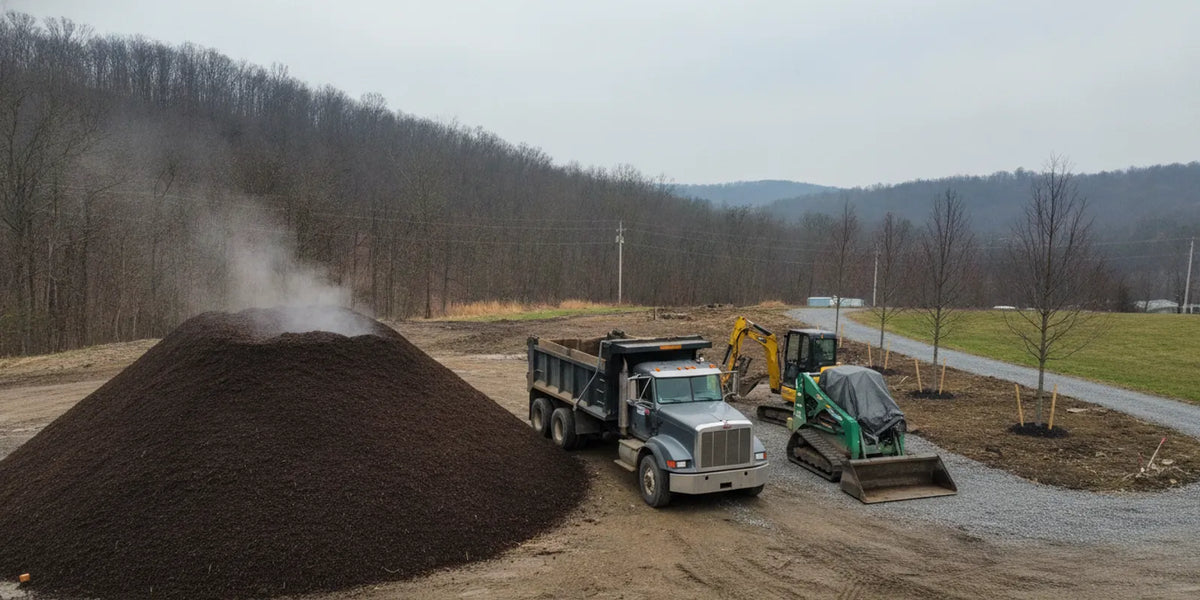
Planning compost contractor supply in Macedonia OH starts with two separate checks: whether a suitable product is available for the job and how it can reach the jobsite. Do not assume pickup at a Macedonia yard or delivery to a particular address; confirm both before you set a schedule or promise material to a customer.
Ask about compost availability and fulfillment
What should a contractor confirm first?
Start by defining the material need, not by choosing a truck or assuming that a nearby yard can fill the order. A contractor may need compost as a soil amendment, a component in a planting mix, or material for a broader landscape scope. Those uses can require different product characteristics, quantities and application plans. The name of a product alone does not establish that it is appropriate for every planting bed, specification or jobsite condition.
Write down the project location, intended use, estimated volume and requested delivery or pickup date. Then ask whether a compost product matching the job is currently available, which warehouse or fulfillment route applies, and whether the company can serve the exact address. The company lists compost among its landscape materials, but product selection, inventory and order eligibility may vary by region and location. A general mention of a material is not confirmation that a particular product is stocked for a particular order.
For Macedonia-area planning, treat the local pickup question especially carefully. Company information flags the Macedonia location as closed, while a store selector has retained a Macedonia link. That conflict is not a basis for planning a pickup. Confirm an active pickup point directly, or ask about a different available route before sending a truck or allocating crew time.
This initial check separates a material inquiry from a project-services request. A standard material order follows product, location, cart and checkout steps. If the job also needs equipment-assisted placement, installation or other work, scope that separately and request confirmation rather than assuming it comes with a load of compost.
What does compost supply mean for a Macedonia-area job?
“Supply” can describe several different things: a product that can be purchased, a load collected at a yard, material delivered to a site, or a coordinated project involving placement or installation. These are not interchangeable. A supplier may be able to discuss a material while the exact warehouse, amount, delivery route or service remains subject to confirmation. For estimating, define precisely which part of the chain you need.
For example, a landscape contractor may want compost delivered in bulk so its own crew can spread it.
A property manager may need a material quote for a scheduled renovation.
A public works buyer may be comparing a compost specification with other approved inputs. Each inquiry needs product and location confirmation, but only the latter two examples may involve procurement documents or formal project requirements. None should assume that delivery includes labor, placement or installation.
Sagamore Companies serves retail and commercial buyers with landscape materials and site services. Its general materials information includes compost, but public information does not establish that every type, quantity or specification is available from a Macedonia pickup point. The company’s materials and supply overview is a starting point for identifying the broad product and service paths. Use direct confirmation for the job-specific answer.
Keep the words in your request specific. Ask whether you are seeking bulk compost for purchase, delivery of a confirmed product, or a separate placement or installation service. If your crew will handle the work, say so. If you expect the supplier to do more than furnish material, describe each task and request a project quote. That one distinction helps prevent the wrong fulfillment assumption from carrying into a bid or schedule.
How should you describe the compost’s intended use?
Give the supplier enough context to identify the right kind of inquiry, while avoiding unsupported assumptions about what a product can do. Describe the area where the material will be used, what is being planted or maintained, and whether project documents specify a material or performance requirement. If a landscape architect, engineer, municipality or owner has written requirements, share the relevant wording rather than paraphrasing it from memory.
For a planting project, note whether the compost will be incorporated into soil, used as part of a specified blend, or applied in another way. For a commercial landscape renovation, say whether the work is new installation, repair or routine improvement. For a public or institutional job, identify approval requirements, delivery windows, load documentation and any restrictions on substitutions. These facts can help the supplier determine whether a listed product merits further review, but they do not substitute for the project designer’s approval.
Do not treat “compost” as one uniform material. Product composition, screening, moisture, particle size and other characteristics can matter to a project. Ask what information is available for the specific product under consideration and compare it with the project specification. If a specification requires documentation that is not available, do not tell the owner or agency that the material complies. Resolve the gap before ordering.
It can help to send a short project description in a consistent format: “We need bulk compost for [use] at [jobsite city or ZIP]. The project calls for [specification or desired characteristics]. Our estimated amount is [quantity and unit]. We need [pickup or delivery] around [date]. Can you confirm the product and fulfillment route?” Avoid including sensitive access codes or private details in an initial public form; provide operational details through the appropriate business contact once requested.
How can you estimate the amount before requesting a quote?
Begin with the dimensions of the area and the planned application depth or design quantity supplied by the project team. For a rectangular area, multiply length by width to get square footage. If applying a consistent depth, convert that depth to feet and multiply by the area to estimate cubic feet; divide by 27 to convert cubic feet to cubic yards. Keep all measurements in compatible units and have another person check the arithmetic before using it in a bid.
As a simple illustration of the method, a 1,000-square-foot area with a planned depth of two inches has a mathematical volume of about 6.2 cubic yards before accounting for site conditions, material characteristics, compaction, uneven ground, handling losses or design adjustments. This is only a calculation example, not a recommendation for a compost application depth or an order quantity. Use the depth and allowances specified for the actual project.
Many jobs are not level rectangles. Separate the site into measured zones, calculate each one, and add the results. For irregular beds, break them into simpler shapes or use a site plan. If the material is intended for incorporation, a surface-volume calculation may not reflect the final amount needed; confirm the method with the project designer or responsible professional. Do not inflate the order merely to avoid a second trip without checking the resulting storage and use plan.
Record the basis of your estimate: area, depth, conversion, number of zones and any allowance. That record makes it easier to compare a supplier’s quote with your takeoff and explain any difference to a customer. Ask whether the supplier sells the confirmed item by cubic yard, ton, bag or another unit, then reconcile that unit with your estimate. A product page showing one unit does not prove that every product or fulfillment route uses the same unit.
Which details affect a delivery or pickup plan?
Material quantity is only one part of a workable plan. For delivery, the supplier may need the complete jobsite address, requested date range, surface and turning conditions, unloading area, overhead obstructions, slope, gate width and any restrictions on truck movement. For a commercial site, identify receiving hours, check-in rules, traffic controls and the person authorized to direct the driver. These details allow the delivery request to be assessed; they do not guarantee that a particular vehicle can access the site.
Walk the intended route before requesting delivery. Note low wires or branches, soft ground, narrow entrances, parked vehicles, pedestrians and areas where a truck could block another operation. If unloading must happen in a precise location, mark it on a site plan or provide clear written directions. A photo can be helpful, but do not rely on a photo alone when grade, turning radius or overhead clearance is uncertain.
For pickup, confirm the actual yard, product, loading process, order requirements, operating hours and vehicle suitability before dispatch. Do not send a driver to the Macedonia address based solely on a store-selection link: the public information is inconsistent about that location’s status. Ask which currently available location, if any, can serve the order and whether the required material is available there. The store selector can help identify the location-selection path, but it does not replace direct confirmation of current operating status or stock.
Also decide where the load can be staged if the crew cannot use it immediately. Compost stored at the site needs a suitable area that does not block access, stormwater controls or other trades. Confirm with the owner or site manager who is responsible for protecting and handling the material after delivery. A clear unloading plan can prevent a scheduled material order from becoming a site logistics problem.
Should you choose pickup or delivery?
Pickup can make sense when the material is confirmed at an eligible location, the order fits the vehicle and the contractor can manage loading, transport and unloading. Delivery may suit a larger or more time-sensitive job when the address is within the service area and the site can receive the vehicle. Neither option is automatically available or less costly. The answer depends on product, warehouse, order size, vehicle, route, scheduling and separate charges.
| Planning factor | Pickup to evaluate | Delivery to evaluate |
|---|---|---|
| Availability | Confirm a currently operating pickup point and stock before dispatch. | Confirm the product, destination eligibility and delivery estimate. |
| Transportation | Provide a suitable vehicle and account for loading, hauling and unloading. | Share address, access details and receiving constraints for review. |
| Site coordination | Plan where the material goes after it returns to the jobsite. | Prepare an unloading zone and an authorized site contact. |
| Cost comparison | Include vehicle, labor, travel and handling in the project estimate. | Check checkout shipping estimates or request a qualified service quote. |
| Schedule | Confirm hours, order readiness and any appointment requirements. | Request a date or window and treat it as unconfirmed until accepted. |
Use the table as a checklist, not as a price or availability promise. A delivered product order may use checkout to show shipping estimates; project-service pricing may require a separate inquiry. Taxes, labor, placement and other charges can be separate. A pickup trip also has real costs even if the cart does not show a delivery charge. Compare the full project cost and the operational risks rather than looking at one line item.
For either choice, ask what confirms the order. It may be a checkout confirmation for a product purchase or a written quote and accepted scope for a service. Make sure the confirmed product, unit, quantity, destination or pickup point, charges and timing match your takeoff and job plan. Keep a copy where the foreperson and procurement contact can find it.
How do product orders differ from placement or installation?
A product order is a purchase of material. A delivery arrangement transports the order to an eligible address. Placement is a separate job activity in which material is positioned at the site using appropriate equipment. Installation can include a broader work scope. Do not assume that a compost order includes spreading, grading, soil preparation, planting, cleanup or any other labor unless those tasks are explicitly included in a written scope.
Sagamore describes a range of material and site-service capabilities, but each service has its own qualification and workflow. Its services information helps distinguish material delivery from equipment-assisted placement and other project work. The published slinger service is conveyor placement for eligible materials and sites; do not call it compost installation or assume that every compost product can be handled through that service. Ask about the exact material and site, and request the service scope separately.
When an owner expects the supplier to do work beyond delivering the compost, list each requested task and identify who will furnish equipment, labor and site preparation. Clarify whether the contractor or supplier is responsible for spreading, final grade, protection of adjacent surfaces and cleanup. If the work is not offered or the site is not eligible, make that clear in your own estimate rather than implying that the material order covers it.
This distinction matters on commercial bids. A supplier quote for bulk material cannot be used as a substitute for a labor quote. Conversely, a project-service inquiry should not be processed as a standard cart order if it requires site review. Keep the material, transportation and work components visible as separate lines in your estimate. It helps the customer compare options and makes scope changes easier to document.
How should you verify Macedonia-area availability?
Do not treat a city in a search phrase, an old product listing or a location link as proof of present-day availability. Confirm the specific material, order quantity and delivery address. Ask which warehouse would fulfill it, whether the order is pickup or delivery, and whether the proposed date is feasible. If the answer depends on a route, stock transfer or job qualification, ask what remains open and when it will be confirmed.
The Macedonia location requires special care: available company information identifies it as closed, even though a store selector still includes a Macedonia shopping link. Until the company confirms otherwise, do not advertise that site as an open pickup option, route a driver there or include it in a customer schedule. A buyer can still ask about service to a Macedonia-area project, but an area inquiry is not a guarantee of delivery, stock or a nearby operating yard.
For the inquiry, use an exact address or ZIP code rather than only “Macedonia.” Include the required amount, product use, preferred fulfillment method and date range. If there are multiple possible jobsite entrances or delivery points, explain which one is intended. The company’s contact route is appropriate for asking about service, stock and project qualification. Avoid treating a general website page as a confirmation of a specific order.
Keep a written record of the answer. Record who confirmed the details, what product or specification was discussed, where it will be supplied from, what fulfillment was offered and what remains subject to change. If the project is competitively bid, state that availability and freight are pending confirmation until you have a firm response. This is particularly useful when a procurement deadline comes before the planned delivery date.
What cost questions should go into the estimate?
Ask for the basis of each quoted amount. Confirm the product name, sales unit, quantity, applicable warehouse or region, fulfillment method and quote date. A per-yard or per-ton listing should not be treated as a universal delivered rate. Price and availability may depend on product, region, location and how the order is fulfilled. If the buyer has an existing allowance, compare like with like: same product, unit, quantity, delivery assumptions and scope.
Separate material from transportation and labor. Ask whether delivery is included or estimated separately, whether the amount shown at checkout is a shipping estimate, and whether taxes or other charges apply. If a job requires slinger placement or installation, obtain a separate qualified scope rather than adding an assumed percentage to the material price. For a pickup plan, include vehicle use, driver time, fuel, loading and the cost of moving the material from the truck to the work area.
Also account for uncertainty in the takeoff. If the design quantity can change after excavation or site preparation, state the assumed amount and the process for ordering additional material. Do not promise a future price or a second load based on an unconfirmed estimate. Where a customer needs a not-to-exceed amount or formal procurement quote, state that requirement at the outset and ask whether the supplier can provide the needed form.
For multi-site or phased work, identify each address and delivery phase separately. A single total quantity across several sites can obscure route, access and timing differences. Ask whether each delivery is quoted independently and what happens if the schedule shifts. A clear quote record helps both the contractor and customer see what the amount covers and what remains outside the price.
How can a contractor compare material options responsibly?
Compare only products that meet the project’s stated needs. Begin with the specification, intended use and any required documentation. Then review the supplier’s available product information, units and fulfillment terms. If one candidate has a different description, screening or declared characteristics, do not assume that it is equivalent to the specified material. Ask the design professional or owner to approve any proposed substitution.
Company materials information may help you identify what to ask about. The soils and material guides provide a related starting point for landscape-supply research, while the soil collection shows a product-browsing route. These pages do not establish that a particular soil product is compost, that it meets a compost specification or that it is available for a Macedonia-area order. Use them to understand the site’s product pathways, then confirm the exact product and suitability for your project.
If the project has no formal specification, write down the functional need and ask what product information is available. For example, distinguish between a request for a named product and a request for a material that meets owner-defined criteria. That prevents the supplier from having to guess what “good compost” means for a particular landscape. It also helps your customer understand why one product may not be an appropriate substitute for another.
Keep the comparison fair. Evaluate product, unit, quantity, availability, delivery, documentation and scope together. Do not select the lowest number if it represents a different material unit or excludes the freight and work your project needs. If documentation or approval is pending, mark it as pending in your estimate and do not describe the comparison as complete.
What should a commercial buyer include in a quote request?
A useful request answers the supplier’s first practical questions without burying them in unrelated project history. Identify your company or organization, the project city and ZIP code, the desired material, the intended use, the estimated amount and the preferred fulfillment method. Include a date range rather than an assumed guaranteed delivery time. If a bid or procurement deadline applies, say when you need a response and what format the buyer requires.
- Project and site: City, ZIP code, site name if useful, delivery entrance, receiving hours and any access restrictions.
- Material: Requested product or specification, intended use, requested documentation and whether substitutions need approval.
- Quantity: Estimated volume, unit, takeoff basis and whether the order may be phased.
- Fulfillment: Pickup or delivery preference, available vehicle information for pickup, and an unloading or staging plan for delivery.
- Timing: Preferred date range, site readiness, receiving contact and any coordination with other trades.
- Scope: Whether you are asking only for material, or separately asking about delivery, placement or installation.
- Commercial process: Quote format, purchase order needs, insurance or documentation questions and the deadline for an answer.
Attach a takeoff, specification excerpt or site plan only when it helps clarify the request. Label assumptions and revisions with dates. If information is not final, state that clearly; an early budget inquiry should not be mistaken for a firm order. For municipal, public works or institutional procurement, confirm that the eventual quote follows the required purchasing process before placing an order.
The more precise your request, the easier it is to identify what has been answered and what still needs review. Ask the supplier to confirm the product and unit, service-area eligibility, fulfillment route, estimate or quote, and timing status in writing. Do not describe a requested date as confirmed until it has been accepted.
How should you plan the site before material arrives?
Before an order is finalized, coordinate with the owner or site manager on where the material can be unloaded and stored. Confirm that the ground can support the planned truck traffic and that the staging area will not block fire lanes, accessible routes, utilities, entrances or ongoing operations. For an occupied commercial property, tell affected tenants or departments what area will be used and when access may be limited.
Assign one person to receive the load and identify how the delivery driver will contact them. If the site has security check-in, a required delivery window, a designated gate or a no-idling rule, provide those details in advance. Mark overhead hazards and restricted zones. If the unloading plan changes after the quote, promptly ask whether the new location or timing can still be accommodated rather than making an unapproved adjustment at the gate.
Decide how quickly the material will be used and how it will be protected while waiting. Plan for runoff, dust, vehicle movement and separation from other materials according to the project’s requirements and site rules. Keep the pile clear of storm drains and sensitive areas as directed by the site plan or responsible professionals. These are practical coordination steps, not a substitute for project-specific environmental or safety requirements.
Confirm who will check the delivered quantity and condition, and how discrepancies should be reported. Keep the purchase confirmation, delivery paperwork and project specification available. If a load appears different from what was ordered, pause use and follow the supplier’s documented process before distributing it across the site. Timely documentation is more useful than relying on memory several days later.
What mistakes most often create avoidable problems?
Assuming a Macedonia pickup point is open. The public information is inconsistent, and the location is identified as closed. Confirm an active fulfillment point before dispatching a truck or setting a customer expectation.
Using “compost” as a complete specification. A broad material name may not answer questions about composition, application or required documentation. Share the intended use and written criteria, then confirm whether the product matches them.
Confusing material delivery with placement. A load arriving at the site does not mean it will be spread or installed. State whether your crew will handle the work, and request a separate project scope for any supplier-performed work.
Estimating from a rough visual guess. Measure the area, record the depth or specified quantity, use consistent units and check the arithmetic. If the project has irregular zones or material will be incorporated, ask the responsible designer how to calculate the order.
Comparing prices that cover different things. A product amount, delivery estimate and installed project price are different figures. List product, unit, quantity, transportation, labor and additional charges separately before evaluating bids.
Promising timing before confirmation. A requested date is not an accepted schedule. Leave room for stock and route confirmation, site readiness, receiving restrictions and other trades. Communicate the status to the customer accurately.
Leaving access details until the truck is en route. A delivery can be disrupted by low clearance, a blocked entrance, soft ground or missing site authorization. Walk the route, identify a receiving contact and communicate constraints early.
Ordering before the material is approved. A product page or broad product description does not establish compliance with a contract specification. Obtain the required review and written approval before ordering a substitute.
How should homeowners and municipalities use the same process?
Homeowners can use the same basic checklist on a smaller project: identify the bed or planting area, estimate quantity using the project’s intended depth, choose a fulfillment preference and confirm that the specific address can be served. Select the correct store or region before browsing products. The company’s store-selection page is relevant for that step, but it should not be read as confirmation that every item is available at every location. Macedonia pickup remains subject to direct confirmation.
For product shopping, follow the store-qualified product, cart and checkout path. Review the displayed unit and shipping estimate, and check whether other charges or handling are separate. If the homeowner needs help with spreading or installation, make a distinct inquiry. Ohio mulch installation is described as coordination with trusted contractors and subject to a five-yard minimum; that policy applies to the stated mulch-installation service and should not be assumed to describe compost work. In the Carolinas, the company describes mulch support as delivery to the customer’s chosen landscaper, not installation by Sagamore.
Municipal and public works buyers should add their procurement and site requirements to the same material questions. Confirm specifications, documentation, approved substitutions, delivery access and purchasing procedures. A buyer should not assume that a product listing meets a public contract requirement or that one location’s availability applies to another. Keep procurement approval, material confirmation and delivery scheduling as separate gates where the process requires them.
In either case, the basic rule remains the same: confirm product, location, quantity and fulfillment before making a firm plan. If a project needs a quote or service review, use a contact route rather than relying on cart checkout alone. For broader background on the company and its regional material-supply role, the company overview is useful, while a job-specific answer still requires direct confirmation.
How should you handle phased or repeat orders?
Some commercial projects use compost in more than one phase. A site may have several work zones, or the owner may release areas as construction progresses. In that case, estimate each phase separately and identify which quantities are firm and which are forecasts. Ask whether each release will be treated as a separate order, whether the same product is expected to remain available, and how much notice is needed to request another load. Do not assume that a later release will have the same stock, price or delivery timing as the first one.
For a multi-site contract, create a simple schedule with one row per destination: address, estimated amount, requested period, receiving contact and current approval status. This makes it easier to spot a site with a different access plan or a quantity that needs a separate takeoff. If several projects share one procurement budget, keep the product and fulfillment charges allocated by site so the customer can reconcile each delivery against the work completed.
When a project is likely to need additional material, explain how the quantity was estimated and what condition would trigger another order. A possible extra quantity is not an order confirmation. Check whether the project can safely store extra material, whether storage affects the planned use, and whether the owner has approved the additional expense. If the project specification or site condition changes, revisit the material choice with the responsible professional before repeating the original order.
Record changes in a dated revision rather than relying on a phone message passed through several crew members. The revision should identify the prior amount, new amount, destination, requested timing and who authorized the change. Ask the supplier to confirm what changed in fulfillment or quote terms. This is particularly valuable when a contractor is coordinating several trades and the original receiving contact may no longer be on site.
How do you keep the supplier, crew and customer aligned?
Assign one person to own the material inquiry and one person at the jobsite to receive the load. Those roles may be held by the same individual on a small project, but they should still be explicit. The person requesting a quote should distribute the confirmed product, quantity, site plan and timing status to the foreperson and customer. The receiving contact should have the driver instructions, unloading point and escalation contact before delivery day.
Use plain status labels in project communications: requested, awaiting product confirmation, awaiting delivery eligibility, quoted, accepted, scheduled or complete. Avoid treating a page view, inquiry submission or preliminary estimate as a confirmed order. If a date is pending, tell the customer what information is still needed and when you expect to follow up. This keeps a reasonable planning estimate from turning into a promise that no one has accepted.
After the load arrives, record the delivered product and quantity using the project’s normal receiving process. Note any discrepancy promptly and contact the supplier before the material is spread or mixed into other site materials. Keep the delivery record with the purchase and specification documents. This creates a usable trail if the owner later asks which material was used, which order supplied it or whether the delivery matched the approved scope.
For contractor teams working under a commercial agreement, tell the customer which party controls each decision. The supplier can confirm its product, fulfillment and quoted scope; the contractor remains responsible for its own estimate, crew plan and representations to the customer. The designer or owner may control specification acceptance. Clarifying these boundaries early makes it easier to resolve questions without implying that any one participant has approved the entire project.
What should you do before confirming the order?
Use a final review to connect the order to the actual project. Check that the selected product meets the stated need, the quantity matches the takeoff, the unit is clear, and the chosen fulfillment method is confirmed for the exact destination. Verify the quoted charges and note which items are estimates or remain separate. Ensure the requested date has been accepted rather than merely entered as a preference.
Then confirm site readiness. The receiving contact should know where the load goes, how the driver enters, when the site can accept it, and what happens if access is blocked. For pickup, the driver should know which confirmed location and order to collect. For delivery, the site should have a clear unloading zone and a plan for using or protecting the compost after arrival.
Keep product purchase and project-service confirmations in their own records. If you arranged material through checkout and separately requested placement or installation, make sure both are documented and that their dates and responsibilities align. Do not infer that one confirmation includes the other. If the supplier cannot confirm a requested service, revise the project plan or assign it to another qualified party without changing the material order’s meaning.
When anything changes—quantity, address, specification, access, schedule or requested scope—ask whether the original confirmation remains valid. A small change can affect fulfillment or pricing. Written, timely updates help prevent a local planning assumption from becoming a jobsite delay.
Request confirmation for your project location and order
For a Macedonia-area compost project, the reliable next step is to share the job details and confirm product, inventory, location eligibility, fulfillment and any separate service scope before you commit to a schedule.
