
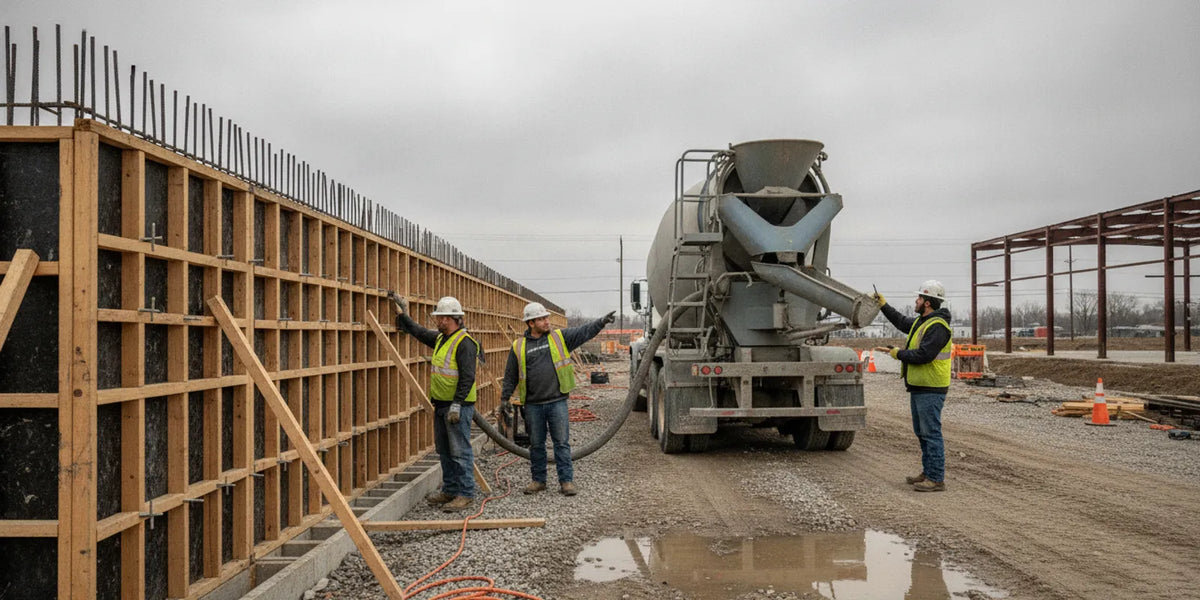
Concrete delivery time is not one fixed number. It can mean the wait between requesting service and getting a scheduled date, travel time to the site, time spent producing and placing concrete, or the full period from arrival through the planned work. Contractors and commercial buyers can make better decisions by defining which clock matters, confirming what service is being scheduled, and checking site readiness before choosing a date. Sagamore Companies offers volumetric concrete supply and separately scoped turnkey concrete installation; the right planning questions differ for each.
What does concrete delivery time mean for a project?
Before comparing schedules, separate four different time periods. They can affect one another, but they are not interchangeable:
- Lead time: The period between asking for service and the date a supplier or installation provider can accept the job. It depends on current scheduling, the project scope, location, and the service requested. A website description or a past job cannot confirm the next available date for a new project.
- Travel time: The time a truck spends going from its dispatch point to the jobsite. Distance is only one factor. Route conditions, truck access, dispatch planning, and the agreed arrival window can also matter. A map estimate is not a delivery commitment.
- On-site production and placement time: The work that occurs after arrival. For volumetric concrete, the truck mixes concrete on site. The actual work period depends on requested quantity, mix requirements, placement method, access, crew coordination, and the way the job is prepared.
- Installation duration: For a concrete installation project, the full planned scope can include preparation, forms, placement, finishing, and other agreed work. It is different from the time needed to supply concrete. A delivery appointment alone does not establish the duration or responsibility for installation.
These distinctions help when someone asks, “How long does concrete take to get here?” A useful answer may involve a requested service date, an arrival window, and a separate estimate for work on site. Ask the provider to identify each one. Do not treat a general estimate of travel time as a confirmed appointment, or assume that a truck arrival means the entire concrete job will be complete.
For example, a contractor might need concrete on a particular morning because a crew, pump, or follow-on trade is booked. The key question is not only whether a truck can travel there quickly. It is whether the provider can confirm the requested service, quantity, mix, arrival plan, access, and handoff with the rest of the crew. The same discipline applies to a commercial property project with restricted access or a work window.
Which service are you scheduling: concrete supply or installation?
First define whether the project needs concrete supplied or a broader installation service. Concrete supply and concrete installation describe different scopes. A buyer who asks only for “a concrete delivery” may mean an order of material, a truck that mixes on site, or a provider responsible for more of the construction sequence. Clarify that meaning before discussing timing.
Sagamore describes its volumetric concrete service as on-site mixing. This is a supply route: confirm the project location, mix needs, quantity estimate, site conditions, and current schedule with the company. Do not assume that concrete supply includes forming, placement, finishing, or curing work. Ask explicitly which tasks are included in the quote and which must be handled by the buyer or another contractor.
A separately scoped turnkey concrete installation request concerns a wider project scope. The installation page describes coordinated work from preparation through finishing, but the actual responsibilities and timing still need to be confirmed for the particular job. Ask who handles each task, what must be ready before the scheduled date, and whether the proposed schedule includes only a pour or additional phases.
These routes should not be collapsed into one promise. A supplier can discuss material and dispatch details, while an installation quote needs to account for the defined work and jobsite. Neither a service page nor a general inquiry establishes capacity or availability for a particular date. A project-specific conversation is how the parties identify what is feasible.
| Planning question | Volumetric concrete supply | Turnkey concrete installation |
|---|---|---|
| What is being requested? | Concrete mixed on site and supplied for the agreed project. | A defined installation scope, with project tasks confirmed in the quote. |
| What affects the schedule? | Requested date, location, mix, estimated quantity, truck access, and readiness to receive and place material. | All supply considerations plus the preparation, forms, placement, finishing, and other agreed work sequence. |
| Who needs to coordinate? | The buyer's placing crew and any other site resources that must be ready for supply. | The buyer and the parties responsible for each stage of the installation scope. |
| What should the buyer confirm? | Availability, arrival plan, mix details, quantity basis, access, and exactly what the supplier provides. | Included work, exclusions, site prerequisites, project sequence, and schedule for each agreed phase. |
| Does a general travel estimate confirm an appointment? | No. Confirm the actual date or arrival window with the provider. | No. Confirm the project schedule and timing of the included work with the provider. |
The table is a comparison checklist, not a service guarantee or schedule quote. A project might need only material supply, or it might need a coordinated installation. State the scope in plain terms when requesting an estimate so that the proposed schedule corresponds to the work you actually want.
What factors can change a concrete delivery schedule?
Concrete delivery time is shaped by operational details that the buyer can often surface early, even if the buyer cannot control every variable. Give the provider enough information to assess the job instead of relying on a broad request for a truck “as soon as possible.” The following factors commonly need discussion.
Location and service eligibility
Start with the complete jobsite address, not only the nearest town or postal code. The location determines whether the service can be considered and helps the provider assess dispatch and travel. Sagamore serves Northeast Ohio and the Charlotte, North Carolina area, but that does not mean service is available at every address or for every type of project. Location and job eligibility should be confirmed directly.
Also share the entrance to use, any gate or check-in process, and whether the truck must follow a particular site route. A site located near a service area may still have access limitations or other conditions that affect whether a requested plan is workable. Confirm eligibility before making dependent crew or equipment bookings.
Scope, quantity, and mix requirements
Describe the intended work and provide the best available quantity estimate. If the quantity is still being calculated, say so and explain what information remains uncertain. Specify any known mix requirements or project constraints rather than assuming a standard order will fit. The provider needs enough detail to discuss the request; the estimate should not be treated as a final project design or an engineering determination.
Quantity matters to scheduling because it influences the production and placement plan. The estimate should state how the quantity will be handled and what happens if field conditions or the final measurement differ. Sagamore’s volumetric service describes on-site mixing and a pay-for-used-yard approach in its marketing; the precise measurement, quote terms, and applicability for a specific project must be confirmed before ordering. Do not assume the same billing or production arrangement applies to every job.
Site access and work area
Tell the provider about narrow entrances, low overhead clearance, soft or uneven ground, slopes, tight turns, overhead lines, nearby structures, traffic controls, and areas that cannot support heavy vehicles. These are examples to check, not a substitute for a site assessment. Note whether trucks can enter, maneuver, and leave without blocking public access or other work. If access conditions are uncertain, ask what information or site review is needed before confirming a date.
For commercial sites, include delivery instructions, security requirements, operating hours, pedestrian routes, and any restrictions on vehicle movement. A schedule that works on paper can fail if a truck cannot reach the intended position when it arrives. Share the contact person who can meet the driver or coordinate access, and keep that person available during the agreed time.
Preparation and crew readiness
Concrete supply depends on the site being ready to receive and place material. The preparation requirements vary by project. The responsible crew should determine what must be completed before arrival, including the work area and any forms or other project components relevant to the job. Agree who checks readiness and by what time. Do not infer that the supplier will prepare the site unless that responsibility appears in the project scope.
Coordinate the people and equipment that must be present. If a separate placing crew, pump, or other resource is part of the buyer's plan, verify its booking and timing against the confirmed supply window. Identify a decision-maker who can resolve a field question without delaying the work. This coordination does not guarantee a specific pour duration; it helps make the scheduled service usable.
Dispatch, route, and schedule changes
Ask how the provider will communicate the appointment and any relevant updates. Confirm whether the date is firm, whether an arrival window applies, and whom to call if site conditions change. Weather, traffic, equipment issues, and other operational events can affect plans in the construction industry. Do not rely on an unconfirmed same-day expectation or promise a project stakeholder a precise arrival without the provider's confirmation.
For a time-sensitive project, discuss what happens if the schedule shifts. The answer may involve rescheduling the crew, revising site access arrangements, or checking with another trade. Ask about the provider's process rather than assuming a guaranteed response time, automatic notification, or specific remedy.
How should a contractor plan a concrete delivery window?
Build the plan backward from the work that must happen on site, then confirm the supplier's actual appointment. The goal is not to invent a universal number of hours. It is to make each dependency visible and leave enough room for the project team to respond to uncertainty.
- Define the work outcome. Decide whether the request is for concrete supply, installation, or a specific combination of tasks. List what the buyer's team and other providers will do.
- Identify the date constraints. Note deadlines, work-hour limits, access windows, inspections, tenant or public activity, and any follow-on trade that depends on the work. Distinguish hard constraints from preferred timing.
- Prepare the site information. Provide the address, access instructions, site contact, known restrictions, and the intended truck position. Include photographs or a site plan if the provider requests them; do not assume they replace a site review.
- Estimate material and specify the request. Share the best available quantity, use, and known mix requirements. Identify uncertainties early and ask how the estimate will be reconciled with actual work.
- Request schedule confirmation. Ask for the service date and whether the provider gives an arrival window. Clarify what the time refers to: dispatch, arrival, start of supply, or another milestone.
- Match other resources to the confirmed plan. Book the buyer's crew and any separate equipment around the provider's confirmed arrangement, not a speculative travel estimate. Confirm who will coordinate if something changes.
- Recheck readiness before the date. Verify that access, work area, staffing, and agreed prerequisites remain in place. Tell the provider promptly if the quantity, location, or conditions have changed.
- Close the communication loop. Make sure the day-of contact knows the plan and has the provider's agreed contact route. Record changes and decisions so the crew is working from the same information.
This process helps a contractor compare proposed schedules on a like-for-like basis. One provider may discuss a delivery window; another conversation may cover an installation sequence. Ask what is included rather than comparing labels such as “fast” or “available.” A reliable plan is one the project team and provider have actually reviewed for the job.
What should a commercial buyer coordinate before the truck arrives?
Commercial buyers may need to fit concrete work around operations that do not stop for a construction project. A retail site, industrial property, school, municipal facility, or multi-tenant location can have rules that affect vehicle access, staffing, and the usable work period. Build those requirements into the first schedule conversation.
- Site authority: Confirm who approves work, access, and any temporary restrictions. Identify the person who can make a decision on the scheduled day.
- Occupant and public safety: Explain pedestrian or vehicle traffic, occupied areas, controlled entrances, and any route that must remain open. The site team is responsible for communicating its operating constraints and arranging appropriate controls.
- Work hours and noise limits: Share the allowed work period and any rules affecting setup, vehicle movement, or cleanup. Do not presume a supplier can arrive outside the approved window.
- Security and check-in: Provide procedures, gate codes through an appropriate secure channel, visitor requirements, and the correct entrance. Verify that the driver or crew will have a way to access the site.
- Vehicle staging: Identify the proposed truck route and staging area. Consider whether parking, other contractors, deliveries, or public traffic may block it.
- Coordination with other trades: List dependencies and confirm who is responsible for each handoff. A concrete supplier's arrival does not automatically coordinate other crews or equipment.
- Contingency contacts: Share who can answer a question if the area is not ready or an access issue arises. Establish a communication path before the date.
These details can help identify a schedule conflict while there is still time to discuss it. They do not guarantee a particular arrival or project outcome. If the site has a narrow operating window, tell the provider at the outset and ask whether it can be considered for the requested job. Keep the final plan aligned with any site rules and the written scope.
How does on-site volumetric mixing affect the time plan?
A volumetric mixer carries concrete-making components and mixes on site. That changes the planning conversation from simply receiving a pre-mixed load to confirming the on-site production and supply arrangement. It does not mean the truck can arrive at any time, that every mix is suitable, or that all constraints disappear. Buyers should confirm the specific mix, quantity, site access, operating plan, and schedule for their job.
On-site mixing can be useful to discuss when a project needs a service configured around actual use. Sagamore markets its volumetric service for contractors and describes pay-for-used-yard messaging. Treat this as a service feature to verify in the project quote: ask how the requested amount is estimated, how actual usage is determined, what is included, and how any remainder or shortfall is handled. Commercial terms matter as much as the equipment description.
Do not infer a particular production rate, truck capacity, uninterrupted output, or time savings from the word “volumetric.” The work pace depends on job-specific conditions and the agreed setup. Ask what the provider needs to know to assess whether the requested quantity and mix can be supplied as planned, and whether the crew can receive and place material continuously or in stages.
For the buyer, the practical task is to coordinate the supply point with the placing operation. Confirm who directs the truck, where the concrete is to be delivered, how the crew will manage movement, and what happens if the work area or quantity changes. The supply process and the installation process remain distinct even when they occur at the same jobsite.
How should buyers compare concrete delivery options?
Compare the actual scope and schedule rather than relying on an advertised speed claim or a single estimated time. A useful comparison includes the requested date, confirmed arrival arrangement, location eligibility, material requirements, access assumptions, and work included. If two quotes describe different scopes, resolve that difference before deciding which schedule better fits the project.
Use a consistent set of questions for every provider:
- Is the quote for concrete supply, on-site mixing, installation, or another defined service?
- Which project tasks are included, and which remain with the buyer or another contractor?
- What requested date can be considered, and what exactly does the arrival or service window mean?
- What site details, access conditions, and preparation must be confirmed before the appointment?
- How should the buyer estimate quantity, communicate changes, and reconcile final usage?
- What mix information or project documentation is needed?
- How will schedule updates be communicated, and who is the day-of contact?
- Are delivery, labor, equipment, placement, or other charges separate from material supply?
- What is the process if the worksite is not ready or conditions differ from those described?
For a Sagamore material order, use the store and warehouse selector to begin with the relevant location. Product availability, pickup or delivery eligibility, and checkout details need to be checked for the specific product and address. A retail product checkout is not the same as booking a concrete project service, and a product page should not be read as confirmation of a service appointment.
For work that needs a project assessment, use the appropriate service route and request a quote. The services overview can help distinguish project work from retail material shopping. It does not establish availability at every address, so state the complete location and project needs when making an inquiry.
What information should go in a concrete quote request?
A concise but complete request gives the provider a basis to discuss fit, scope, and schedule. It also reduces the chance that a response addresses material supply when the buyer meant installation, or the reverse. Include the essentials below and label any information that is not yet known.
- Project address and location: Include the full jobsite address, site name if relevant, and the required entrance or access route.
- Buyer and jobsite contacts: Provide the person responsible for decisions and the person who will be on site. Include the best way and time to reach them.
- Requested service: State whether you want volumetric concrete supply, turnkey installation, or an initial discussion to determine scope. Name tasks you expect to be included.
- Timing: Give the preferred date, acceptable alternatives, critical deadline, operating hours, and any restricted window. Ask what appointment or arrival arrangement the provider can confirm.
- Quantity and mix: Share an estimate and the known project requirements. Explain how the estimate was developed and identify open questions.
- Access and conditions: Describe truck route, staging, clearance, ground conditions, security, traffic, and other known constraints. Include any requested documentation or images if appropriate.
- Readiness and dependencies: Say what preparation is complete, what remains, and which crews or equipment have separate schedules.
- Commercial details: Ask what the quote includes, what charges may be separate, how usage or quantity is treated, and what terms apply if the schedule or scope changes.
One practical template is: “We are requesting [supply or installation] at [full address]. The preferred date is [date], with [acceptable alternatives or work window]. Our current quantity estimate is [amount], and the known mix or project requirements are [details]. Site access is [route and restrictions]. The work area is expected to be ready by [time or condition]. Please confirm whether the location and scope can be considered, what is included, and what schedule information you can provide.” Adjust it to the actual project; do not leave placeholders in a final request.
Buyers with plans, specifications, or a project schedule can ask what documents will help assess the request. Share only the information needed for the quote through the provider's preferred contact method. Keep technical design decisions with the project professionals responsible for them.
What costs and timing assumptions should be kept separate?
A delivery conversation can become confusing if the buyer treats every cost and every duration as part of one figure. Separate material, transportation, placement, installation labor, equipment, and any other quoted charges. The actual items depend on the service and the written quote. Confirm what the stated price covers and whether taxes, delivery, labor, or other charges are separate.
Keep the following assumptions distinct when you compare offers:
- Material cost versus project cost: A concrete supply price does not automatically include site preparation, forms, labor, finishing, or related work.
- Travel estimate versus arrival commitment: A map or distance estimate does not confirm a booked time. Use the provider's confirmed appointment information.
- Arrival versus completion: A truck reaching the site is not a promise that the whole pour or installation will be finished by a particular time.
- Estimated versus actual quantity: Record the basis of the estimate and confirm how final usage or quantity adjustments are handled.
- Material supply versus placement: If a crew must place or install the concrete, verify who provides that work and what method or sequence is included.
- One phase versus full project: A service date for one phase does not establish dates for later preparation, finishing, or other activities.
These distinctions are especially important when a buyer has a fixed labor budget or has booked follow-on trades. Do not compare a material-only offer with an installation quote as if they include the same responsibilities. Ask for written clarification before relying on a proposed scope, cost, or schedule.
What can delay a planned concrete service?
No planning checklist can remove all uncertainty. Common sources of change include an unready work area, inaccurate quantity assumptions, access that differs from what was described, a site rule that was not communicated, changing weather or route conditions, and a revised project scope. The specific impact depends on the job and provider arrangements. The best response is to surface changes quickly and ask how they affect the appointment.
Before the service date, review the original details and report anything material that has changed: a different address or entrance, a revised quantity, newly restricted access, or a change in scope. Do not assume that an update to one project contact reaches dispatch, the crew, or other providers automatically. Ask who needs to know and get confirmation through the agreed channel.
If the team finds a problem on site, pause to identify the issue and the decision-maker. A provider may need to reassess access or the plan before continuing. A buyer should not rely on an informal assumption that the crew can work around an unsafe or unsuitable condition. Project-specific decisions belong with the responsible parties who understand the site and the agreed scope.
For future planning, note what caused the schedule change and include that information in the next request. That record can help the contractor improve its own readiness plan, but it should not be used to promise a repeatable delivery time on a different job.
How can homeowners use the same planning approach?
Homeowners can apply the same distinctions on a smaller project. Decide whether the need is an order of concrete material or an installation service, confirm whether the provider serves the address, and ask what the quoted work includes. A short residential driveway or patio can still have access, preparation, quantity, and crew coordination questions that need direct answers.
Prepare a clear description of the job and identify who is responsible for planning and completing it. If a contractor is managing the work, coordinate the supply question through that contractor rather than booking a delivery that may not match the project plan. If requesting a service quote directly, ask what details are needed and how the site will be evaluated.
Homeowners considering other landscape materials should use the location-qualified shopping path rather than assuming that every product or service is available everywhere. Sagamore's concrete guides and landscape material articles provide related reading, while a particular concrete appointment still requires a project-specific inquiry. For installation, supply, and other service questions, use the contact route rather than treating a general article as a quote.
What should you ask before confirming a date?
Before accepting a proposed schedule, make sure both sides agree on the service and its timing. Use this final checklist:
- Does the scope mean concrete supply, on-site mixing, installation, or a combination that is described in the quote?
- Has the provider confirmed the address and considered the requested date?
- Is the time a scheduled arrival, an arrival window, or a different project milestone?
- Are the quantity, mix needs, access route, and work area clear?
- Does the buyer know what must be ready and who is responsible for each prerequisite?
- Are other crews or equipment coordinated with the confirmed plan?
- Are material, delivery, labor, placement, installation, and any other charges distinguished?
- Who will communicate a change, and what should the buyer do if the site conditions shift?
If any answer is uncertain, resolve it before making commitments to other trades or promising a completion time to a customer. The objective is a mutually understood plan, not a generic estimate that sounds precise but leaves the scope undefined.
Request a project-specific concrete discussion
Frequently asked questions about concrete delivery time
How long does concrete delivery take after I place an order?
There is no single lead time or travel duration that applies to every order. It depends on location, service requested, current scheduling, project requirements, and site conditions. Ask the provider to confirm a date and clarify whether it is an arrival window, supply start, or another milestone.
Does volumetric concrete mean a faster delivery?
Not by itself. Volumetric describes concrete mixed on site, but it does not establish availability, arrival time, production rate, or completion time. Confirm the service plan, mix, quantity, access, and appointment for the specific project.
Is concrete delivery time the same as concrete installation time?
No. Delivery or supply concerns getting concrete to the project under the agreed arrangement. Installation can include a wider scope, such as preparation and finishing, depending on what the quote specifically includes. Confirm responsibilities and timing for each phase.
Can I schedule concrete delivery for an exact time?
Ask the provider what scheduling commitment it can offer for the job. Do not assume an exact arrival is available or guaranteed. Share any restricted work window early, then plan other crews around the confirmed arrangement and its stated limits.
What information helps a provider estimate the schedule?
Provide the full address, requested service, preferred date, quantity estimate, known mix requirements, site access details, work-area readiness, and contact person. Explain any commercial rules or deadlines and identify what is still unknown. A complete request allows the provider to assess the project rather than guess from a general description.
Concrete delivery time is easiest to plan when supply, travel, placement, and installation are treated as separate parts of the job. Confirm the service scope, location, site requirements, and appointment directly, then coordinate your crew around the schedule the provider actually agrees to.
