
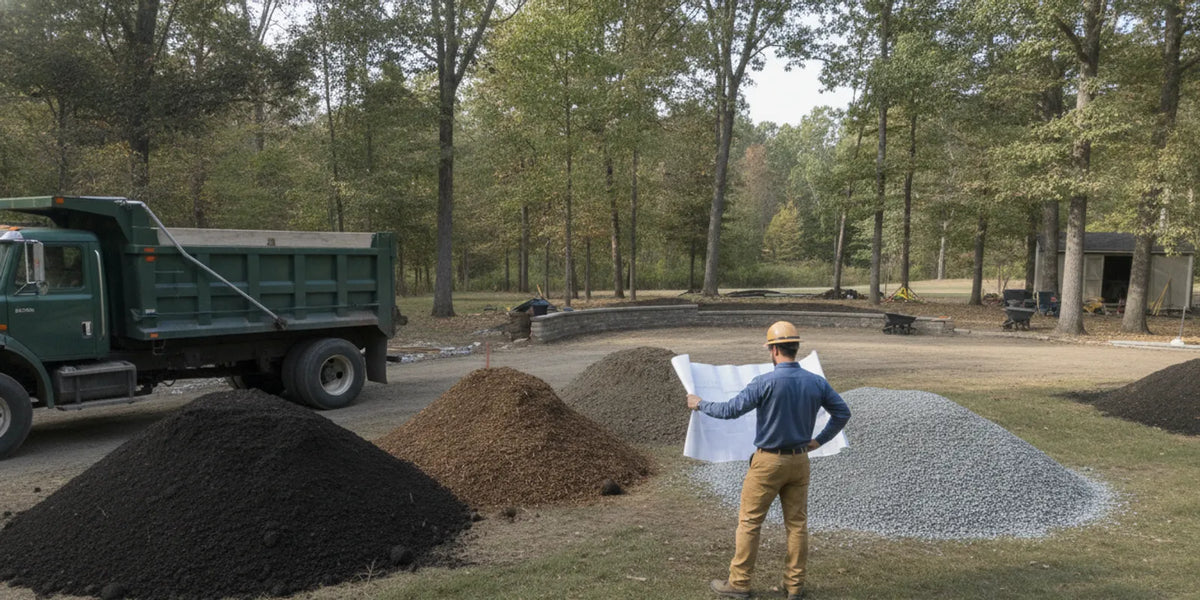
When planning a bulk order, choosing between cubic yard vs ton landscape materials is not just a matter of switching units. A cubic yard measures volume, while a ton measures weight, and the relationship between them changes with material type, density, moisture, and handling. For contractors and commercial buyers, the safe approach is to estimate the job in the unit that matches the work, then confirm product-specific supply details before ordering.
Ask about a project quantity or quote
What does a cubic yard measure?
A cubic yard is a volume measurement. It describes a space that is one yard long, one yard wide, and one yard deep. In feet, that is a three-foot cube, or 27 cubic feet. The unit is useful when a project is planned by the area to cover and the depth to install. Mulch, compost, many soils, and some fill materials are commonly discussed by volume because the buyer needs to spread a layer or fill a defined space.
Volume is a natural planning unit for a bed, planting area, or broad grading zone. If a crew knows the area and desired depth, it can calculate the approximate volume required before checking how the supplier sells a specific product. The cubic-yard result is a planning quantity, not a guarantee that every pile will have exactly the same shape, settle the same way, or yield identical coverage under different jobsite conditions.
A cubic yard also does not tell you the material’s mass. One cubic yard of a light, loose material can weigh much less than one cubic yard of a dense aggregate. This is why a cubic yard cannot be translated into a fixed number of tons without product-specific information. Treating volume as weight, or weight as volume, can lead to an order that is too small, too large, or unsuitable for the equipment and delivery plan.
What does a ton measure?
A ton is a unit of weight. When a supplier sells a landscape material by the ton, the transaction is based on mass rather than the space the pile occupies. Stone and gravel are often ordered this way, as are some sands and other heavy materials. A weight-based unit can suit products that are measured, loaded, and sold by scale weight.
Weight alone does not indicate how much ground a material will cover. Coverage depends on how much volume a given weight occupies and on the project’s finished depth. The physical form matters too: a coarse stone does not fill space in the same way as fine particles, and a loose pile can have voids between pieces. A project plan should therefore specify the product, the area, and the installation depth rather than relying on a ton count without context.
For a contractor, tons can be practical when the product listing and quote use that unit and the work is being planned around an aggregate specification. For a homeowner or property manager, the same unit can be less intuitive if the immediate question is how many beds or square feet a load will cover. In either case, the correct response is not to choose the unit that sounds larger or smaller. It is to connect the unit to the material and the finished work.
Why can’t you use one conversion for every material?
Converting volume to weight requires knowing the material’s density under the conditions relevant to the order. Density describes how much mass is contained in a given volume. Materials with different composition and particle sizes have different densities. Even within a general category such as soil or stone, product specifications can vary. A generic conversion copied from a chart may therefore be a poor match for the particular product being sold.
Moisture is another variable. Water adds weight, and the amount of moisture in a bulk material can change with storage, weather, and handling. A cubic yard of relatively dry material may not have the same weight as a cubic yard of a wetter batch. A conversion estimate that ignores moisture can be misleading, especially when a buyer is using the estimate to compare a volume-based quantity with a weight-based quote.
Particle size, grading, compaction, and void space also affect how a load behaves. A pile of larger stones contains spaces between pieces. Finer material may occupy some of those spaces, depending on the blend. Material that has been disturbed, compacted, or heaped can also occupy a different volume than a loose, level measure. The practical lesson is simple: do not assume that all products sold under a broad name share a universal pounds-per-cubic-yard or tons-per-yard value.
Conversion can also be confused with coverage. Even if a reliable density value is available, it only helps translate weight to volume. To estimate coverage, the buyer still needs the area and depth, plus an understanding of how the material will be placed and finished. A correct unit conversion does not automatically determine the right order quantity for a project.
Which unit should you use to plan the job?
Start with the work the crew must complete, not the unit shown first on a product page. If the task is to spread a measured layer over an area, calculate the approximate volume from area and depth, then check whether the chosen product is offered by the cubic yard, ton, bag, or another unit. If the task is to place aggregate to a specified depth or meet a construction detail, follow the material specification and supplier’s unit for that product.
For example, a landscape contractor planning a new bed may measure the bed’s footprint and decide how deep the mulch layer should be. That yields a volume-oriented estimate. The contractor should then confirm the selected mulch, the regional listing, the unit sold, delivery options, and any separate placement or installation scope. The calculated volume guides the order; it does not replace confirming the product’s actual sales unit.
For a gravel base, a plan may call for a particular aggregate and finished depth. In that case, use the project’s material specification and ask the supplier whether the product is quoted by weight or volume. If the product is sold by ton, ask for the supplier’s product-specific estimate of how the amount relates to the planned coverage. Do not silently substitute one gravel grade for another simply because a rough conversion appears to produce the same number.
Some projects include more than one type of work. A site might need topsoil in planting areas and stone on a drive or access path. Keep the quantities separate by product, unit, and destination. Combining them into one estimated total obscures important differences in density, intended depth, delivery access, and how each material will be placed.
How can you estimate a volume-based quantity?
For a simple rectangular area, estimate the length and width in the same unit, calculate the area, and multiply by the planned depth. Keep the units consistent. If the dimensions are in feet, calculate the volume in cubic feet and divide by 27 to express it in cubic yards. The arithmetic gives an initial planning figure. It does not account for every contour, irregular bed edge, settlement, or field adjustment.
Basic planning formula: length in feet × width in feet × depth in feet ÷ 27 = approximate cubic yards.
Suppose a rectangular planting area is 12 feet long and 9 feet wide, with a planned layer 3 inches deep. First convert the depth to feet: 3 inches is one quarter of a foot. Then multiply 12 by 9 by 0.25, giving 27 cubic feet. Dividing by 27 gives an initial estimate of one cubic yard. This example demonstrates the arithmetic only. It is not a recommendation for a specific product, depth, or order size.
For multiple sections, calculate each area separately and add the volumes after checking that the target depth and material are the same. For a project with a mixture of depths or products, keep separate lines on the takeoff. A clear breakdown makes it easier to review the estimate, identify measurement mistakes, and match each quantity to a product listing or quote.
Irregular shapes can be split into simple rectangles, triangles, or other manageable sections. If the site has slopes or changing grades, a single average depth may conceal the actual amount needed. Use the project plans or field measurements that suit the job, and ask the designer, estimator, or supplier when the required depth is uncertain. Do not use a rough area calculation as a substitute for design requirements or compaction specifications.
Where a supplier offers a calculator, use it as an aid and inspect the inputs. The result depends on the dimensions and depth entered, and may not include delivery, placement, installation, taxes, product-specific density, or site conditions. For product selection and fulfillment, begin at the store and warehouse selector so the appropriate location and regional product information can be checked. Availability and delivery eligibility should be confirmed for the address rather than assumed from a general estimate.
How should you think about a ton-based estimate?
When the product is sold by weight, first record the project’s intended material and specification. Then measure the area and required depth, if coverage is the planning goal. Share those details with the supplier and ask what quantity in the listed unit is appropriate for that product. The supplier’s guidance should relate to the specific material and job rather than a broad conversion pulled from an unrelated source.
If you already have a volume estimate and need to compare it with a ton-based quote, ask the supplier to explain the assumptions behind the comparison. Useful questions include: Which exact product and grade does the estimate cover? Is the density value product-specific? Does moisture affect the estimate? Is the quoted amount measured by scale weight? What level of coverage or depth does the estimate assume? These questions help reveal whether two quotes are actually describing equivalent quantities.
Be cautious about comparing a listing priced by the ton with another listing priced by the cubic yard as though the unit alone determines value. The products may differ in composition, size, region, availability, delivery route, or fulfillment terms. A fair comparison requires matching the material specification and quantity basis, then checking what is included in each price. Delivery, taxes, placement, and labor may be separate from the material price.
Product pages may show different units for different materials and regions. Review the product name, unit, and location qualification together. For instance, a regional aggregate selection can help identify products to discuss, but it does not establish that every option is stocked at every warehouse or eligible for delivery to every address. Confirm the location-specific offering before treating an online example as a project commitment.
How do cubic yards and tons compare in practice?
The table below is a planning comparison, not a conversion chart. It shows how to decide what information to gather before setting an order quantity. The product’s published unit and supplier confirmation control the actual order.
| Planning question | Cubic-yard approach | Ton approach | What to confirm |
|---|---|---|---|
| What is being measured? | Volume, or the space occupied | Weight, or mass | Which unit the exact product is sold in |
| What job detail is most useful? | Area and intended depth | Product specification and required weight quantity | How the project plan describes the material and finished work |
| What can change a comparison? | Material type, moisture, particle size, settling, and how it is measured | Density assumptions, moisture, product grade, and weighing method | Whether a supplier’s conversion estimate applies to the actual product |
| What does the unit not tell you? | Exact mass or universal coverage | Exact volume or coverage without a product-specific basis | Depth, access, placement scope, or delivery charges |
| Best next step | Calculate approximate volume, then match it to the listed sales unit | Share the project details and request product-specific quantity guidance | Confirm location, stock, quote scope, and delivery eligibility |
Use the table to structure a conversation, not to replace one. The two approaches are complementary: area and depth help define the work, while the supplier’s unit defines how the material is offered and measured. A reliable order connects those two pieces with a product-specific estimate.
What details should contractors collect before requesting a quote?
A complete request saves time because it lets the supplier assess the material, quantity, and fulfillment path together. Before asking for a project quote or order estimate, gather the following information:
- Project location: Provide the job address or ZIP code and note any separate delivery destination. Service eligibility and warehouse availability are location-specific.
- Product and use: Name the desired material and explain whether it is for planting, finish grading, a base, drainage, access, or another purpose. A broad label such as “soil” or “stone” may not identify the right product.
- Measurements: Share area, depth, and the method used to estimate them. Include separate dimensions for areas with different depths or materials.
- Order unit: State whether your takeoff is in cubic yards, tons, or another unit, and ask how the selected product is sold. Do not convert without noting the assumptions.
- Schedule: Give the desired work sequence and a realistic delivery period. A requested date is not a guaranteed delivery window; confirm available scheduling for the location and project.
- Access and unloading: Describe the road, gate, overhead clearance, turning space, surface conditions, slope, and the location where the material must be placed or unloaded.
- Fulfillment scope: Clarify whether you need material pickup, delivery, slinger placement, installation, or a separate service quote. These are different scopes and should not be assumed to be included together.
Contractors can make the request more useful by attaching a simple site sketch or clearly labeling areas on a plan. Identify the quantity and material for each area. If the plan includes a specified stone gradation, soil type, or finished depth, include that detail exactly rather than paraphrasing it. If plans are preliminary, state that the quantity is an estimate and may change after field verification.
For recurring commercial work, keep a record of the calculation method, product name, unit, date, supplier guidance, and final quantity used. That record can help with future estimating, but it should not be treated as a permanent conversion rule. Product batches, moisture, project design, and fulfillment conditions may differ from one order to the next.
How does pickup, delivery, or slinger placement affect the plan?
The unit calculation answers only how much material may be needed. It does not determine how the material reaches the work area. Pickup, ordinary delivery, conveyor-based slinger placement, and installation are separate ways to fulfill or complete a project. Decide which pathway fits the jobsite before finalizing the order quantity, timing, and crew plan.
Pickup may suit a buyer with an appropriate vehicle and a manageable quantity, but confirm the product, location, loading arrangements, and the vehicle’s capacity and legal limits. A material sold by volume still has weight, and the actual load weight matters for safe transport. Do not infer that a vehicle can carry a particular quantity merely from its cargo-space volume.
Delivery can move bulk material to the site, but delivery does not necessarily mean that the material is installed or placed at the exact point of use. Confirm unloading location, access, delivery terms, and whether the service is available for the address. Shipping estimates and charges depend on the order and location; review the checkout information and any written quote rather than assuming the material price includes transport.
Slinger placement uses a conveyor to place eligible material where ordinary dumping may not be suitable. It is a placement method, not a unit conversion and not the same as mulch blowing. The amount a crew can place and the reach possible at a particular site depend on material, equipment, access, setup, and job conditions. For a project involving placement, review the slinger service information and request project-specific qualification.
Installation involves work beyond supplying material or unloading it. Clarify who is responsible for preparation, spreading, grading, forming, finishing, or other labor required by the project. For example, a material order should not be mistaken for a full installation scope. If the job needs a turnkey concrete installation quote, discuss the complete project scope separately from a concrete supply question.
Make sure the crew schedule reflects the actual fulfillment method. A bulk delivery arriving at a convenient time still may need an accessible staging area and equipment to move the material into place. A slinger job requires suitable truck access and a workable placement path. If the jobsite cannot support the planned method, the crew may need to adjust staging, order timing, or the scope. Share constraints early rather than adding them after the quantity and schedule are set.
How should buyers compare two supplier estimates?
Start by checking whether each estimate covers the same material and use. Product names that sound similar may refer to different sizes, blends, or regional offerings. Compare the product description and intended application, not just the broad category. If one quote uses a cubic-yard quantity and another uses tons, ask for the assumptions that connect each quantity to the required coverage or project specification.
Next, compare the actual commercial terms. Record the unit price, quantity, delivery or pickup method, separate transportation charges, taxes, placement or labor charges, and any minimums or other conditions stated in the quote. Do not treat an online unit price as a complete installed cost. An order delivered to a site and an order that includes material placement are not automatically equivalent.
Then review the schedule and site assumptions. Ask whether the estimate is based on a particular delivery address, unloading location, access route, or equipment setup. A quote based on a simple roadside dump may not cover conveyor placement through a restricted access route. Similarly, a volume estimate based on a level area may not apply to a sloped site or a variable-depth installation.
Finally, confirm how long the quote remains valid and whether it is a firm project quote or an estimate subject to verification. Do not assume availability, a delivery time, or a specific material quantity from an old estimate. For a new job, confirm current location-qualified information and keep the response with the project file.
What ordering mistakes can create avoidable rework?
One common mistake is treating a generic conversion as a product fact. An internet chart may be useful for a rough educational comparison, but it may use a different material, moisture condition, or measurement basis. If a small difference matters to the project, ask for a product-specific estimate instead of disguising an approximation as an exact quantity.
Another mistake is mixing units on the takeoff. A list that combines cubic yards, tons, and truckloads without showing the corresponding product and assumptions is difficult to audit. Keep a separate line for every product and unit. If a conversion is used, document who supplied it, what it applies to, and whether it is an estimate or a specification.
Buyers can also overlook depth. An area measurement without a planned depth cannot produce a useful volume estimate. Conversely, a quantity in tons without a target area or project specification cannot reliably show how much coverage it provides. Confirm the design depth with the project plans or appropriate project lead before calculating an order.
Do not assume that all material delivered to the site is in place and ready for use. Delivery, dumping, slinger placement, and installation are distinct. Confirm the exact scope in writing, especially when the project requires a particular placement location, grading finish, or labor sequence.
Finally, avoid ordering from an unqualified regional listing. A material may be listed for a specific state or warehouse, while stock and delivery options vary. Check the location selector and product listing before planning the crew around an assumed supply source. If online information does not answer the question, ask directly rather than making the order plan depend on an unconfirmed detail.
What is the practical quantity-planning workflow?
- Define the finished work. Identify each area, its intended use, and the required depth or material specification. Separate unlike tasks rather than averaging them together.
- Measure the project. Record length, width, area, depth, and notable slopes or irregular boundaries. Use the project plan or verify dimensions in the field where appropriate.
- Estimate in the unit that fits the work. Calculate a preliminary volume for a spread layer or use the specified weight basis where the plan calls for it. Label all assumptions.
- Select a product and verify its sales unit. Review the regional product listing and check whether it is sold by cubic yard, ton, or another unit. Match its description to the application.
- Ask for product-specific guidance. If you need to compare volume and weight, ask the supplier what conversion or coverage assumptions apply to that material. Avoid imposing a generic value.
- Choose the fulfillment method. Decide between pickup, delivery, or a separately scoped placement or installation service. Confirm access, timing, and charges.
- Confirm before dispatch. Verify product, quantity, unit, location, schedule, order terms, and jobsite details. Keep the final confirmation with the job documentation.
This process keeps the estimate traceable. If the project changes, update the measurements and quantity rather than adjusting a conversion number without understanding its basis. For a commercial bid, note which dimensions came from the drawings and which are field-verified so the estimator and supplier are working from the same information.
What information belongs in an order request?
A concise order or quote request can still be specific. Include the project address, desired material, intended use, approximate quantity and unit, dimensions or plan reference, and preferred fulfillment method. Mention whether you need material only or a separate service. If there are access limitations, include them in the first conversation.
For a volume-based estimate, state the area and depth rather than sending only a cubic-yard figure. For a weight-based estimate, state the product specification and the work the material must perform. If you are comparing two unit types, say so and request the assumptions for each. That helps avoid a response based on a different product or an unrelated conversion.
Contractors working across multiple sites should avoid reusing one site’s delivery details for another. Address, warehouse, access, staging, and local availability can change. Likewise, do not copy the quantity from a prior project just because the site area seems similar; differences in grade, depth, and material can change the requirement.
For retail material orders, the soil selection and the relevant product page can help narrow the question to a specific listing. A buyer considering a mulch order can review a listed mulch product and verify the location-specific unit and fulfillment details. Catalog information is a starting point, not confirmation that an item is available at every location.
Use the Sagamore Companies website to begin product selection, and use the store selector to identify the relevant warehouse before completing a product order. Online checkout provides the applicable shipping estimate for the order. For a project-service scope such as slinger placement, concrete work, or commercial processing, request a quote so the work and site can be qualified separately.
Request product or project guidance
How should you handle changing moisture and site conditions?
Moisture is one reason to treat conversions as estimates rather than fixed rules. Bulk material can be stored outdoors and exposed to changing weather. A wet load may weigh more than a drier amount with the same apparent volume, while the product’s shape and packing can affect the space it occupies. The buyer may not be able to determine these variables from a product name or photograph alone. If the difference matters to a bid or engineered specification, ask for the information the supplier can provide and keep the project professional’s requirements in control.
Site conditions can change the quantity needed even when the material itself is consistent. An uneven subgrade, settling, soft ground, existing vegetation, or a change in finished grade can alter the depth needed. A takeoff based on a simple rectangle may also leave out narrow strips, transitions, and areas around obstacles. Before placing a large order, compare the measurement with site plans and field observations. If the drawings and actual grade disagree, resolve the discrepancy with the project lead rather than trying to compensate through a guessed conversion.
For repeat work, record both the estimated and actual quantity and note any conditions that explain the difference. This may improve future takeoffs for similar jobs, but it should not become a blanket material conversion. A previous soil order does not establish the weight of a different soil, and one stone project does not set coverage for another stone size or depth. Retain the record as project history, then verify the next product and scope independently.
When comparing a delivered amount with the quantity installed, remember that the remaining pile may include a staging reserve or material intended for another section. The job record should distinguish what was ordered, what was delivered, what was placed, and what remains. That distinction makes change orders and closeout discussions clearer. It also helps an estimator determine whether an apparent shortage came from measurement, scope changes, access constraints, or the way the material was used.
How can you build a clearer material takeoff?
Organize the takeoff as a short schedule rather than a single total. Include one row for each distinct material and work area, with columns for location on site, intended use, dimensions, depth, calculated volume, listed sales unit, and questions to confirm. This lets a reviewer see which figures are measured and which are still assumptions. It also reduces the risk of requesting a quote for an unclear mix of products and units.
Label dimensions consistently. If some measurements are in feet and others in yards or inches, convert them before doing the calculation and write down the converted depth. For a sloped or irregular area, describe the method used to estimate the average depth. If the project specification gives a compacted depth but the product is delivered loose, do not assume those are the same basis; ask the project designer or supplier how the quantity should be specified.
For phased work, list quantities by phase and identify where each load can be staged. A single total can hide a logistical issue if the site has limited storage or if different areas must be completed on separate days. Confirm whether a partial delivery or a later top-up is practical and what charges or scheduling conditions may apply. Do not assume that a multi-phase plan is included in one material quote.
Before sending the takeoff, ask a colleague to check the arithmetic and unit labels. A quick review can catch a missed conversion from inches to feet, a duplicated area, or a mistaken assumption that a ton and cubic yard mean the same thing. Keep the calculation method available so the supplier can identify where its product-specific guidance fits into the plan.
Frequently asked questions
Is one cubic yard always equal to a fixed number of tons?
No. A cubic yard is volume and a ton is weight. The weight of a given volume depends on the particular material and conditions such as density and moisture. Use supplier information for the actual product rather than assuming one universal conversion.
Should I estimate mulch by cubic yard or by ton?
Begin with the area and depth needed for the work, which gives a volume-oriented planning estimate. Then check how the specific mulch product is sold at the appropriate location and confirm the order unit. Do not assume that every listing uses the same unit or that a general conversion is exact.
Can I use a ton estimate to determine how many square feet a load covers?
Not by itself. Coverage also depends on the material, its volume per unit of weight, and the intended depth. Share the product and target area or specification with the supplier and request a product-specific estimate.
Does a delivery quantity include placement or installation?
Not necessarily. Material supply, delivery, slinger placement, and installation are distinct scopes. Confirm in the order or quote what the service includes, where the material will be unloaded or placed, and whether labor is separate.
What should I do if a product page and my estimate use different units?
Keep the original estimate and product unit visible, then ask the supplier to reconcile them for the exact material. Provide the project dimensions, required depth or specification, and location. Do not convert silently or substitute another product based only on a similar-looking quantity.
What is the next step for a reliable order?
Use cubic yards to think through volume-based work and tons when the material or specification is weight-based, but do not treat the units as interchangeable. Record the product, measurements, depth, location, and fulfillment needs, then ask for confirmation where density or conversion matters. A product-specific quantity check is the practical bridge between a project estimate and an order that fits the job.