
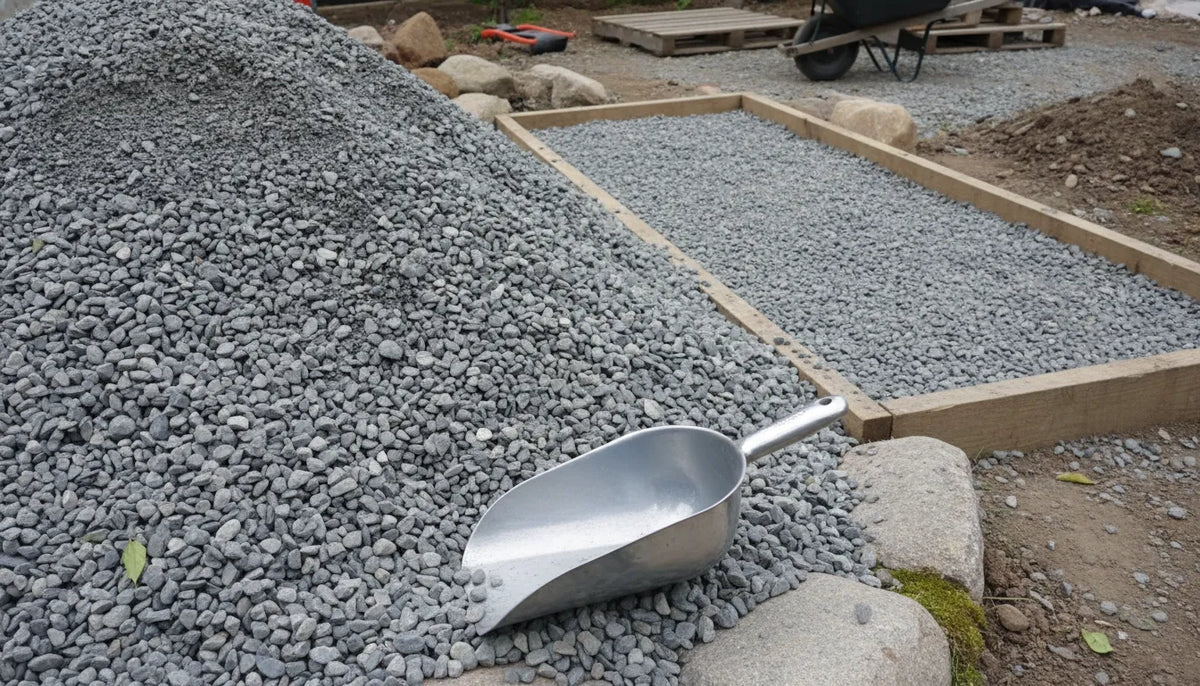
When someone asks how much is a ton of gravel, they may be asking two different questions: how much material a ton represents, and what the order will cost after the stone, fulfillment method, and jobsite details are known. A US short ton is 2,000 pounds, but the area that one ton covers depends on the stone, its depth, moisture, and how it is placed. The right answer starts with the project, not a one-size-fits-all number.
Call (330) 656-5720 to discuss your gravel quantity and delivery options.
What a ton of gravel actually means
A ton is a weight measurement. It does not describe a fixed pile shape or a guaranteed number of cubic feet. Two tons of different aggregates can occupy different volumes because stone size, shape, density, and the amount of void space between pieces vary.
That distinction matters when you are ordering for a driveway, drainage trench, walkway, landscape bed, or construction base. A supplier may sell a material by the ton while the project plan is written in inches, square feet, or cubic yards. Those measurements need to be reconciled before ordering.
- Weight: One US short ton equals 2,000 pounds.
- Volume: The space occupied by that ton changes with the material and how it is spread.
- Coverage: The area a ton covers depends mainly on the planned depth and the material's bulk density.
- Order total: The final amount depends on the selected product, location, warehouse, availability, fulfillment method, and any separately quoted placement or project work.
For that reason, use a ton as the purchase unit only after you have a reasonable quantity estimate. If you are unsure whether a rounded drainage stone, angular driveway stone, or compactable base is appropriate, compare the available gravel and other aggregates before choosing a product.
How much area does one ton cover?
There is no single coverage figure that applies to every ton of gravel. A shallow layer covers more square feet than a deep structural layer, and a coarse rounded stone may settle differently from a finer, angular aggregate. The best estimate uses the project's square footage and the planned depth.
The basic coverage calculation
Start by calculating the area in square feet:
Length in feet × width in feet = square feet
Then convert the planned depth from inches to feet and calculate the volume:
Square feet × depth in feet = cubic feet
From there, the cubic-foot estimate can be converted to cubic yards by dividing by 27. A supplier can then help translate the estimated volume into tons for the specific product. Do not assume that a generic online tons-to-yards conversion will match every stone. The product's density, grading, moisture, and the amount of compaction all affect the result.
As a simple planning example, a 20-foot by 10-foot area is 200 square feet. A two-inch layer is one-sixth of a foot, so the unadjusted volume is about 33.3 cubic feet, or roughly 1.23 cubic yards. That is a volume estimate, not a final tonnage recommendation. Add the product-specific density and an appropriate allowance for settling, grade variation, and jobsite conditions before placing the order.
Why depth changes the answer
Depth is often the biggest difference between a small and large order. A decorative ground-cover layer, drainage trench, driveway surface, and compacted base do not serve the same purpose or use the same thickness. A project that needs a stable base may require several inches and compaction, while a light landscape application may use a shallower layer.
Do not increase depth simply to use extra material, and do not reduce depth to force a lower order quantity. Thin or uneven placement can leave low spots and exposed soil. Excess material can change grades, block drainage paths, bury edging, or create an unstable surface. Confirm the design depth with the installer or project plan, especially when the aggregate supports pavers, a driveway, a foundation drain, or a concrete-related application.
Which gravel should you order by the ton?
The word “gravel” covers several materials. Stone size and shape are not just appearance details; they affect drainage, compaction, traction, and the finished surface. A material that works well around a foundation may not be the right material for a vehicle-bearing driveway.
| Material | Product details to consider | Project-planning question |
|---|---|---|
| Gravel #57 | Approximately nickel- to quarter-sized and rounded; used for drainage, French drains, foundation drain tile, walkways, and ground cover. | Does the project need water to move through the stone rather than a tightly compacted driving surface? |
| Gravel #34 | A larger rounded drainage stone used around drain tile, in French-drain applications, on walkways, and as decorative ground cover. | What trench, drainage, or low-traffic landscape application is the stone intended to serve? |
| Gravel #8 | A by-the-ton aggregate described for drainage, landscape, utility, and other property applications where a finished stone surface is needed. | Will the stone be used for drainage or landscape work rather than a compacted structural base? |
| Limestone #57 | Nickel- to quarter-size angular limestone that interlocks for a stable, weight-bearing surface and can be used for driveways, drainage, and concrete-related base work. | Does the project need angular stone that can lock together under traffic or weight? |
| #411 limestone | A mixture of #57 and #10 limestone used as a compactable base for pavers, sheds, wallstone, driveway work, and low-area or pothole repair. | Is the order for a base layer that will be spread and compacted rather than left as loose drainage stone? |
This comparison is a starting point, not a substitute for the project specification. The same word, such as “driveway,” can describe a new base, a surface refresh, a pothole repair, or a decorative drive. Each use may call for a different material and depth.
Related products

Warm, natural tones add visual texture to outdoor projects.
View product
Looking for the perfect stone to accent your garden?
View product
Estimate the area and depth, then confirm your order quantity by the ton.
View productWhy #57 gravel is not always the right driveway stone
Gravel #57 is a common search term because it can be useful for drainage and landscaping. Its rounded pieces are approximately nickel to quarter sized. That shape helps create voids for water movement, which is useful around foundation drain tile and in French-drain applications. It can also work for walkways and ground cover when the application is appropriate.
Those same rounded pieces do not compact like angular limestone. For that reason, the product guidance does not position #57 gravel as a good driveway material. A vehicle surface usually needs a material that forms a more stable, weight-bearing layer. If the goal is a driveway, ask whether a product such as angular Limestone #57 or a compactable #411 base is better suited to the specified layer.
Choosing the right product before calculating tonnage avoids a common mistake: ordering the correct amount of the wrong stone. If the job includes several layers, keep the drainage stone, base material, and surface aggregate separate in the takeoff and in the order conversation.
What affects the cost of a ton of gravel?
A product page or checkout total is not a universal price for every order. Gravel cost changes with the product, location, warehouse, order date, availability, and fulfillment method. Delivery, taxes, labor, placement, and other charges may be separate. Confirm the current product and shipping details for the address before treating an estimate as a final order total.
Material selection
Decorative stone, drainage gravel, limestone, screenings, and compactable blends can have different sourcing and handling costs. Even products that look similar may be graded or processed for different uses. Start with the product that fits the application, then compare the order details for that product.
Quantity and minimums
A tonnage estimate that is too low can create a second delivery, a visible shortfall, or an unfinished drainage layer. An estimate that is too high leaves unused material and may require additional handling. Measure the project in sections when the grade or material changes. Add only a reasonable allowance for uneven ground and settling, and ask for help when the calculation crosses multiple products.
Distance and fulfillment
Shipping estimates depend on the delivery address, the supplying warehouse, route requirements, and the selected product. Not every stone is available at every location. Checkout establishes the shipping estimate for a qualified address, so use the location selector and product details rather than assuming that a material shown online can be delivered everywhere.
Access and placement
Dumping material near the curb is different from placing it at the back of a property, beside a foundation, or along a narrow path. If the project needs equipment-assisted placement, ask about separately scoped slinger placement and jobsite access. The product page for #57 gravel notes that it is commonly slung into place, but delivery does not automatically mean that placement labor is included.
Before scheduling, identify overhead wires, gates, soft ground, retaining walls, low branches, slopes, and the location where the truck can safely work. A placement plan can affect labor, equipment, and the amount of material that can be handled efficiently.
How to estimate your gravel order before checkout
- Define the use. Write down whether the material is for drainage, a French drain, foundation drain tile, a walkway, ground cover, a driveway, paver base, or another application.
- Measure each section. Record length, width, and planned depth separately for each area. Use feet for length and width, and convert inches to feet for the calculation.
- Choose the material. Match the stone's size and shape to the job. Rounded drainage gravel and angular compactable limestone should not be treated as interchangeable.
- Convert volume to a product-specific tonnage. Use the supplier's guidance for the selected stone. Do not rely on a single generic conversion for every aggregate.
- Check location and availability. Confirm the serving warehouse, address eligibility, current inventory, and fulfillment method. Availability may vary by location.
- Plan access and placement. Decide where the load can be dumped and whether the job needs separately quoted slinger placement or other project services.
- Review checkout and delivery details. Treat the checkout shipping estimate and product-specific order information as the current source for the purchase decision.
For a contractor, keep the takeoff and the supplier order aligned. Note the product name, size, intended layer, estimated tons, delivery address, requested date, and any placement notes. For a homeowner, photographs and a simple sketch of the area can make a quantity conversation much more productive.
Can one ton be delivered and placed in the exact spot?
That depends on the address, access, selected product, and the scope of work. Standard delivery and equipment-assisted placement are separate considerations. A slinger may be useful when the material needs to travel beyond a driveway or be placed along a foundation, but the site must be evaluated for access and safe operation.
Keep the material order and the placement question distinct. The store can support a qualified product purchase, while project-specific placement or installation requires confirmation of the jobsite and scope. Do not assume that a product's delivery option includes grading, spreading, compaction, trench preparation, or installation labor.
What to ask before ordering a ton of gravel
- Is the selected stone appropriate for the intended use and traffic level?
- Is the quantity expressed in tons based on the actual product rather than a generic conversion?
- What depth is required after spreading and compaction?
- Is the product available from the warehouse serving the delivery address?
- Are delivery, taxes, labor, placement, or other charges separate from the material?
- Can the truck access the planned drop point without damaging pavement, lawn, utilities, or structures?
- Would a different product be more appropriate for a driveway base, drainage layer, walkway, or decorative finish?
These questions turn “how much is a ton of gravel” into an order that is more likely to fit the job. The material cost is only one part of the decision; choosing the correct stone, estimating the right quantity, and planning delivery can prevent rework.
Get a gravel quantity and fulfillment check
Start with the aggregates collection to compare gravel, limestone, and other available stone products. For a product-specific answer, have the material name, measured area, planned depth, delivery address, and access details ready. Sagamore serves customers in Northeast Ohio and the Charlotte, NC metro area, with availability and fulfillment confirmed by product and address.
