
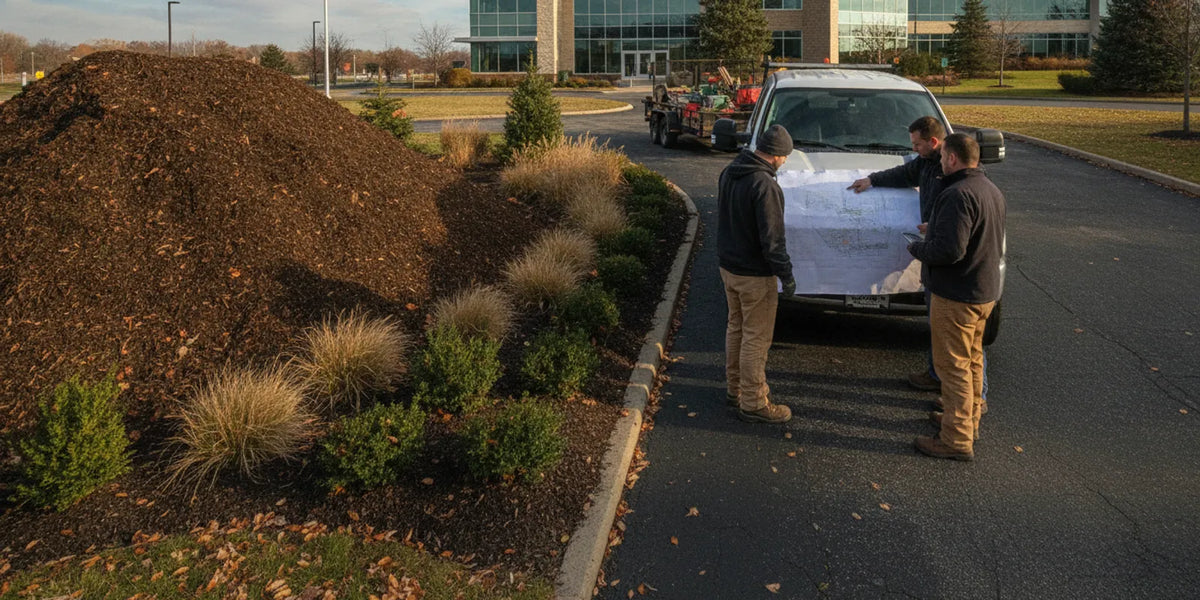
Planning mulch contractor supply Hudson OH work means coordinating the material, quantity, fulfillment method, and jobsite conditions—not simply picking a color. Landscape contractors and commercial buyers need to know what the specification calls for, where the product will go, and what a delivery or placement quote actually covers. Sagamore Companies supplies landscape materials across a regional network, but warehouse availability, address eligibility, and project services must be confirmed for the specific order. Use this guide to prepare a clear, practical plan before you schedule a crew.
Discuss a Hudson-area mulch order
What should a contractor confirm before ordering mulch near Hudson?
Start with the job requirement rather than a supplier’s product label. The landscape plan, planting specification, property standard, maintenance agreement, or project owner may identify a particular mulch, color, texture, or installation depth. Put those requirements in front of the person who will place the order. If substitutions are allowed, find out who can approve one and what characteristics must stay the same. A delivery crew should not have to interpret a contract or choose between products at the gate.
Then write down the basic order facts: intended use, product, measured area, specified depth, estimated volume, delivery address or pickup warehouse, and preferred date range. Record whether the requested scope is material only, material delivery, slinger placement, or separately coordinated installation. Those terms describe different work. Use the store and warehouse selector to identify the location relevant to the purchase, then check product availability and fulfillment details for that location. Product options and stock are not necessarily identical from one warehouse to another.
- Purpose: new planting, bed refresh, playground surfacing, erosion-related work, or another use named in the project documents.
- Specification: requested material, color, particle characteristics, and any limits on alternatives.
- Takeoff: measured area, specified depth, calculated volume, and units used in the estimate.
- Fulfillment: pickup, delivery to a drop point, conveyor-assisted slinger placement, or a separate installation inquiry.
- Site conditions: approach route, tightest gate, overhead clearance, surface, turning area, unloading point, and access hours.
- Schedule: target date, acceptable delivery range, receiving contact, and how much flexibility the crew has.
- Commercial coordination: project number, property manager or general contractor contact, and any site check-in or documentation process.
For a multi-property maintenance contract, do not treat a regional product listing as a confirmation for every address. Check each property separately. A material that is available at one warehouse may not be stocked at another, and a general service-area description does not establish eligibility for every ZIP code or jobsite. Confirm the exact address, requested material, chosen location, delivery method, and quantity before promising a date to a client or assigning labor.
A simple order brief is useful when several people are involved. Give the estimator and crew the same product name and unit, then identify which beds receive that material. If the account manager requests one product but the site supervisor expects another, the crew can lose time resolving a preventable mismatch. Keep the approved specification, takeoff, quote, and delivery instructions together so changes can be traced and confirmed.
Which mulch details matter for a commercial job?
Mulch is not a single interchangeable material. Composition, color, texture, and intended use influence whether it meets a project’s visual and practical requirements. A property manager may care about a consistent appearance across entrances and planting beds; a contractor working from plans may need to match a specified product; a maintenance team may prioritize a repeatable order they can identify next season. Decide which characteristics are mandatory and which are preferences before comparing options.
Confirm how the product is named and sold at the selected location. A familiar color description may not be enough to distinguish one product from another, especially if the estimate, listing, and project documents use different names. If the specification calls for a named mulch, compare the actual listing rather than assuming a similarly named product is an approved substitute. Where there is uncertainty, ask the project owner or supplier to clarify before loading or dispatch.
Unit matters too. Bulk mulch is often estimated by volume, while packaged products may be listed by bag or another unit. Make sure the takeoff, quote, and order all use the same unit. If a supplier estimate is expressed differently from the contractor’s worksheet, convert and record the calculation instead of comparing the raw figures. Do not assume that a product’s unit price includes delivery, taxes, labor, placement, or other charges.
For properties with several bed types, divide the scope into zones. A front entrance, tree ring, long foundation bed, and back-of-site planting area may need different products, depths, or drop points. Give each zone an identifier such as A, B, and C on the site plan. This is especially helpful when a single project has a public-facing area with a strict color requirement and less visible beds with a different approved material. The split makes it easier to check quantities and communicate any substitution without reworking the full order.
For recurring work, preserve a short material record: product name, supplying location, approximate quantity, date, and the areas covered. That record does not replace a new measurement or stock check, but it gives the next estimator a practical starting point. If the property’s plan changes, compare the previous material against the current specification rather than repeating the old order automatically.
How can you estimate the amount of mulch?
Measure each bed’s surface area and use the depth named in the approved plan or scope. For a rectangular bed, multiply length by width. For a long curved bed, break it into manageable sections, such as rectangles and triangles, then total the estimated areas. For a circular tree bed, estimate the radius and use the circle’s area formula; for an irregular shape, make a practical sketch and split it into simple shapes. The goal is a documented takeoff, not false precision.
A common volume-planning calculation is:
Area in square feet × depth in inches ÷ 324 = approximate cubic yards.
For example, a rectangular bed 45 feet long and 36 feet wide has an area of 1,620 square feet. If the approved scope calls for a depth of 3 inches, the calculation is 1,620 × 3 ÷ 324, or 15 approximate cubic yards. That result is a planning estimate, not a guarantee of the exact order quantity. Edges, slopes, existing material, soil shape, bed borders, and the installation approach may affect what the project needs.
For multiple beds at one depth and using one product, calculate each bed separately and add the results. Suppose a property has three beds measuring 1,620, 720, and 360 square feet, all planned at 3 inches. The combined area is 2,700 square feet, so the same formula gives 25 approximate cubic yards. If one bed needs a different depth or product, keep it separate: combining all areas before checking those differences can conceal an incorrect assumption.
For mixed depths, work zone by zone. For instance, calculate a 900-square-foot entrance bed at the plan’s 2-inch depth separately from a 1,200-square-foot perimeter bed specified at 3 inches. The first estimate is 900 × 2 ÷ 324, or about 5.6 cubic yards; the second is 1,200 × 3 ÷ 324, or about 11.1 cubic yards. The resulting total is about 16.7 cubic yards before reviewing the site-specific allowance or quote. Keeping the two figures separate helps the buyer see which assumptions drive the total.
Do not replace the project depth with a generic rule of thumb. If the plan specifies an installation depth or method, follow that direction and ask the responsible project contact about any ambiguity. Also determine what happens to existing mulch: will it be removed, redistributed, left in place, or covered? The answer can affect the new volume and finished grade. A thicker layer is not automatically appropriate; plant conditions, edging, drainage, and the project standard all matter.
Use a measuring wheel, tape, approved drawing, or site plan and note which source produced each dimension. If the field measurement differs from the drawing, ask whether the work area has changed. When boundaries are irregular, record the method and assumptions so another estimator can understand the number. For high-impact or specification-driven areas, have a second person review the calculation before turning it into a purchase quantity.
When requesting a quote, provide the area, depth, calculation, and requested quantity rather than simply asking for “one truckload.” Vehicle capacities and order arrangements can vary, and the right amount depends on the job. Ask the supplier to confirm the stated unit, estimated quantity, and whether the requested load can be delivered as proposed. If a calculator is used, check that its input units are correct and compare its result with the project takeoff.
How do common ordering options compare?
| Option | Useful when | Confirm before choosing | Not automatically included |
|---|---|---|---|
| Bulk material pickup | The contractor has suitable transport and can haul, unload, and distribute the material. | Selected warehouse, stock, unit, pickup timing, loading process, and vehicle suitability. | Transport to the job, unloading labor, or spreading. |
| Bulk delivery | The main need is to bring material to an agreed drop point. | Full address, eligibility, delivery estimate, access, unloading location, and applicable charges. | Moving material across the site, bed preparation, or spreading unless scoped separately. |
| Slinger placement | Conveyor placement may help deliver eligible bulk material to an agreed location where access allows. | Material suitability, setup point, route, reach, obstacles, quantity, and written scope. | Every kind of installation or guaranteed access to every bed. |
| Coordinated Ohio mulch installation | A qualifying Ohio project needs installation coordination as well as material. | Location, contractor coordination, exact scope, schedule, and the five-yard minimum described for this arrangement. | An assumption that a normal material delivery includes installation. |
The options distinguish getting material to a site from moving it into the work area and performing installation. A delivered load may be dropped at a designated location; taking material across a property and spreading it in beds are separate activities unless the quote says otherwise. Slinger placement is conveyor-assisted material placement, not a synonym for general installation. Review Sagamore’s material delivery and service information and request a scope that identifies the specific work.
For qualifying Ohio mulch installation, Sagamore describes coordinating with trusted contractors subject to a five-yard minimum. That arrangement should be confirmed for the specific project, including the location and work requested. Carolina support is described as delivery to the customer’s chosen landscaper unless a particular location is confirmed otherwise. Do not infer from either description that every region has identical installation availability or that delivery alone includes spreading.
Think through the total handling chain. With pickup, the contractor is responsible for arranging transport from the warehouse and onward movement at the site. With ordinary delivery, the buyer still needs a plan for moving the load from the drop point to each bed. With slinger placement, some of that movement may be addressed by the conveyor, subject to site conditions and an agreed setup. With installation coordination, confirm who performs each task and who is responsible for preparing the site. Writing those responsibilities down prevents a gap between material arrival and the crew’s expected work.
Related products

Estimate the area and depth, then confirm your order quantity by the ton.
View productShould you choose pickup, delivery, or slinger placement?
Pickup can work when the selected warehouse has the requested product, the contractor has a suitable vehicle, and the crew can fit hauling into its schedule. Before choosing it, confirm the correct location, stock, product, and loading process. Account for the time to travel, load, secure, transport, and unload the material. The truck or trailer also needs to suit the expected load and the operation’s own safety and payload limits. Do not make those assumptions based only on an order quantity.
Pickup may be especially practical for a small or flexible order when a crew is already working nearby and has appropriate equipment. It may be less convenient when the site is far from the selected warehouse, the truck is committed elsewhere, or the material is needed at a precise phase of a large job. Compare the whole work plan, including crew hours and trips, rather than treating the material figure as the only decision factor. Availability and terms still need confirmation for the product and date.
Delivery may be a better fit when transporting bulk material is the main obstacle. Tell the supplier the full address and identify the intended drop location. A town name alone is not enough to confirm eligibility or a delivery estimate. Ask what charges are included and what may be separate, such as taxes, labor, placement, or other fees. The online checkout process may provide a shipping estimate for eligible product orders; project services require separate qualification and a specific quote.
Slinger placement uses a conveyor to place eligible bulk material beyond the immediate truck drop point when the equipment setup and site conditions allow. It may help on a landscape job where carrying material from one central pile to separate beds would be difficult. The workable reach and placement plan are specific to the site. Do not schedule around a general illustration or assume a truck can reach a particular bed without review. Share the material, quantity, setup area, approximate route, obstacles, and desired placement zones when asking about the service.
Consider a typical property with a narrow entrance bed, several interior planting areas, and a finished driveway that should not be used as a staging area. Pickup gives the contractor control over the transport plan but requires suitable vehicles and crew time. A standard delivery could place the load at an approved area, after which the crew must move it into the beds. Slinger placement may be worth discussing if the equipment can be set up and reach the intended areas. A site-specific review—not the property’s general description—determines whether that route fits.
For a larger multi-phase contract, delivery or placement may need to be broken into separate dates or drops. Check whether the supplier can support the requested sequence and whether each phase changes the cost or quote. A site may be available for one drop but not another because other trades, tenants, or vehicles occupy the access route. Keep a current site contact and backup plan in the order notes, and reconfirm if the schedule changes.
What site-access details can change the delivery plan?
Access is part of the order, not an arrival-day detail. A route that looks open on a map may have a narrow gate, low branches, wires, a steep grade, soft ground, parked vehicles, or limited room to turn. A large truck may need a different approach or drop point than a crew pickup. Tell the supplier about conditions that could affect the route, unloading, or equipment setup. If the location is difficult to describe, mark it on a site plan or provide clear directions approved by the property manager.
- Measure the narrowest gate and approach rather than reporting only the width of the main entrance.
- Check overhead obstructions such as branches, wires, signs, building projections, and covered entries.
- Identify steep sections, soft shoulders, unpaved surfaces, curbs, paving restrictions, or areas that could affect vehicle movement.
- Mark the requested drop point and keep it clear before arrival; describe any backup point only if the site owner approves it.
- Report restricted hours, security check-in, resident or tenant traffic, school or business activity, and required site contacts.
- For slinger placement, describe the equipment setup area and the route between the truck and intended placement zones, including fences, trees, walls, and other barriers.
- Tell the supplier about one-way traffic patterns, temporary construction, or access changes expected on the planned date.
Coordinate with the property owner, general contractor, or site manager before approving a drop point. The driver should not be expected to choose an alternative without authorization: a new location could block traffic, damage finished work, interfere with another crew, or create a conflict with the property’s operating plan. If the site changes between quote and delivery, notify the supplier and review the plan again. Equipment suitability and service availability must be confirmed for the actual address and job.
For commercial properties, consider who will receive the load and what happens if that person is delayed. Identify a reachable contact, share arrival instructions, and make sure the designated area is not scheduled for another activity. If access depends on a gate code or an escort, communicate the process through the approved channel. These steps do not guarantee a particular arrival time, but they reduce the chance that an avoidable access issue prevents the work from proceeding as planned.
Document sensitive surfaces and no-go areas in plain language. For example, specify that the approved drop zone is the gravel staging area beside the service drive, not the finished walkway or planted bed. If the property manager requires a pre-arrival call, note who makes it and which number to use. A brief map with a marked entrance and drop point is often easier for a driver and field crew to act on than a long set of directions alone.
How should commercial buyers compare mulch quotes?
Compare equivalent scopes, not headline totals. One estimate may cover material only, another may include transportation, and a third may add separately quoted placement or installation coordination. Use the same product, unit, quantity, delivery address, timing assumptions, and fulfillment method for each comparison. If one figure is much higher or lower, identify whether the product, quantity, service, or conditions differ before choosing.
| Quote item | Question to ask | Why it matters |
|---|---|---|
| Product and location | Does the quote name the same requested material and the relevant warehouse or region? | Product names, stock, and options may differ by location. |
| Unit and quantity | Are both estimates based on the same unit and takeoff assumptions? | Different units or depths can make totals look comparable when they are not. |
| Fulfillment | Is the scope pickup, delivery, slinger placement, or installation coordination? | These routes include different tasks and responsibilities. |
| Site assumptions | Are access, drop point, obstacles, schedule limits, and receiving arrangements recorded? | Unstated site conditions can require a revised plan or quote. |
| Charges and terms | Are transportation, taxes, labor, placement, and other charges identified? | The material figure alone may not represent the full project amount. |
| Availability and timing | What current stock and delivery estimate apply to this address and requested date? | A requested date should not be treated as a guaranteed service window. |
| Change process | How should a product, quantity, address, or timing change be confirmed? | A clear change process helps keep purchasing, dispatch, and field teams aligned. |
For example, compare a pickup estimate for 20 cubic yards with a delivered estimate for 20 cubic yards only after checking that the material, unit, location, and taxes are understood. The delivered option may have a transport charge, while pickup may require the contractor to supply a vehicle and crew time. Neither total alone reveals the better fit for a particular job. Put the operational responsibility alongside the cost so the decision reflects the actual work plan.
For a commercial site or contractor account, retain the quote and order confirmation with project records. Give the crew the product, quantity, drop location, and placement instructions. If the job is phased, ask whether separate deliveries are possible and how they affect the estimate. Confirm revisions in writing rather than relying on an assumption from an earlier conversation. A useful comparison sheet can include one row per supplier and columns for material, unit, fulfillment, included work, separate charges, schedule estimate, and open questions.
Do not treat an online price or product page as a project estimate for services. Material prices must be considered in relation to product, region, unit, warehouse, date, and fulfillment method. Delivery, taxes, labor, placement, and other charges may be separate; checkout establishes shipping estimates for eligible purchases, while quoted service pricing depends on project qualification. If the scope includes equipment or installation coordination, request a quote for that work rather than adding an assumed amount to the product listing.
How does material supply differ from placement and installation?
Supply means selecting and purchasing a product. The order should identify what material is being purchased, the unit, and the relevant location, subject to availability confirmation. Contractors can browse the mulch product selection and use the store selector to choose the relevant warehouse before reviewing the order. A product listing is a path to a material purchase; it does not define a separate field-service scope.
Delivery means arranging transport to an agreed destination. The order or quote should clarify the address, drop location, estimate, and applicable terms. Delivery does not by itself mean that material will be moved across the property or spread into beds. If the site needs material placed beyond the drop point, explain that need during the service inquiry.
Slinger placement uses conveyor equipment to place eligible bulk materials at an agreed area when the site and setup allow. It changes the placement method but should not be described as a universal installation service. The buyer should discuss the distance, obstacles, setup location, target areas, and material so the provider can assess the request. Do not assume advertised examples of reach, capacity, or price apply to every site.
Installation is a distinct work scope. It may include preparation, moving or spreading the material, and coordination with other site activities. Sagamore’s described Ohio mulch arrangement is coordination with trusted contractors for qualifying projects subject to a five-yard minimum. Confirm the location, scope, schedule, and assigned responsibilities before considering installation part of the order. In the Carolinas, the described support is delivery to the customer’s chosen landscaper unless a particular location is confirmed otherwise.
The distinction matters for bid writing. A contractor who purchases material for its own crew may need supply and delivery only. A property manager asking for beds to be finished may need both material and labor arranged. A project superintendent may already have an installation subcontractor and only need a confirmed delivery. State the intended result and identify which party handles each step. For broader project context, review the mulch installation information and ask whether the described arrangement fits the address and work.
One practical way to prevent scope gaps is to list tasks in sequence: confirm material, secure quantity, transport it, unload or place it, prepare beds, spread it, and inspect the finished area against the project requirements. Mark which items are included in the material order and which remain the contractor’s responsibility. That checklist is helpful even when one party handles several tasks because it makes the expected handoff explicit.
What information should go into a Hudson-area quote request?
A clear request gives the supplier enough information to assess the product and service route without guessing. It is an inquiry, not a confirmed order; ask for current availability and location-specific fulfillment terms. If the work is part of a bid, mention any deadline for receiving the estimate and whether the project schedule is firm or preliminary.
- Project location: full job address, municipality, ZIP code, and the warehouse you expect to use if known.
- Buyer and project: company or property name, project type, and whether the work is commercial, public, contractor-led, or residential.
- Material request: requested mulch, color or specification, named product if available, and rules for approving alternatives.
- Takeoff: measured area, specified depth, calculation, requested quantity, and units.
- Fulfillment: pickup, delivery, slinger placement, or separate installation coordination.
- Access notes: approach, narrowest gate, overhead clearance, surface, drop point, obstacles, and any site map.
- Schedule: preferred date range, working hours, restricted periods, receiving contact, and flexibility.
- Cost questions: ask which charges are included and which may be separate.
- Documentation: purchase order or project reference, approval contact, and any required quote format.
For a product purchase, start with the location-qualified listing and confirm details in the cart or at checkout. For project services, use Sagamore’s contact and project inquiry page and explain the complete scope. You can also review the company’s landscape material and service options to distinguish retail product selection from quote-led services. Neither a general inquiry nor a product listing should be treated as confirmation until the relevant order or project details have been reviewed.
A strong inquiry makes assumptions visible. Rather than write “need mulch for the site,” say, “Please confirm current availability for the requested product, approximately 18 cubic yards based on our measured area and specified depth, with delivery to the marked staging area. We need to know whether delivery is available for this address, what charges may be separate, and whether slinger placement should be quoted.” This gives the supplier actionable questions without implying that availability or service is already approved.
How can you coordinate delivery with the work schedule?
Plan backward from when the crew expects to use the material, allowing time to confirm stock, quote details, and access. A preferred date is a request, not a guaranteed delivery window. Check the current estimate and coordinate the receiving person, drop location, and site readiness. If another trade must finish first, avoid scheduling material to arrive before the site can accept it. Confirm the sequence with the general contractor or property manager.
Before the delivery, prepare the drop zone and communicate instructions to the field crew. Keep the route and unloading area clear. Make sure the receiver knows the product and quantity expected, can identify any discrepancy, and understands whom to contact. For a multi-tenant or public-facing site, coordinate traffic, access permissions, and any temporary restrictions with the responsible person. Do not assume that a delivery service includes site traffic control or project supervision.
For phased work, label the areas and track the amount assigned to each phase. A simple field log can record the date, approximate amount used, zones completed, and remaining work. That helps the contractor decide whether another order is needed and whether the takeoff assumptions were close. If the project needs a different material in a later phase, isolate that quantity rather than combining it with an earlier order under an ambiguous description.
Weather, construction progress, and access can change between quote and delivery. If the work area becomes unavailable, contact the supplier to review the plan instead of assuming the original arrangement still fits. Keep a short list of what would cause a schedule change—such as a closed service entrance, unfinished paving, or a delayed planting crew—and who has authority to approve a revised drop point. The objective is not to eliminate every uncertainty; it is to surface changes early enough for the parties to reassess.
For recurring commercial work, use a pre-arrival checklist that can be reused at each property. Verify the address, warehouse, product, quantity, vehicle route, drop zone, access hours, receiving contact, and current delivery estimate. Assign one person to confirm the checklist and circulate the final instructions to the crew. If the account covers multiple properties, keep a separate record for each address so details from one site do not get copied into another by mistake.
What mistakes can create avoidable cost or delay?
- Ordering from a town name alone. Confirm the address, ZIP eligibility, warehouse, and product availability rather than assuming every regional location serves every job.
- Comparing different units. Match the unit and write down any conversion before comparing estimates.
- Using a guessed quantity. Measure the bed areas and use the depth in the project scope; show the calculation so it can be reviewed.
- Leaving old material unaccounted for. Decide whether it will be removed, redistributed, or left in place before finalizing the new volume.
- Ignoring delivery and labor. Separate the material figure from transportation, taxes, labor, placement, installation, and other charges.
- Assuming drop delivery means spreading. Identify whether the need is supply, delivery, slinger placement, or installation coordination.
- Leaving access details until arrival. Report obstructions, restrictions, drop points, and setup conditions while the service is being evaluated.
- Assuming stock or timing. Confirm availability and delivery estimates for the selected location and requested date.
- Using a regional description as a promise. Request address- and project-specific confirmation, especially for equipment or installation work.
- Sending inconsistent instructions. Make sure the estimator, purchaser, site manager, and crew use the same product name, unit, and delivery location.
A simple written scope prevents many misunderstandings: product, quantity, unit, address, fulfillment method, access, schedule, and included charges. If a detail is unresolved, turn it into a question in the quote conversation. For example, if the requested product appears under a different name in a location’s catalog, ask whether it matches the project specification instead of making an unapproved substitution. If the designated drop zone is unavailable on the proposed date, identify the alternate location and obtain approval before dispatch.
What is the practical next step for a Hudson contractor?
Measure the work areas, verify the requested product, and identify the specified depth. Calculate each zone separately, decide whether the crew can pick up and distribute the material, and then compare that plan with delivery or a separately scoped placement request. Confirm the warehouse and availability for the project address. If the job needs installation or commercial service, send the complete details for a quote rather than relying on a retail product page to define the service scope.
Before submitting, do a final order review: product, unit, quantity, address, fulfillment, drop point, access notes, schedule request, and open cost questions. Have the person responsible for the project approve any material alternative. Share the confirmed plan with the receiving contact and crew, and retain the written order or quote with the project file. This process gives everyone a common reference without treating an estimate as a guarantee of stock, delivery time, or site fit.
Request a project-specific mulch quote
With the product, quantity, location, access, and fulfillment route clarified in advance, contractors can build a more dependable mulch plan for Hudson-area work while keeping material supply, delivery, placement, and installation responsibilities distinct.