
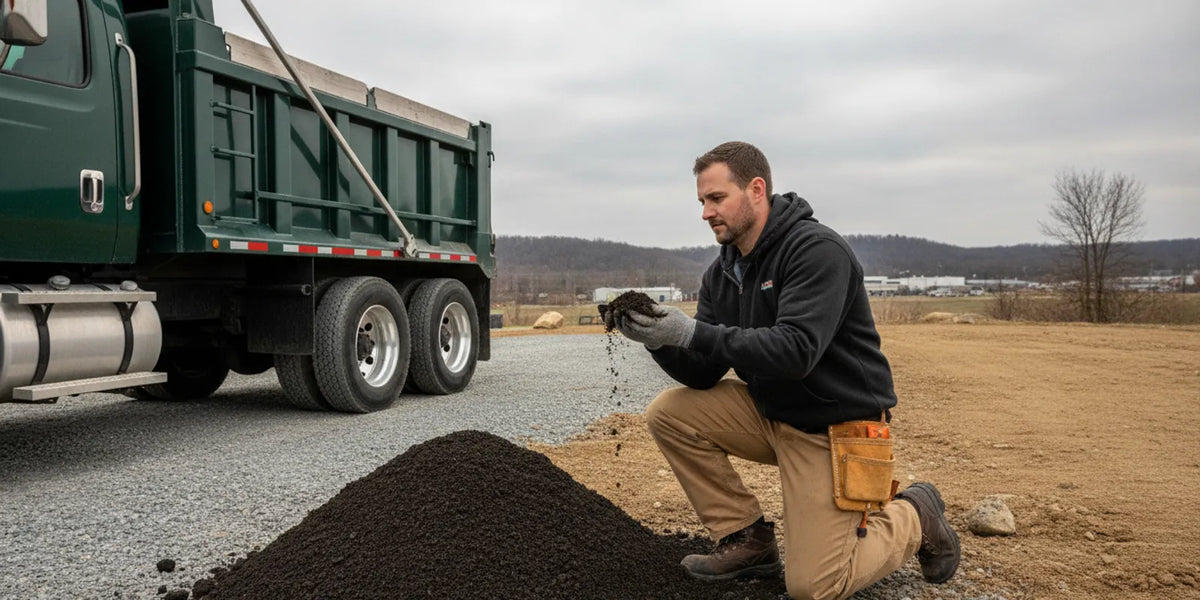
Planning topsoil contractor supply in Fairlawn, OH starts with defining the work, not choosing a load size. The right order depends on the soil’s intended use, the quantity and finish required, the jobsite access, and whether pickup or delivery is practical. Availability and delivery eligibility must be confirmed for the project address; a regional service area does not mean every product or service is available at every location.
Ask about a Fairlawn-area topsoil order
What should you confirm before ordering topsoil for a Fairlawn job?
Start with five facts: what the topsoil is for, how much is needed, where it will be placed, when it is needed, and how the material can reach the placement area. Those details help distinguish a straightforward bulk-material order from a project that also needs equipment-assisted placement or other site work.
Fairlawn is a useful project reference, but it is not enough to establish stock or delivery. Share the job’s full address or ZIP code when you ask about supply. Confirm the appropriate warehouse, product availability, order minimums, delivery eligibility, and any dispatch limits before assuming that a listed item can be supplied to the site. For warehouse selection, start with the store and warehouse selector, then verify the specific item and fulfillment method.
- Use: Identify whether the material is for lawn establishment, planting beds, grading, filling, or another purpose.
- Area and depth: Measure the area to cover and the planned depth, accounting for the final grade and any settlement or blending requirements specified for the project.
- Access: Note the route to the drop point, overhead or side clearances, surface conditions, turning room, and any restrictions on truck movement.
- Timing: Give the requested delivery or pickup date as a planning preference, not a guaranteed window.
- Scope: State whether you need material only, ordinary delivery, conveyor-based slinger placement, or a separately scoped installation service.
Use the services overview to understand the broad distinction between material supply and project services. Ask a specific question about the service you need. A material order does not automatically include unloading at the exact placement point, spreading, grading, or labor.
What does topsoil contractor supply mean for a Fairlawn-area job?
For a contractor, topsoil supply generally means sourcing bulk soil in the quantity required for a defined scope and arranging a practical way to get it to the work area. “Supply” alone does not settle what the soil contains, whether it is suitable for a particular specification, how it will be unloaded, or who will spread and finish it. Those items should be discussed directly rather than inferred from the product name.
Sagamore Companies is a regional landscape-material supplier and site-services provider. Buyers can explore soil options and submit product orders through the location-qualified online store, while jobs that need placement or installation require a project-specific conversation. If you are comparing soil products, browse the soil collection and review the item details for the relevant region. A product listing is a starting point; it is not proof of stock at a particular warehouse or delivery eligibility at a particular address.
Contractors may need a different decision process than a homeowner ordering a small landscape refresh. A commercial buyer could be coordinating several crews, a specified soil profile, phased work, or a narrow delivery window. Bring those constraints into the first conversation. The supplier can then tell you what can be confirmed and what still needs evaluation.
Do not treat a topsoil listing, fill material, compost, and engineered or project-specified soil as interchangeable. If the plans or owner’s specifications name a material standard, ask how the offered product corresponds to that requirement and whether documentation or testing is available. Do not assume a product meets a project specification unless the supplier confirms it.
How should you describe the topsoil’s intended use?
Describe the finished task in plain terms. “Need soil for a 6,000-square-foot area” is a useful start, but it leaves out whether the area is a lawn, planting bed, or grading zone. That distinction can change the questions to ask about texture, screening, existing ground, drainage, and finish elevation. If the work is governed by plans or a landscape specification, provide that information instead of substituting a general product description.
Lawn preparation or repair
For lawn work, clarify whether the soil is being used to build up an area, prepare a seedbed, repair low spots, or establish new turf. The desired final grade, existing soil condition, and planned seed or sod work affect how much soil is useful and how it will be placed. Confirm whether the order is for soil only; seed, installation labor, and finish grading are not automatically included in material supply.
Planting beds and landscape work
For planting beds, describe the planting plan and whether the soil will be used alone or blended with other materials. Avoid assuming that all topsoil is appropriate for every plant or bed. If the designer or project specification calls for a particular composition, have the supplier review the exact requirement before ordering.
Grading and fill
For grading, identify the depth and extent of the area, the required elevation, and whether the material will be covered with another soil or finish layer. A fill product and a planting topsoil serve different roles. Sagamore lists region-specific options such as Ohio fill dirt; check the item’s intended use and confirm that it matches the job’s design rather than choosing by name alone.
Commercial specifications
For commercial, municipal, or public-works jobs, collect the relevant plan notes before requesting a quote. State the required material description, testing or documentation requirements, delivery sequence, work hours, and site restrictions. If the buyer must approve a submittal, say so early. A supplier’s general product page may not answer project-specific compliance questions.
How can you estimate the amount of topsoil?
Measure the area and the intended depth, then convert to cubic yards. For a simple rectangular area, multiply length by width by depth using the same units, and convert the result to cubic yards. One cubic yard is 27 cubic feet. For example, an area measuring 30 feet by 40 feet with a planned soil depth of 4 inches has a basic volume of about 14.8 cubic yards: 30 × 40 × (4 ÷ 12) ÷ 27. This is a planning estimate, not an order quantity recommendation.
Real sites are rarely perfect rectangles. Divide an irregular area into manageable sections, estimate each section, and add the volumes. For a sloped area, stepped grade, or varying depth, use measurements that reflect the actual design rather than one average depth if that could materially change the result. When a grading plan exists, use its quantities or ask the project designer to confirm them.
Consider what the calculation does not include. It does not account for an uneven existing surface, compaction, settlement, spillage, soil left in a truck, or a deliberate overage. Those factors depend on the job. Avoid padding a quantity automatically: a surplus can create handling, storage, and disposal problems, while a shortfall can interrupt work and require another delivery. Ask the project lead how much contingency is appropriate.
Sagamore’s site includes a material calculator. Use it as a planning aid and check the inputs before relying on the result. Confirm whether it calculates volume for your dimensions and selected depth, and remember that a calculator cannot inspect the site or establish the quantity required by project plans.
When requesting a quote, share both the estimate and the measurements behind it. This makes it easier to catch a unit error, mistaken depth, or scope mismatch. Specify whether the number is in cubic yards or another unit; do not assume that material is sold, priced, or dispatched using the same unit across every product and region.
Which soil and material details should you compare?
Compare the actual job requirements, not only the word “topsoil.” Product names do not necessarily describe a uniform recipe across regions. Ask for the current product description applicable to the selected warehouse and clarify details that matter to the project. Do not infer screened status, composition, source, moisture, or suitability unless those details are stated and confirmed.
Useful questions include:
- What is the product’s current description and intended use?
- Is the specific product available through the warehouse serving this job?
- What unit is used for ordering and pricing?
- Does the project require a written specification, sample, or testing information?
- Will the material be delivered loose, and where can the truck unload?
- Are product, delivery, taxes, and any placement or labor quoted separately?
- Could another soil or fill option better match the scope, and what is the tradeoff?
For an Ohio listing, you can review PureSoil for Ohio as one possible product reference. Check the live listing for the current product details and ordering terms. Do not take a regional product page as a representation of every soil available or as confirmation of a particular project’s specification.
If your project is not asking for planting topsoil, compare the correct category instead. A blend, compost, fill product, and aggregate have different purposes. The soil guides can help frame general selection questions, but a project specification and direct confirmation should govern a commercial order.
How should you choose pickup or delivery?
Pickup can work when the selected warehouse has the material, the buyer can arrange a suitable truck and loading plan, and the receiving crew can unload and move the soil efficiently. Before dispatching a vehicle, confirm the warehouse, hours, stock, load process, order details, and whether the vehicle is appropriate for the planned quantity. A store selector or cart is useful for location-qualified shopping, but verify any details that affect a commercial schedule.
Delivery may reduce the buyer’s hauling coordination, but it introduces different questions: Can the truck reach the site? Where will it discharge the load? Is the delivery route suitable? Are there site rules or time restrictions? What is included in the delivery charge, and what is estimated at checkout? Do not assume delivery means that material will be spread or carried to a distant placement area.
| Planning factor | Pickup | Delivery | What to confirm |
|---|---|---|---|
| Material source | Buyer collects from a confirmed warehouse. | Supplier dispatches material subject to address and job qualification. | Current stock, warehouse, product, unit, and order minimum. |
| Transportation | Buyer arranges a vehicle, loading plan, and haul. | Delivery is arranged under the applicable order terms. | Vehicle access, route, timing request, and delivery charges. |
| Unloading point | Buyer unloads at the jobsite. | Truck unload location must be agreed and accessible. | Overhead clearance, turning area, surface, obstacles, and restrictions. |
| Final placement | Buyer moves material from the pickup vehicle. | Ordinary delivery is not automatically spreading or installation. | Whether separate slinger placement or installation is needed. |
| Final cost | Material and buyer’s transport costs must be considered. | Material and fulfillment charges can be separate. | Checkout shipping estimate, taxes, labor, placement, and quote scope. |
The table is a planning comparison, not a promise of a particular service or price. For online purchases, select the appropriate store and product variant, review the cart, and check the shipping estimate at checkout. Prices depend on product, region, unit, warehouse, date, and fulfillment method. Delivery, taxes, labor, placement, and other charges may be separate. A project-services quote is not the same as an online product checkout.
What site-access details can change a delivery plan?
Access can determine whether a delivery is practical and where a load can be discharged. A truck that can enter a site may not be able to reach the desired drop point, turn around, or travel over every surface. Explain constraints before a date is confirmed so the delivery plan can be reviewed against the actual job.
- Approach route: Describe narrow streets, sharp turns, steep approaches, gates, low branches, utility lines, or other obstructions.
- Ground conditions: Note soft ground, fresh pavement, lawns, underground utilities, weight limits, or surfaces that should not be driven over.
- Working room: Identify a safe place for the truck to stop, unload, and exit without blocking traffic or interfering with other crews.
- Jobsite rules: Share access hours, check-in requirements, traffic-control procedures, protective equipment rules, and contact instructions.
- Drop location: Mark the intended location and say how far it is from the final work area.
- Sequence: Explain whether other trades, grading, irrigation, or paving work must happen before the soil arrives.
Photos, a marked site plan, or a short written access description can help make the request more specific, but they do not replace direct confirmation. If the site changes after the order is placed, tell the supplier before dispatch. A revised location, blocked route, or new surface restriction may affect what can be accommodated.
When is slinger placement different from ordinary delivery?
A standard bulk delivery typically unloads material at an accessible drop point. Slinger placement uses a conveyor-equipped truck to place eligible material farther from the vehicle, subject to reach, site layout, material, and job conditions. It is a placement option to evaluate, not a guarantee that the truck can reach every part of a site.
Consider slinger placement when the drop point is separated from the work area, when hauling material across a finished surface would be difficult, or when a project needs material directed to a particular area. Compare that option with ordinary delivery and the contractor’s own equipment and labor plan. Identify the material type, estimated quantity, target area, obstacles, overhead conditions, truck location, and required reach when asking about feasibility.
Sagamore offers slinger truck placement as a separate service to discuss. Published capability examples are not a commitment for a particular Fairlawn project. Site access, distance, material, setup, and other job conditions need review. Ask whether the quote covers material, transportation, placement, or a combination, and keep those parts explicit in the written scope.
Slinger placement is not the same as mulch blowing, nor does it mean the company is installing or finishing the entire landscape. For topsoil, clarify where the conveyor can place the material and what preparation, spreading, grading, compaction, or finish work remains with the contractor or another provider.
Related products

How do supply, delivery, placement, and installation differ?
These words describe different parts of a job. Keeping them separate avoids assumptions about what the quote includes and who is responsible for each stage.
- Supply: The material is sold or quoted in a specified product and quantity. Confirm unit, source, current availability, and any project documentation.
- Pickup: The buyer collects material at a confirmed location and manages transport to the site.
- Delivery: Material is transported to an agreed jobsite drop point. Delivery does not necessarily include moving it to the final work area.
- Slinger placement: Eligible material is conveyed to an agreed placement area where site conditions allow. This is separately scoped from ordinary delivery.
- Installation: A broader work scope may include preparation, placement, spreading, grading, or finishing, depending on the written agreement.
For topsoil, the final tasks could include rough grading, spreading, final grade checks, blending, seeding, or laying sod. Do not assume that any of those tasks are included in a material or delivery order. Define the boundary between the supplier’s scope and the contractor’s scope, and identify who is responsible for protecting finished surfaces and coordinating other trades.
If the broader project involves concrete or another service, keep that separate from the soil order. Sagamore describes turnkey concrete installation as its own project service. A concrete service page does not establish that topsoil installation is part of a material order; ask for the applicable scope and quote for each service.
How should commercial buyers compare supplier quotes?
Compare quotes on the same basis. One quote may describe only bulk material, while another may include delivery or a separate placement service. Before choosing, line up the product, unit, quantity, delivery destination, timing assumptions, and included work. If the details do not match, a lower total may not represent the same scope.
| Quote item | Question to ask | Why it matters |
|---|---|---|
| Product | Is the product described for the same intended use and specification? | Similar names do not establish identical composition or project suitability. |
| Quantity and unit | Are both quotes based on the same amount and ordering unit? | Different units or rounded quantities can distort comparisons. |
| Fulfillment | Does the quote include pickup, delivery, or another method? | Transport responsibilities and charges can differ. |
| Placement | Is unloading at the drop point or conveyor placement included? | Material delivery and final placement are different scopes. |
| Timing | Is the date confirmed, requested, or subject to dispatch and stock? | A requested window is not automatically a guaranteed delivery time. |
| Extra charges | How are taxes, shipping, labor, site restrictions, and other charges handled? | The quoted material amount may not be the delivered project total. |
| Documentation | Are submittals, test information, or approvals required and available? | Commercial specifications may require confirmation before purchase. |
Ask for a written description of what is and is not included. Note any assumptions, such as an accessible drop point, a specific warehouse, or a buyer-provided loader. If a quote changes after site review, reconcile the scope before approving work. Keep the purchase order, quote, delivery instructions, and approved product description together for the crew.
What information should go into a Fairlawn-area quote request?
A complete request reduces follow-up and gives the supplier a clearer basis for checking the job. You do not need to know every answer before asking, but include what is already established and flag anything awaiting confirmation.
- Project location: Provide the full address or ZIP code, plus any special gate, check-in, or access instructions.
- Buyer and job type: Identify the contractor, property manager, public agency, or other buyer and describe the work.
- Soil requirement: Name the requested product or attach the specification. Explain the intended use and any required documentation.
- Quantity: Give the estimated amount, ordering unit, area, depth, and the source of the calculation.
- Fulfillment preference: Say whether you are considering pickup or delivery and where the material should be unloaded.
- Access and placement: Describe route, clearances, ground conditions, the final placement area, and whether slinger placement should be evaluated.
- Schedule: Give the requested date or project phase and explain any constraints. Ask what can be confirmed rather than assuming a guaranteed window.
- Commercial requirements: Note purchase-order procedures, tax or billing details, insurance or site rules, and submittal or approval requirements that must be addressed.
For a service or project quote, use the contact route and clearly identify the service being requested. For a straightforward product order, check the applicable location and product listing, then review cart and checkout details. Product questions and project-service questions may follow different paths, so state which one you need.
How can you coordinate the order with the job schedule?
Build the soil order into the sequence of work rather than treating it as an isolated delivery. Confirm that the receiving area is ready, the crew responsible for unloading or placement is available, and other trades will not block the route. If the site needs preparation first, schedule that work before requesting dispatch.
Agree internally on who will receive the truck and who can make decisions if the planned drop point is unavailable. Provide a current phone contact to the supplier through the appropriate order or project channel, and make sure the on-site contact knows the expected plan. That coordination can help resolve practical questions, but it does not guarantee a particular arrival time or job outcome.
Where the work is phased, decide whether to order the full estimated quantity or arrange separate loads. A single large order may simplify coordination, but only if there is adequate storage and the material can be used without disrupting the site. Multiple deliveries may support phased work, but can affect logistics and cost. Ask for the available options and quote each one against the same project assumptions.
Keep a record of the approved product, quantity, destination, and unloading instructions. After the material arrives, compare the delivery documentation with the order and note any issue promptly through the supplier’s contact process. Do not wait until a later phase to report a mismatch that could have been addressed at receipt.
How should you prepare the receiving area?
Before the truck is scheduled, decide where the material can safely be unloaded and how the crew will move it from that point. Mark a location that leaves room for the vehicle to approach and exit, keeps the load away from drains or protected features, and does not block other work. The right location depends on the site plan and the supplier’s equipment, so describe the proposed spot and ask whether it is workable.
Make the receiving plan specific. A general instruction such as “behind the building” may not help a driver locate a safe drop point. Provide a marked plan, clear written directions, or an on-site contact who can guide the vehicle. If there are multiple entrances, identify the correct one and note any access code or check-in requirement using the agreed order channel. Keep access details current if the route or site contact changes.
Consider what lies below and around the proposed drop location. Underground utilities, drainage structures, landscaping to preserve, retaining walls, and newly finished surfaces may affect where a truck can travel or unload. The project team should identify restrictions before delivery and should not assume that a truck can cross a lawn, sidewalk, or other surface without impact. If there are load limits or protected areas, state them plainly and ask how they affect the plan.
Plan for the material after it is dropped. Is there enough space to store the full amount without obstructing a path or another trade? Will equipment be available to spread or move it? Can the pile remain in that location until the crew uses it? A delivery can be completed as ordered and still create a site problem if the receiving area is too small or the downstream work is not ready.
For a multi-load or phased job, establish the drop locations and sequence for each load in advance. Identify whether the truck should return to the same place or use a different area as work progresses. Do not assume that a driver can make an unplanned change at the gate; revised instructions may require additional review. Provide enough detail for the supplier to assess the requested plan before dispatch.
What should the crew check when the soil arrives?
Assign someone who knows the order to receive the delivery. That person should be able to confirm the job, product description, quantity or load documentation, and intended drop location. If the order is tied to a project specification, keep the approved description available at the site. A receiving check is not a substitute for laboratory testing or formal acceptance procedures when those are required, but it can catch a basic mismatch while the order details are at hand.
- Confirm that the delivery is for the correct project and address.
- Compare the available product and load information with the approved order and quote.
- Check that the truck is directed to the agreed drop point and that the area remains safe to use.
- Record a discrepancy promptly and contact the supplier through the appropriate order channel.
- Keep delivery records with project documentation, especially when several loads or products are involved.
Do not make an informal substitution if the planned product is unavailable. A different soil or fill material may affect the design, finish, or approval process. Ask the project decision-maker whether a substitute is acceptable, then confirm the change in writing before proceeding. Likewise, if the delivered quantity appears different from the order, document what was received and resolve the question before planning a later phase around an assumed balance.
After receipt, protect the pile and coordinate its use with the work sequence. The contractor remains responsible for determining how the material is handled and installed under the project plan unless a written service scope assigns that work elsewhere. Keep unused material out of drainage paths and away from areas where it could interfere with traffic or completed work. If you need help with placement rather than supply, ask for that scope specifically.
How can a homeowner or property manager use the same process?
The same checks help buyers outside a contractor crew. A homeowner refreshing a lawn or a property manager planning common-area repairs should identify the purpose, measure the area, and confirm access and the drop point before ordering. If the buyer is coordinating a landscaper, confirm who will receive the material, who will spread it, and whether the contractor wants a particular product or quantity. This prevents a retail material purchase from being mistaken for a complete installation arrangement.
For smaller or less technical work, a rough area-and-depth estimate can provide a starting point, but do not treat it as a substitute for a designer’s or contractor’s specified quantity. Ask the person completing the work to confirm the product and volume before the order is placed. If the job is in a commercial property or governed by site rules, follow the property’s receiving procedures even when the amount is modest.
Buyers should also keep regional product pages in context. A listed product may be associated with a particular region or warehouse, and stock or delivery eligibility can vary. Start at the warehouse selector, review the relevant product listing, and verify the job address and fulfillment charges. For help distinguishing material questions from service questions, use the company’s contact page and explain whether you need a product order, delivery review, or project quote.
What mistakes can create avoidable cost or delay?
- Ordering by town name alone: Fairlawn-area language does not confirm warehouse stock or delivery coverage. Provide the exact job location and request confirmation.
- Choosing by a generic label: “Topsoil” may not answer composition or specification questions. Review the current product details and state the intended use.
- Using the wrong unit: Confusing cubic yards, tons, or another unit can change the order significantly. State the unit and verify the product’s sales unit.
- Ignoring depth: A small difference in planned depth across a large area changes the volume. Measure carefully and use the project plan where available.
- Assuming the load will reach the work area: A truck may only unload at an accessible point. Describe the route and discuss placement separately.
- Combining supply and installation: A material order does not automatically cover spreading, grading, or finishing. Ask for a separate scope where needed.
- Planning around an unconfirmed date: A preferred date is not a guaranteed window. Confirm what is scheduled and what remains subject to availability or dispatch.
- Comparing different quote scopes: Check product, quantity, unit, delivery, placement, taxes, and other charges before comparing totals.
- Leaving site requirements until the last minute: Access rules, underground utilities, soft ground, or work-hour restrictions can change the plan. Share them at the request stage.
What should you confirm before placing the order?
Before authorizing a topsoil order, make sure the product and unit match the job, the quantity is based on a checked measurement, and the project address has been evaluated for the requested fulfillment method. Confirm the order total and any separate shipping, tax, labor, placement, or other charges. Review the delivery or pickup instructions with the crew responsible for receiving the material.
If the job needs more than bulk material, describe the additional work and ask for a separate project scope. Sagamore’s service information can help you identify a route for questions about material delivery and site services, while the contact page is the next step for a project-specific inquiry. Any service, price, stock, or coverage should be confirmed for the address and job before you schedule around it.
Request a project-specific topsoil quote
A clear request—with the soil use, measured quantity, full job location, access details, and scope boundary—gives the supplier a practical basis to check the order and explain the next step.