
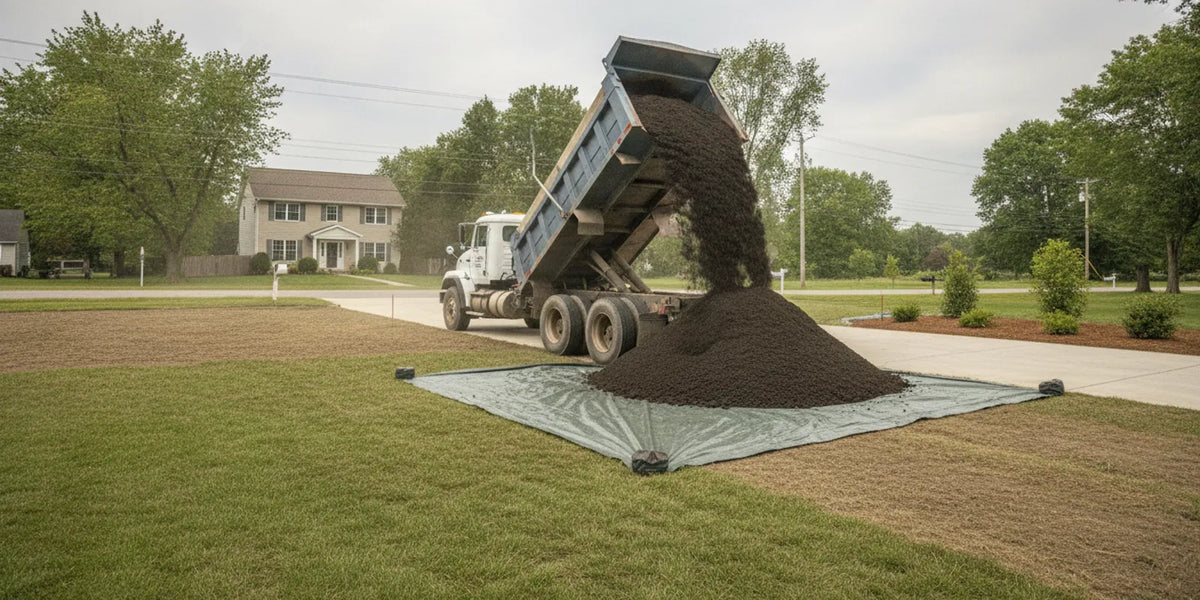
Planning a topsoil delivery takes more than estimating how much soil a project needs. The right product, warehouse, delivery address, unloading area, and vehicle access all affect whether an order can be fulfilled as expected. A little preparation helps homeowners, landscapers, and contractors identify what to confirm before ordering, without confusing a material purchase with placement or installation.
Start with the job the soil needs to do
Before looking at delivery options, describe the work. Topsoil is not a one-size-fits-all answer for every landscape or construction task. A lawn renovation, raised planting area, low spot, and rough grading job may call for different material characteristics and preparation. Naming the use gives you a better starting point for selecting a product and explaining the request to a supplier.
Write down the project area and intended finish. For example, are you preparing a seedbed, repairing thin lawn areas, building up a planting bed, or bringing a broad area closer to grade before finishing? Note whether the soil will be the final layer or whether another material will go over it. If the project has specifications from a landscape designer, contractor, municipality, or engineer, use those requirements rather than substituting a general retail description.
Topsoil products and blends can differ. A product labeled topsoil may be screened, blended, or marketed for a particular regional use. The words on a product page do not establish that two soils have identical ingredients or performance. Michigan State University Extension explains that garden soil and topsoil are different products and that landscape suppliers may blend compost or other organic matter with topsoil. Review the particular product description and ask about its intended use when the distinction matters. (Michigan State University Extension’s topsoil guidance.)
For a small lawn repair, the important questions may be whether the material is suitable for the surface layer and how you will spread it. For a commercial landscape installation, the specification may name a particular soil blend, screening standard, or planting purpose. When there is a written specification, share it before ordering and confirm whether the available product meets it. Do not assume that a product with a familiar name satisfies a project requirement without checking.
It also helps to separate soil selection from delivery planning. The material question is, “What soil fits this use?” The logistics question is, “Can this product be delivered to this address and unloaded in the space available?” Both matter, but they may involve different information and different next steps.
Choose a product before calculating the load
Once you have defined the application, look for a product that matches it and is offered for your region. A product listing may identify a unit such as a cubic yard, a warehouse or region, and other order details. Check the full listing rather than relying on a search result or a product name alone. Similar names may refer to different regional offerings, and the available selection may not be identical at every warehouse.
For a material purchase, use Sagamore’s store and warehouse selector to begin with the location relevant to your job. Then review the location-qualified product listing and its ordering details. If you are comparing soil options, the soil collection can help you find listings, but the selected warehouse and current product information still need to match your destination.
Do not treat a product shown online as proof of current inventory at every yard. Product availability can vary by location and time. If the listing is unclear, if you need a specified blend, or if the quantity is unusual, contact the company before finalizing plans. Contractors working against a schedule should make the availability question explicit and avoid committing a crew based only on a general catalog listing.
For some projects, the best next step is a product order through the store. For a specified installation or a complex site, ask for project-specific guidance instead. Sagamore serves retail and commercial buyers with landscape materials and site services, but the correct route depends on whether you are buying soil alone or requesting a separately scoped service. The services overview can help distinguish material supply from project services.
Estimate the quantity without treating it as a delivery promise
Quantity planning starts with the area to be covered and the intended depth. A material calculator can help convert those measurements into an approximate volume. Measure the project area carefully, including irregular edges, and note any areas that should be excluded. If the finished surface will be sloped or stepped, break it into simpler sections rather than treating the entire site as a single rectangle.
Keep the calculation in its proper role: it estimates material volume. It does not confirm product availability, the amount a truck can deliver in one trip, the delivery charge, or whether the truck can reach the requested unloading point. Those questions need to be checked separately. A calculator output is a planning estimate, not a confirmed order or a guarantee that the delivered soil will produce a specific finished surface.
For an uncomplicated residential area, you can use the result to decide whether the project is likely to need a small order or a larger bulk quantity. For a landscape installation with several elevations, long beds, variable soil conditions, or strict finish requirements, ask the person responsible for the design or installation to verify the quantity. Contractors may also want to account for site conditions and the planned method of spreading before confirming the requested volume.
Avoid adding a large arbitrary buffer just to be safe. Too much material can create a new handling and storage problem, while too little can interrupt work and require another order. Instead, check your measurements and assumptions. If the depth varies, calculate each zone separately and add the results. If there is uncertainty about the final grade or compaction, confirm the estimating approach with the project professional. The supplier can help with product and order questions, but a general delivery inquiry cannot replace an on-site assessment or a design quantity.
Write down the units used in your calculation and compare them with the product listing. Do not assume that a load described casually as a “truckload” is a precise amount of soil. Make sure the quantity requested corresponds to the unit displayed for the selected product. If you have an older estimate or a note from a different supplier, verify the unit and product before using that figure in a new order.
Check the delivery address and warehouse first
Delivery qualification is address-specific. A broad service-area statement or a warehouse location does not mean every address in a state or region has the same delivery options. Enter the actual jobsite destination through the available store and checkout flow, and review the options presented for that location. If the address cannot be selected, the delivery method is not clear, or you have a commercial site with special requirements, contact Sagamore to confirm the next step.
Make sure you are using the delivery address, not just the billing address or a nearby landmark. Include the correct street number, road name, municipality, state, and postal code. For a new construction site or a large property, add useful directions such as a gate entrance, building name, or designated receiving point when requested. Do not assume that a driver can find an informal site entrance from a parcel address alone.
Warehouse selection matters because a product or fulfillment option associated with one location may not apply to another. Review the store selection carefully before you put a product in the cart. If you are uncertain which warehouse serves the address, ask instead of choosing a location simply because it appears nearest on a map. Actual delivery eligibility, product selection, and available fulfillment methods need to be confirmed for the job.
For a buyer comparing locations, keep the comparison consistent. Confirm the same product, quantity, destination, and fulfillment method before comparing the totals or timing shown. A different warehouse may have a different product listing, stock position, or delivery route. A local pickup option is not interchangeable with delivery, and a product available for pickup in one area should not be assumed to be available for delivery elsewhere.
The checkout flow is important because delivery estimates and charges may be determined by the order details and destination. Review the shipping information presented before paying. Delivery, taxes, labor, placement, and other charges may be separate from a material’s displayed unit price. The checkout information establishes the applicable shipping estimate for that order; do not rely on an old screenshot, an unrelated quote, or a general price as a current delivered total.
Prepare the unloading area and route
A delivery is only useful if the material can be unloaded in a practical location. Before ordering, identify where the soil should be placed and how the truck can reach that point. Think through the route from the public road or site entrance to the unloading area, not just the distance from the driveway to the lawn. A route that looks open to a person may still be unsuitable for a delivery vehicle.
Walk the route and note narrow entrances, sharp turns, low branches, overhead wires, gates, steep grades, soft ground, limited turning space, and other obstructions. Check for parked vehicles, equipment, dumpsters, landscaping, retaining walls, and overhead structures that could constrain movement. If the delivery area is behind a building or inside a gated site, confirm how the driver will enter and who will provide access at the scheduled time.
Think about the surface as well as the clearances. A wet or soft lawn, freshly finished driveway, underground utility area, drain field, or unprotected hardscape may not be appropriate for a heavy vehicle. Do not assume that a truck can safely travel over turf or cross a curb simply because the distance is short. If you have concerns about ground conditions or potential damage, describe them before ordering and ask what delivery arrangements are possible. Do not ask a driver to enter a route that has not been confirmed as suitable.
Choose a staging point that leaves room for the material pile and the work that follows. Keep it out of drainage paths and away from areas where runoff could carry soil into a drain or waterway. Avoid blocking fire lanes, public sidewalks, shared driveways, or access needed by residents and other trades. On a commercial job, confirm the placement area with the site supervisor and communicate any receiving rules, check-in procedures, or vehicle restrictions.
Be specific when describing placement expectations. Standard material delivery and specialized placement are not the same service. A request to drop soil at a reachable staging area does not mean the material will be spread across a lawn, carried through a property, or positioned over an obstacle. If the job requires soil to be placed at a difficult-to-reach location, ask whether a separately scoped equipment-assisted service is appropriate. Sagamore describes conveyor work as slinger placement; suitability depends on the site, material, access, and project qualification. Review the slinger placement information and request a project quote rather than assuming ordinary delivery includes that work.
Mark the unloading area clearly when practical and make sure the person accepting the delivery understands the plan. If a crew will be working nearby, arrange a safe separation between equipment and people. Keep children, pets, pedestrians, and unrelated vehicles away from the active delivery area. The person coordinating the order should be reachable if a site decision is needed, but do not count on a driver being able to change the delivery plan after arrival.
Decide whether to order material or request a project quote
There are two distinct paths: purchasing topsoil as a material and arranging a project service. For a straightforward material order, select a location-qualified product, enter the requested quantity, and review pickup or delivery options in the store flow. A product purchase does not automatically include unloading at a precise location, spreading, grading, or installation labor.
If you need a service beyond material supply, describe the work and ask for a quote. Explain the area, intended use, approximate quantity, destination, access route, staging location, desired placement, and timing considerations. Include photographs or a site plan if requested and useful. A quote request should identify whether you want only bulk soil delivered or are asking about a separate equipment-assisted placement service. Be clear about who will handle spreading and final grading.
Those distinctions matter for homeowners and trade buyers alike. A homeowner may expect a pile in a driveway and plan to move it with a wheelbarrow. A landscaper may be coordinating delivery with a crew and equipment. A contractor on a commercial site may need a documented specification and a delivery window coordinated with other work. These are different scopes, and the request should make the difference plain.
When asking about delivery, avoid framing a preferred date as a confirmed appointment unless the order process or a representative confirms it. A requested date is information for planning; it is not, by itself, a guaranteed delivery window. If the site will only be accessible during a limited period, mention that early and ask what can be accommodated before arranging labor or closing a work area.
Keep product questions and project-service questions separate in your notes. For example, “Is this soil available for my selected warehouse?” is a product and inventory question. “Can it be placed beyond the driveway at this jobsite?” is a placement and access question. “Can the entire area be graded and finished?” describes broader project work. The answers may require different information, and one should not be taken to imply the others are included.
Related products

If you want a lush, green lawn, try Sagamore’s screened topsoil or PureSoil.
View product

Review the price and fulfillment details before checkout
Compare the full order, not just the unit price displayed beside the material. The applicable product, region, unit, selected warehouse, order quantity, and fulfillment method all matter. Delivery charges, taxes, labor, placement, and other charges may be separate. Checkout provides the shipping estimate associated with the order details entered there, so review it before submitting payment.
If an estimate changes when you adjust the delivery address, warehouse, quantity, or fulfillment option, stop and confirm that the order still matches the job. Do not use a price from a different region as a substitute for a current order total. Similarly, do not assume a delivery charge includes spreading or any other project service. Ask specifically what the listed fulfillment method covers if the description is unclear.
Keep a copy of the product and order details for the project coordinator. Useful information includes the product name, selected warehouse, quantity and unit, delivery destination, fulfillment method, shipping estimate, and any separate written quote. If a contractor or property manager is paying for the order, agree in advance who will review and approve the checkout details. Clear records reduce the risk of a mismatch between what the site needs and what was ordered.
For service work, request a project-specific quote and confirm its scope. A quote may need to account for access, material, placement method, equipment, job size, and other site conditions. Do not turn an illustrative example or a quote for a different project into a universal rate. Ask which items are included, what remains the customer’s responsibility, and what conditions could change the scope.
Coordinate the delivery with the work plan
Topsoil delivery is one part of a sequence. Before the truck arrives, decide who will receive the load, who will direct the driver to the staging point, and who will move or spread the material. If the material is arriving before a crew, confirm where it can remain and how long the area can be used. If a crew is already on site, ensure that its work plan allows for the delivery vehicle and unloading activity.
For lawn work, consider how the soil will be spread and how the finished area will be prepared afterward. This article does not replace a lawn-depth or coverage calculation: use a project-specific measurement and follow the seed, sod, or landscape plan that applies to the site. For a planting bed or grade adjustment, coordinate the delivery with edging, drainage, and other materials so that the soil pile does not obstruct work or create an unintended runoff path.
On construction and commercial projects, coordinate the order with site access rules and other deliveries. Identify the receiving contact, required check-in process, permitted delivery hours, vehicle limits, and any safety requirements. If multiple trades are using the same access road, select a staging area that does not interfere with concrete, aggregate, equipment, or emergency access. Share changes in site conditions before delivery rather than expecting the driver to resolve conflicts on arrival.
Have a contingency for weather and site changes. Rain can affect the condition of unpaved access, and a work area can change between the time an order is planned and the delivery date. Recheck that the route remains clear, the receiving person is available, and the unloading point is still appropriate. If the site is no longer ready, contact the supplier to ask what options are available under the current order terms.
Do not plan your schedule around an unconfirmed assumption about same-day availability, exact arrival time, or a particular truck capacity. Product availability, route, order details, and project needs must be assessed for the specific delivery. A confirmed order or service arrangement is a more reliable planning basis than a general capability statement.
Resolve product and site questions before booking work
Some delivery plans are straightforward: a known product, a clear driveway, and a convenient place to unload. Other sites need extra coordination. Identifying the complication early gives you time to ask the right question before a crew, rental equipment, or other trades are scheduled.
If the project has a soil specification, send the exact wording rather than summarizing it as “good topsoil.” Specifications may address intended use, composition, screening, or other characteristics. Ask whether the product listing aligns with that requirement and what information is available to confirm it. If the specification comes from a project owner or design professional, do not change it based on a product name alone. Have the responsible professional approve any substitution.
For a homeowner choosing soil without a written specification, explain the site and intended use in plain language. Mention whether the ground is already prepared, whether the soil will be a thin surface layer or part of a larger grade change, and what is planned afterward. If the area has drainage problems, contaminated fill concerns, or a construction requirement, general product guidance is not a site evaluation. Consult the appropriate project professional before ordering material for a condition that requires technical assessment.
On a commercial project, a purchasing contact may not know all the access or material requirements. Coordinate with the site superintendent, landscape contractor, owner representative, and whoever will receive the delivery. Confirm who can approve a product substitution, who is responsible for checking the load against the order, and where the delivery ticket or order record should go. If the site has vendor onboarding, insurance, safety, or check-in requirements, communicate them before the order is placed.
For a shared residential drive, multi-unit property, or neighborhood work zone, ask who controls the route and staging area. A resident may not have authority to block a shared lane or direct a delivery vehicle into a common area. Get permission where needed, make arrangements for access, and notify anyone who could be affected by the temporary soil pile or vehicle movement.
Clarify what happens if an address is outside the available delivery area, the selected product is not available at the chosen warehouse, or the site access description raises a concern. A fallback might be a different product or warehouse, pickup, a revised delivery point, or a separate service quote, but each option must be checked for the actual project. Do not assume a substitute, transfer, pickup arrangement, or added placement work is automatically available.
It is useful to record the answer to each open question with the name of the product and the address it applies to. A verbal discussion about one location does not necessarily qualify a different destination or a later order. For a contractor managing more than one job, label notes by project address so that product and delivery details do not get carried over incorrectly.
Get the receiving area ready for delivery day
Revisit the plan shortly before the delivery. Move vehicles, trailers, bins, and equipment that could narrow the route or occupy the designated unloading area. Unlock the agreed gate, share any access code through the appropriate channel, and make sure the receiving contact knows when to be available. If the contact changes, update the plan rather than leaving the driver to find someone on site.
Make the drop location unambiguous. A driveway, side yard, and street-side area may look similar when viewed from the entrance, especially on a large or multi-building property. Tell the receiving person which one is intended and, where appropriate, mark the spot visibly from a safe location. Do not mark an area in a way that creates a hazard or directs the driver under wires or branches.
Protect nearby work and keep the route clear of people. Pause activity in the immediate unloading area and keep bystanders away while the vehicle is moving or discharging material. On a jobsite, use the site’s normal traffic and safety procedures. A person should not stand behind or beside a moving vehicle to direct it without following safe signaling practices and the driver’s instructions.
Before the load is accepted, compare the delivery with the order details available to you. Check that the product and quantity information correspond to the order record, and raise a discrepancy promptly through the appropriate contact route. Do not ask the driver to resolve a product-selection issue or add work outside the agreed scope. Keep the paperwork or digital confirmation with the project documents.
After unloading, protect the pile and the surrounding area until the soil is used. Consider rain, wind, runoff, traffic, pets, and pedestrian access. Keep soil from washing into drains or adjoining properties, and follow any applicable site or project controls. If you will not spread the material immediately, choose the staging area with that temporary storage period in mind.
If the planned route or site condition changes before the truck arrives, contact the supplier and ask how to proceed. A newly parked vehicle, locked gate, saturated lawn, or active construction activity can make the original plan unsuitable. A timely update gives the parties a chance to confirm an alternative; it does not guarantee a particular rescheduling option or outcome.
Use a pre-order checklist
Before placing an order or asking for a project quote, gather the basic facts. A complete request makes it easier to identify questions that still need a site-specific answer.
- Use: State whether the soil is for lawn preparation, a bed, fill or grade work, or another purpose.
- Product: Identify the product listing or written soil specification you want reviewed.
- Quantity: Record your measured area, planned depth, estimated volume, and unit. Flag any uncertain measurements.
- Address: Provide the complete destination, including the correct postal code and any site entrance details.
- Warehouse: Confirm which location and product listing apply to the delivery address; do not assume every location has the same stock.
- Fulfillment: Decide whether you are arranging pickup, ordinary delivery, or asking about a separately scoped placement service.
- Access: Describe the route, surface, gate, clearances, turning space, slopes, overhead obstacles, and any vehicle restrictions.
- Staging: Identify the intended unloading area and check that it will not block traffic, drainage, or other work.
- Timing: Share the date or site constraint you are working around, then confirm what can be accommodated.
- Cost: Review the order’s current checkout estimate and any written service quote; do not assume material price includes delivery, labor, or placement.
- Receiving contact: Name who will be present or reachable and who has authority to direct unloading.
This checklist is intentionally practical rather than a substitute for the checkout process. Product and delivery options need to be reviewed for the specific location and order. A service request may need additional information or a site review before a scope can be confirmed.
Common questions about topsoil delivery
Does buying topsoil include spreading it?
No. A material purchase and the labor to spread, grade, or install soil are separate unless a specific written service scope says otherwise. When ordering, confirm where the soil will be unloaded and who will move it from that point to the work area. If you need equipment-assisted placement, describe the access and placement requirements and request a separate project qualification.
Can I order topsoil from any warehouse?
Do not assume that every warehouse offers the same product, stock, or delivery option. Start with the store selector and check the product and fulfillment details for your jobsite. If the correct location or delivery eligibility is unclear, contact Sagamore with the full address and product information before placing the order.
How do I know whether a truck can reach my desired drop location?
Describe the complete route and unloading point, including entrance width, turns, overhead clearance, slope, ground condition, and obstructions. A site that appears close to the road may still have access limits. If the requested placement goes beyond a practical unloading area, ask whether a separately scoped slinger placement service could suit the job. Do not assume an ordinary delivery vehicle can travel across turf or through a restricted route.
Does the displayed soil price include delivery?
Not necessarily. The applicable total depends on product, region, unit, selected warehouse, quantity, destination, and fulfillment method. Delivery, taxes, labor, placement, and other charges may be separate. Enter the actual order details and review the shipping estimate at checkout; request a separate quote for project services.
Should I order extra soil in case the estimate is short?
First recheck the project dimensions, planned depth, and units used in the calculation. For irregular areas or changing elevations, calculate the sections separately and ask the project professional to review the assumptions. Avoid ordering an arbitrary extra amount without a plan for handling and storing it. A calculator estimates volume, while product availability and delivery qualification are confirmed separately.
Make the next step specific
A well-planned order begins with a clear purpose and ends with confirmed product, address, fulfillment, and access details. Use the store and checkout flow for a material purchase, and ask for a project quote when you need specialized placement or other work beyond delivery. If you are unsure which route fits your site, share the intended use, location, quantity estimate, and access conditions so the question can be directed appropriately.
Choose a store for your material order
Taking time to confirm these details helps keep the soil order aligned with the actual jobsite and the work planned for it.
