
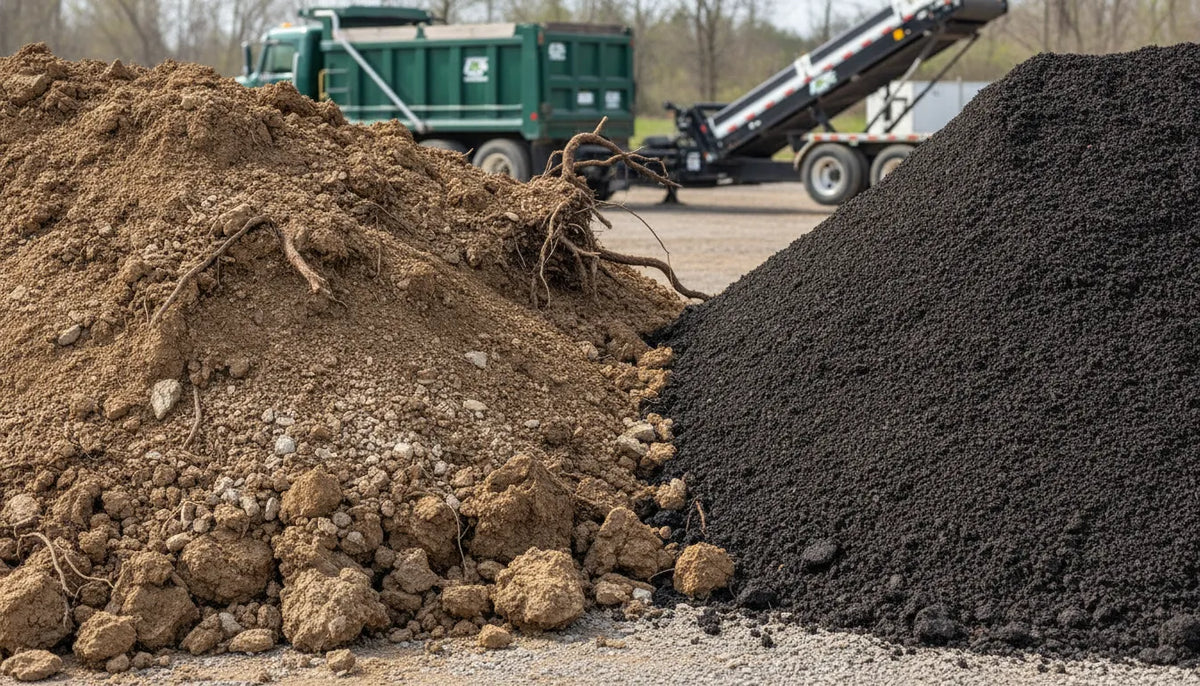
Fill dirt vs topsoil is a job question, not a price question. Fill dirt raises low ground, fills deep holes, and builds embankments. Topsoil is the layer you put on top when grass or plants need something to grow in. Sagamore's Ohio fill dirt page says the material can be a blend of clay, sand, rock, and roots, and it says plainly that fill dirt is not an inexpensive topsoil. If the finished surface has to support plants, finish with topsoil.
Call (330) 656-5720 to check Ohio fill dirt before you order, then add a planting soil where grass or plants have to grow.
What fill dirt is, and what it is not
Fill dirt is bulk material used to change the shape of the ground. On the Ohio product page, Sagamore describes it as fill for low-lying areas, deep holes, and embankments, and as a mix that can include clay, sand, rock, and roots. The same page says quality varies, and it asks buyers to look at the product before they assume it will suit the job.
That mix is why fill dirt and topsoil get confused. Both are brown, both come by the yard, and both can sit in a low spot. The difference is organic matter and the job it can do. Fill dirt has little to no organic matter, so it is not a growing medium. The product FAQ says it is used for grading, backfilling, and preparing land before topsoil goes on. It also says fill dirt is for structural fill, not for growing plants.
Sagamore sells Ohio fill dirt by the yard and asks shoppers to confirm the warehouse, the ZIP, and whether pickup or delivery fits the site. Carolina fill dirt is a separate product with the same warning: it is not topsoil, and planting still needs a topsoil finish. Availability, price, and delivery eligibility depend on the yard and on checkout. This article does not quote a rate.
What topsoil is for
Topsoil is the layer plants actually root into. The USDA Natural Resources Conservation Service describes topsoil as surface soil, usually the top 15 to 20 centimeters, that is richer in organic matter than the layers under it. That organic matter is what holds water and nutrients near roots. Fill dirt is not sold as that layer.
Sagamore's planting soils are named products, not a single bag labeled topsoil. In Ohio, PureSoil is screened topsoil for lawn repair, grading, and leveling, and the product page says one yard covers about 100 square feet at 3 inches deep. PlantPal is a bed mix of soil, compost, and sand for flower and vegetable beds, with better drainage than straight topsoil. Bioretention topsoil is a separate specification soil, not a substitute for everyday lawn repair. Carolina PureSoil is the screened topsoil sold for that region.
If the question is topsoil versus compost, that comparison already lives in Topsoil vs. Compost: Which One Should You Use? Compost amends a bed. It does not replace the fill under a grade change. Screened versus unscreened topsoil is a different choice again, covered in Screened Topsoil vs. Unscreened Topsoil.
Fill dirt vs topsoil by the job
Match the material to the finished surface, not to whichever pile looks cheaper. A hole that only needs to come up to grade can take fill dirt. A hole that will be lawn needs fill dirt underneath and topsoil in the root zone. A flower bed is usually a bed mix, not raw fill.
| Job | Material that fits | Why |
|---|---|---|
| Raise a low spot or fill a deep hole that will not be planted | Fill dirt | The Ohio product is sold for low areas, holes, and embankments. It is not a growing medium. |
| Build an embankment or rough grade before a finish layer | Fill dirt, then topsoil only where plants go | The product FAQ says to prepare land with fill dirt before adding topsoil. |
| Repair or establish a lawn | Screened topsoil such as PureSoil | PureSoil is sold for lawn repair and is screened so it spreads with less raking. |
| Flower or vegetable beds | A bed mix such as PlantPal | PlantPal blends soil, compost, and sand for drainage and nutrients. Straight fill dirt will not do that job. |
| General fill that may include sticks and wood pieces | StructaFill, not fill dirt and not topsoil | StructaFill is a screened blend of soil, sand, rock, and organic pieces. It is not a finished planting soil and it is not an engineered spec. |
Read the row for the surface you will actually leave behind. Covering fill dirt with a thin dusting of topsoil and expecting a lawn is the mistake the product page warns about. The planting layer has to be thick enough for roots. Use the yardage guide for the topsoil layer, and keep the fill volume as its own number.
Related products


There are many different grades and qualities of fill dirt.
View productHow the two materials behave once they are placed
Fill dirt that includes clay and rock can pack into a mass. That is useful under a grade change and a poor place for roots. Roots, stones, and clay clods are part of what the Ohio listing says you may see, which is why Sagamore asks buyers to look at the pile. A load that looks right for a hole in the back yard may be wrong behind a wall or under a slab. If the project has a compaction, drainage, or structural requirement, confirm the material with the project professional before you order. The product page does not claim fill dirt meets an engineering specification.
Screened topsoil is the opposite texture. PureSoil is screened finer than many supplier piles so it rakes and spreads with less debris. That makes it a finish layer, not a cheap way to raise a yard by a foot. Using topsoil as deep structural fill wastes a planting product and can settle as the organic matter breaks down. Use it where roots will live, typically a few inches for a lawn repair, and put the bulk of a deep fill in fill dirt.
StructaFill sits between those two and should not be treated as either one. The Ohio listing calls it an economical blend of soil, sand, rock, and organic material, including small sticks and wood pieces. It can be considered for raising areas and filling low spots when a mixed fill is acceptable. It is not screened topsoil, and the page says not to assume it meets a compaction or construction spec. If the pile needs to look clean or grow a lawn, ask for the planting product instead.
A practical way to order both
Start with the finished surface, then work down.
- Mark what the area has to do: stay as grade, become lawn, or become a bed.
- Measure the deep fill separately from the planting layer. A foot of fill dirt plus a few inches of topsoil is two orders, not one.
- For lawn work, read how to plan a topsoil delivery before you lock a yardage. That guide covers access, placement, and what checkout still has to confirm.
- Choose the region product. Ohio fill dirt and Carolina fill dirt are different listings. PureSoil is listed for Ohio and for Carolina. PlantPal in this comparison is the Ohio bed mix.
- Enter the jobsite ZIP on shop at a store near you. The selector is how Sagamore shows local products and pricing. Delivery eligibility, charges, and timing are confirmed in checkout, not in this article.
- If you can, look at the fill dirt before a large order. The product page recommends that because grade and debris vary.
Pickup and delivery are different paths. Delivery, taxes, and any placement are separate from the material price. Slinger placement is a separate service from the material order. Do not assume a soil delivery includes spreading. If standard online delivery is not available for the ZIP, the store selector still offers a quote request.
Contractors ordering for several jobs should keep fill dirt, StructaFill, and planting soils on separate lines. Mixing them into one "dirt" quantity makes the finish layer too thin or puts roots and wood where a lawn was supposed to go. Homeowners can use the same split: bulk underneath, planting mix on top.
Where people go wrong
The product page says many customers think fill dirt is inexpensive topsoil. It is not. Ordering it for a new lawn, then discovering clay, rock, and roots, means a second order and a delay. The reverse mistake is ordering screened topsoil to fill a deep low spot. You pay for a planting blend to do a bulk-fill job, and the organic fraction can settle.
Another miss is treating every Sagamore soil as interchangeable. PureSoil, PlantPal, StructaFill, bioretention topsoil, and fill dirt answer different specs. Bioretention topsoil belongs in a bioretention detail, not in a backyard hole. StructaFill can include sticks. Fill dirt can include roots and rock. Only the planting products are sold for grass and beds.
Service area is address-specific across Ohio, North Carolina, and South Carolina yards. A product being active in the catalog does not mean every warehouse has it today, and it does not mean every ZIP gets delivery. Confirm the yard before you promise a crew the material will be there.
If the project is a grade change, start with fill dirt and add PureSoil or PlantPal only for the layer that has to grow something. Questions about a load go to (330) 656-5720.
Depth, access, and what to tell the yard
A fill dirt vs topsoil order gets simpler when the two depths are written down before anyone calls. Measure length and width in feet. Multiply by the fill depth in feet, then divide by 27 to get cubic yards of fill. Do the same math again for the planting layer, which is often only a few inches. Those are estimates. Final grade, compaction, and waste change the number you actually need.
PureSoil's Ohio page uses a coverage check you can borrow for the top layer. One yard covers about 100 square feet at 3 inches deep. A 1,000 square foot lawn repair at that depth is about 10 yards of screened topsoil, plus whatever fill dirt sits under it. Do not fold the fill yards into that 10. The hole or the low spot is a separate volume.
Access decides whether the material can be delivered or has to be picked up. Tell the yard about overhead lines, soft ground, a narrow drive, and where the truck can dump. Delivery timing is an estimate, not a guaranteed window. If a slinger is part of the plan, that is a placement service scoped on its own. It is not included because you bought soil.
Have this ready when you order fill dirt:
- Jobsite ZIP and whether the buyer is a contractor or a homeowner.
- Intended use: low spot, hole, embankment, lawn finish, or bed.
- Estimated yards of fill dirt and, separately, yards of PureSoil or PlantPal.
- Pickup or delivery, and any access limit the driver should know.
- Whether someone can look at the fill before a large load is scheduled.
If the job is in the Carolinas, use the Carolina fill dirt and Carolina PureSoil listings instead of the Ohio ones. The warning is the same. Fill dirt is not a planting soil. Warehouse stock and delivery eligibility still depend on the yard you select. Questions that are not a product order, including placement and other project services, go through contact rather than checkout.
Keep the comparison tight. Fill dirt changes the ground. Topsoil and bed mix are what you grow in. StructaFill is a mixed fill with sticks and wood pieces, useful when that blend is acceptable and wrong when you need a clean lawn surface. Confirm the product, the yard, and the ZIP before the truck is booked.
FAQ
Is fill dirt the same as topsoil?
No. Sagamore's fill dirt FAQ says fill dirt is a mix of clay, sand, rock, and roots with little to no organic matter. Topsoil is the surface layer that contains the organic matter plants need. Use fill dirt to change grade, then topsoil where you want grass or plants.
Can I grow grass on fill dirt?
Not on fill dirt alone. The Ohio listing says to finish with topsoil if you hope to grow anything. The FAQ says fill dirt should be covered with topsoil for planting. Put the grass in a screened topsoil layer such as PureSoil, over the fill.
What should I look at before buying fill dirt?
Look at the pile. The product page says grades vary with the mix of clay, sand, and debris. It recommends inspecting the material so it matches a grading or landscaping need. Also confirm the yard and whether the ZIP qualifies for delivery.
When do I need topsoil instead?
Choose topsoil or a bed mix when the surface has to support plants. PureSoil is the screened Ohio lawn product. PlantPal is the Ohio bed mix for flowers and vegetables. Fill dirt is the wrong product for either finish layer.
Does this article set the price?
No. Fill dirt and the planting soils are priced by product, region, unit, warehouse, and fulfillment method. Checkout shows the shipping estimate. Delivery, taxes, and placement can be separate from the material.