
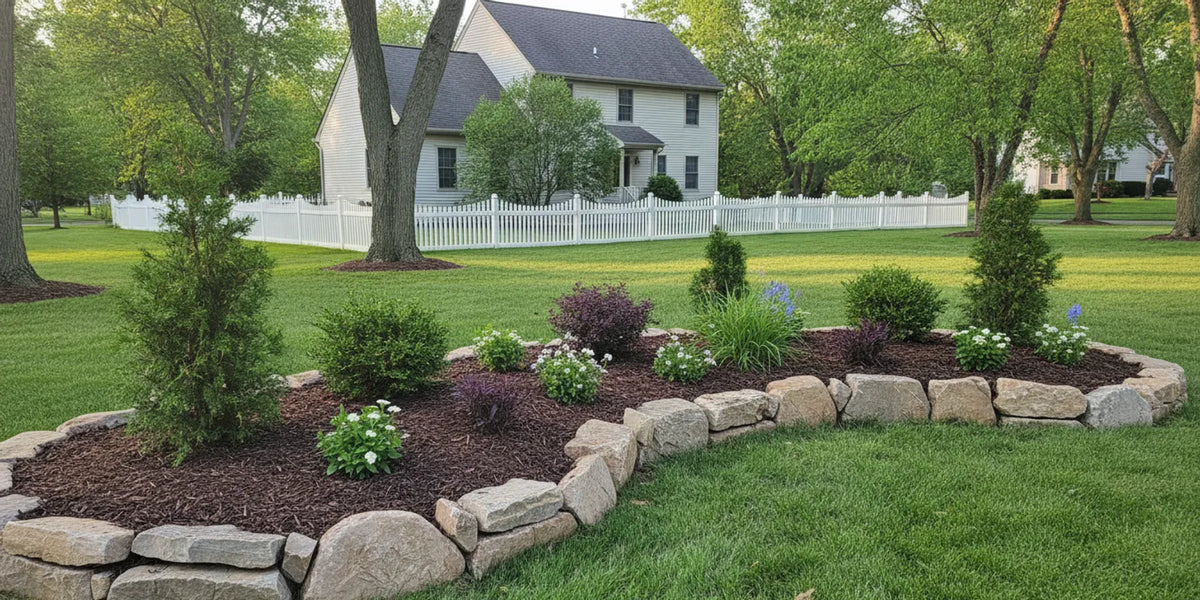
How much decorative stone do I need? Estimate the area you plan to cover, choose a depth that suits the stone and use, then calculate volume: square feet multiplied by depth in inches, divided by 324, gives approximate cubic yards. Treat the result as a planning estimate; the product, site, and fulfillment method can affect the amount to order. For a broader look at planning bulk purchases, see our guide to Ohio homeowner material decisions for bulk landscape projects.
Ask about your decorative stone project
Define the area and intended use
Start with the space, not the number of tons or yards you think you might need. A useful estimate depends on the shape of the area, the coverage depth, the stone itself, and whether the stone is intended as a thin decorative layer or a deeper walking surface. Measuring first helps you compare options on the same basis and makes it easier to explain the project when checking local availability or arranging delivery.
Write down the intended use before doing the math. A bed around shrubs, a narrow foundation strip, a path, and a broad open area may use different stone sizes and depths. A surface meant mainly to show color and texture has different needs from a path that will receive regular foot traffic. If stone is going over an existing surface, account for the condition and shape of that base rather than assuming the ground is uniformly level.
Break an irregular garden into simple shapes
Measure the length and width of each rectangular section in feet, then multiply length by width to get square feet. For a triangular section, multiply its base by its perpendicular height and divide by two. For a circle, multiply 3.14 by the radius squared. An oval or curved bed can be approximated by a rectangle or several smaller sections. A rough but careful breakdown is usually more useful than guessing at the total area by eye.
- Rectangle: length × width = area in square feet.
- Triangle: base × perpendicular height ÷ 2 = area in square feet.
- Circle: 3.14 × radius × radius = area in square feet.
- Several sections: calculate each section separately and add the areas.
For example, a bed that measures 18 feet by 6 feet has 108 square feet. If a second bed is 10 feet by 4 feet, it has 40 square feet. Together they cover 148 square feet. Keep the individual measurements in your notes, too. It is easier to spot a mistaken measurement and adjust the plan when the sections are listed separately.
For a curved edge, measure the average width and length or divide the space into smaller rectangles and triangles. Do not measure only the longest and widest points of a crescent-shaped bed and treat the entire outline as a rectangle; that can substantially overstate its actual area. Conversely, do not trim the calculation too aggressively around curves, tree trunks, or planting pockets if you intend to cover those places with stone.
For a long, curved strip, take width measurements at several points rather than relying on one narrow spot. Add the widths and divide by the number of measurements to estimate average width, then multiply by the strip length. For example, widths of 2, 3, and 4 feet average 3 feet. If the strip is 24 feet long, use about 72 square feet as a starting area. Where a shape bends sharply or widens into a separate bed, split it into sections instead; averaging the entire run could hide a large change in width. Write down the method so you can repeat the measurement if the border moves.
Measure boundaries and exclusions
Decide whether the measured footprint includes areas that will remain uncovered. Subtract a large tree ring, a broad planting pocket, a paved section, or another intentional opening. Small gaps between plants may be easier to leave in the total, particularly when the stone will be spread continuously around them. The goal is not survey-grade precision; it is a sensible surface area that matches the layout you will actually install.
For borders, measure the width of the strip between the edge and the planting line, not just the length of the foundation. A 30-foot foundation run with a 3-foot-wide bed covers 90 square feet before subtracting any openings. For a curved or tapering strip, estimate its average width. If the width changes substantially, divide the strip into sections and measure each one.
Also note sloping or uneven ground. A plan-view measurement gives the horizontal footprint, while the actual surface may be larger on a slope. The effect depends on the steepness and the area. For a small, gently sloping bed, the basic estimate can still serve as a starting point; for a large or noticeably sloped area, discuss the conditions before finalizing an order.
If you are still deciding what else belongs in a bulk project, the Ohio guide to bulk landscape materials provides a useful companion. This article focuses on estimating decorative stone, not selecting every landscape material for a property.
Choose stone size and coverage depth
Depth is the second part of the estimate. A small decorative stone used as a finish layer may be planned at a different depth from a larger stone or a surface designed for regular walking. The stone size, intended appearance, base condition, slope, and edge containment all matter. There is no one depth that is right for every landscape job, so treat any example as a starting point and confirm the product and application before ordering.
Stone that is too shallow may leave parts of the underlying surface visible, particularly after raking or movement. Ordering substantially more depth than needed can raise the material and handling burden and may affect the way borders, plant stems, or hardscape meet the finished surface. Decide what a finished bed should look like before using the formula. If the product description or project plan gives a recommended depth, use that direction instead of a generic rule of thumb.
Consider what the stone will do
- Decorative bed: Choose a depth that gives the selected stone a consistent visual layer while respecting plants, edging, and nearby surfaces.
- Path or access area: Think about the base, foot traffic, drainage, edge restraint, and whether the stone will shift under use. A decorative finish alone may not provide the desired walking surface.
- Area over existing stone: Check the existing material and grade. Adding a new layer can raise the surface and may conceal drainage or edging details.
- Slope or runoff area: Consider whether the stone can stay in place and where water travels. Material quantity alone does not resolve drainage or erosion concerns.
- Around plants: Plan the finished level so the stone does not bury stems or cover areas that should remain open.
A common planning comparison is to calculate at two and three inches, then decide which depth better fits the job. Those are estimating scenarios, not a promise that either depth is appropriate for every product or site. For instance, if the selected stone is relatively large, the layer may need to be deeper to look uniform. If you are topping up a bed, the existing material may mean less new stone is needed than for a bare surface.
Stone dimensions also influence appearance. A small stone can settle into low spots and may move differently from a larger decorative stone. A larger piece may leave more open space between stones, depending on its shape. That is one reason a volume calculation cannot predict exactly how a particular load will look when spread. Compare the selected material with the intended use, and use a consistent depth measurement for the calculation.
One practical way to settle on a planning depth is to mark the intended finished level against a fixed edge, such as a path, curb, or edging. Check several points rather than choosing a depth from one convenient spot. If the bed has a low section and a high section, note both and decide whether you will level the base first or accept a varying layer. The same volume spread across a deeper low spot and a shallower high spot will not create an even finish. A quick sketch with the target depth, existing surface, and edge height makes the trade-off visible before ordering.
Check the product and location
Product names and options can vary by region. A material offered in one service area may not be available from another warehouse, and products sold by the ton should not be assumed to convert to cubic yards at a universal rate. Stone density differs by material, size, and moisture. Do not turn a cubic-yard estimate into tons using an unverified conversion factor.
Use the store selector to identify the appropriate location before relying on a product listing or availability detail. The site’s store and warehouse selector is a practical starting point; local inventory, pickup eligibility, and delivery service still need to be confirmed for the order. A listing for a product or a nearby service page is not a guarantee that every size is stocked or deliverable to every address.
If you are comparing stone intended for a local Ohio project, the decorative stone information for Hudson, Ohio is one regional reference. Confirm that the location and product fit your address and project rather than assuming the same product assortment applies throughout Ohio or in the Carolinas.
Related products

Made from high-quality natural stone for long-lasting performance.
View product

Made from durable, natural stone for long-lasting performance.
View productCalculate bulk decorative stone
Once you have area and a planned depth, use this formula to estimate cubic yards:
Square feet × depth in inches ÷ 324 = approximate cubic yards.
The number 324 comes from the number of cubic inches in a cubic yard expressed across one square foot of surface area: 1 cubic yard is 27 cubic feet, and at a depth of one inch, it covers 324 square feet. For a quick estimate, divide the area by 324 and multiply by the chosen depth in inches. This provides volume, not weight.
At common planning depths, the approximate coverage per cubic yard is:
- At 2 inches: about 162 square feet per cubic yard.
- At 3 inches: about 108 square feet per cubic yard.
- At 4 inches: about 81 square feet per cubic yard.
These are mathematical coverage estimates. They assume a consistent depth across the measured area and do not account for uneven grade, settling, handling loss, or a specific stone’s characteristics. Use them to compare quantities, then qualify the actual purchase by product and sales unit.
Worked example: one rectangular bed
Suppose a bed is 18 feet long and 6 feet wide. Its area is 108 square feet. If the plan is to estimate a two-inch layer, calculate 108 × 2 ÷ 324. The result is about 0.67 cubic yards. At three inches, calculate 108 × 3 ÷ 324, which is 1 cubic yard. The formula shows how much the depth choice changes volume even though the bed’s dimensions stay the same.
That result does not mean a supplier sells a particular product in exactly those amounts, nor does it establish a weight equivalent. Check the item’s unit of sale and ordering increments. If the item is sold by the ton, ask for product-specific guidance rather than applying a generic yards-to-tons shortcut.
Worked example: several beds with an excluded tree ring
Imagine two rectangular beds: one is 14 feet by 5 feet, and another is 8 feet by 4 feet. Their combined area is 70 + 32 = 102 square feet. If a circular tree ring with a 2-foot radius is not being covered, its area is approximately 3.14 × 2 × 2, or 12.56 square feet. Subtracting that leaves about 89.4 square feet to cover.
At a three-inch planning depth, multiply 89.4 by 3 and divide by 324. The estimate is about 0.83 cubic yards. Keep a note that this is the mathematical amount before product, grade, and ordering factors are considered. It helps the supplier understand the goal without implying the final order must match a rounded calculation exactly.
Worked example: a long, narrow foundation strip
A strip that is 36 feet long and averages 2.5 feet wide covers 90 square feet. At two inches, the formula gives 90 × 2 ÷ 324, or about 0.56 cubic yards. At three inches, it gives about 0.83 cubic yards. If the strip varies in width, calculate narrower and wider sections separately. If the surface is sloped, has deep low spots, or includes a substantial existing layer, make a note of that when checking the estimate.
The difference between a computed volume and an order quantity can arise because of product sale units, availability, minimum quantities, or the way the project will be spread. Avoid adding an arbitrary percentage just to make the number feel safer. First review measurements, intended depth, low areas, and the material’s unit. If you want a reserve for future touch-ups, decide that separately from the amount required to cover the defined area.
How to check your result
- Confirm that every length and width is in feet and the planned depth is in inches.
- Check each section’s area, then add the sections and subtract meaningful uncovered areas.
- Calculate cubic yards using area × depth ÷ 324.
- Compare the volume with the product’s listed sales unit; do not assume cubic yards and tons are interchangeable.
- Ask whether the product, delivery method, and address can be served before placing an order.
A calculator can help with arithmetic, but it cannot decide whether your chosen depth suits the stone or whether your property is eligible for delivery. Bring the measurements and the intended use into that conversation.
Choose a reasonable level of precision
Measurements gathered with a tape measure or from a simple sketch are estimates. Do not report an answer such as 0.67284 cubic yards as if that level of precision were meaningful when the bed dimensions are approximate. Keep the calculation to a practical number of decimal places, explain how you measured, and then check how the selected product is sold. A clear estimate of roughly two-thirds of a cubic yard is easier to discuss than a long decimal that implies certainty the measurements do not support.
Rounding should happen after you calculate the area and volume, not before every multiplication. If several sections are involved, calculate each area accurately enough to preserve the shape, add the sections, and then apply the chosen depth. Round the volume to a useful planning figure. The order quantity may need to be rounded again to match an available sale increment. Those are separate decisions: arithmetic estimates coverage, while the product listing and seller confirm what amount can actually be ordered.
For example, a calculated requirement of about 1.4 cubic yards does not automatically mean an order for 1.4 cubic yards is available. The product may be sold by the ton or in another increment, and the weight-to-volume relationship is material-specific. Ask what quantity the item represents and whether it is appropriate for your measured area. If it is sold by weight, the answer should be based on that particular product rather than a conversion borrowed from a different stone.
Decide whether a contingency is justified
A reserve can be reasonable when the surface is uneven, the boundaries are difficult to measure, or the project includes several transitions and low spots. It is not a substitute for checking the depth or material unit. Before adding contingency, ask what uncertainty it is meant to cover. If the concern is a measurement error, remeasure. If it is a low section, measure that section and include it. If the concern is that the material may settle or spread differently, ask about the product and application rather than adding an unsupported percentage.
Some homeowners prefer a small amount available for later touch-ups; others want to avoid storing leftover stone. Neither choice changes the coverage formula, but it can change the quantity they choose to purchase. Consider storage space, whether the same product can be identified later, and whether the extra material can be kept dry and separate. A future top-up may not look identical if the product, source, or lot changes, so a reserve should be a deliberate preference, not a hidden assumption in the calculation.
Use a sketch to prevent double counting
When a project has several beds, sketch the boundaries and label each section with its length and width. Give each section a name, such as front foundation strip, mailbox bed, or rear path. This simple record helps prevent overlap where two measured sections touch and makes it easier to revise the estimate if the landscape plan changes. Mark areas that are not included, such as a walkway, a large tree well, or a planting pocket that will stay open.
For an L-shaped bed, one practical method is to divide it into two rectangles that do not overlap. Measure each rectangle, calculate each area, and add them. If a rectangular approximation includes a corner that should not receive stone, calculate that cut-out as its own rectangle and subtract it. For a rounded bed, several smaller sections can approximate the curve without treating the entire footprint as a full rectangle. The method need not be complicated; it should simply be understandable when you review the measurements later.
Check the sketch against the actual edge line and the intended finished boundary. A border can shift the usable coverage area. If the stone will stop at an existing edging strip, do not include the edging width as material coverage. If edging is being installed separately and the bed dimensions might change, finalize the boundary before committing to the material estimate.
Know what the formula cannot tell you
The formula returns a volume estimate for a uniform layer. It cannot tell you whether a particular stone drains properly in a specific soil, whether a path base is stable, whether the color fits the property, or whether a truck can unload at your preferred location. It also does not include labor or establish a delivered price. Those questions require product and site details beyond length, width, and depth.
Similarly, a coverage number from one product should not automatically be applied to another. Different particle size, shape, density, and sale units can make product comparisons uneven. Compare options by intended use and the information available for each listing. When a listing gives a package or area estimate, check its stated depth and unit before comparing it with your own calculation.
If your area is large or the plan has significant slope, retaining edges, unusual drainage, or a complex base, material quantity may be only one part of the design. Resolve construction questions with a qualified project professional rather than treating a bulk-material estimate as engineering guidance. The calculation is useful for planning and asking informed questions; it is not a specification for every landscape assembly.
Plan delivery, placement, and access
After calculating volume, plan how the stone will reach the project area. Pickup and delivery are not the same as spreading or installation. A bulk delivery may get material to a designated drop point, while moving it from that point into beds, shaping the surface, and finishing edges may be separate work that the customer arranges. Confirm the scope instead of assuming that delivery includes labor or placement.
For a pickup order, consider the selected location, vehicle capacity, safe loading, and how the material will be transported and unloaded. The correct vehicle and load limits depend on the product and the carrier. Confirm pickup instructions and product availability before making the trip. A location selector can help identify the right warehouse, but do not treat the selector alone as proof of current inventory or a promised pickup time.
For delivery, check the estimate in checkout and confirm any project-specific details directly. Delivery charges, taxes, placement, labor, and other fees may be separate from the material price. A displayed material price alone does not establish the complete delivered cost. Address eligibility, order quantity, site conditions, and fulfillment route can affect whether and how a delivery can be arranged.
Prepare a suitable drop area
Before placing an order, identify a practical unloading point and the path between that point and the work area. Think about driveway width, turning space, overhead branches or wires, gates, soft ground, parked vehicles, and nearby structures. Do not assume a truck can reach the exact bed or pass over a surface just because a smaller vehicle can.
- Mark the intended drop location and keep it clear of vehicles and obstacles.
- Check the access route for tight turns, narrow gates, soft shoulders, overhead obstructions, and weight-sensitive surfaces.
- Consider whether the unloading spot is close enough for your planned wheelbarrow or equipment route.
- Tell the supplier about slopes, restricted access, fragile pavement, or other unusual site conditions while qualifying the order.
- Confirm the delivery method, estimated charges, and what the driver can and cannot do at the site.
Access details can influence the right fulfillment plan even when the quantity calculation is correct. A pile dropped at the street may not be easy to move through a narrow side yard. Conversely, a wide open driveway may make a standard drop practical. Describe the real route rather than simply saying the site is accessible.
Before delivery day, walk the route from the likely drop point to the bed and identify where the material will be staged as you work. A route that seems short on a map can involve steps, soft lawn, a tight gate, or a steep grade that slows hand movement. If the pile must be split between more than one bed, estimate how you will transport it without blocking the driveway or damaging nearby planting. Clear the drop point, move vehicles, and protect any surfaces that need protection. These preparations do not change the material calculation, but they can determine whether the planned fulfillment method is practical.
Distinguish delivery from slinger placement
Some projects have a designated drop zone that is distant from the final bed or difficult to reach with a wheelbarrow. Sagamore describes slinger work as conveyor placement for eligible materials, not ordinary delivery and not mulch blowing. The equipment-assisted service is project-specific: material, reach, access, site layout, and quantity need qualification. Learn about slinger placement and project requirements if the drop point and final placement area are different.
Do not assume a slinger can reach every area, work over every obstacle, or place every decorative stone product. Nor should a published example of reach or load size be treated as a commitment for a particular job. Share the address, material, estimated amount, distance, obstructions, and desired placement area to determine whether the service is a fit and to obtain a project-specific quote.
Placement is also distinct from installing or finishing the bed. Conveyor delivery can put eligible material in a planned location; it does not automatically include preparing the base, installing edging, moving stone around plants, raking to a specified depth, or completing other landscape work. Ask which tasks are included in any project quote.
Move from estimate to qualified material order
Use your estimate as a starting point for a product and fulfillment check. The material should be appropriate for the landscape use, available for the relevant service area, and orderable in the listed unit. The final delivery estimate comes through the applicable checkout process, while project services require direct qualification. Keep product purchase questions separate from requests for placement or installation so the scope is clear.
Before buying, gather the details that make the estimate actionable:
- Project address or ZIP code and the nearest candidate warehouse.
- Measured area, including separate sections and any exclusions.
- Planned depth and why it suits the intended use.
- Stone name, size, or product listing under consideration.
- Whether you need pickup, ordinary delivery, slinger placement, or separate installation help.
- Drop location, access route, slope, and other site constraints.
With those details, check the location-qualified listing or contact the company to confirm the next step. The contact page is the route for address- and project-specific questions. If you are comparing listed products, verify the location, unit, inventory, and fulfillment method before treating the listing as a complete order quote.
Material price is only one part of the decision. Delivery, taxes, labor, placement, and any other charges may be separate. Checkout establishes the applicable shipping estimate for an online product order; service pricing depends on project qualification. Do not use an old estimate, an illustrative example, or another location’s item price as a current delivered total for your property.
Use a short order checklist
- Measure: Write down length, width, shape, and uncovered areas.
- Select a depth: Match the intended appearance and use, and confirm product-specific guidance where needed.
- Calculate: Convert the area-and-depth result to approximate cubic yards, then check the item’s actual sales unit.
- Qualify the location: Confirm warehouse, service territory, address eligibility, stock, and pickup or delivery options.
- Set the scope: Clarify whether the request is for material only, delivery, slinger placement, or separate installation.
- Review the total: Check shipping estimates and any separately quoted labor or service charges before committing.
For a small home bed, the measurements and formula may be enough to narrow the quantity. For a larger, sloped, irregular, or access-constrained project, provide the measurements and a site description when requesting guidance. That lets the conversation focus on the variable that actually needs checking rather than relying on a generic online coverage number.
Request help checking your stone estimate
Common questions about decorative stone quantities
How many square feet does one cubic yard of stone cover?
Coverage depends on depth. Using the standard volume formula, one cubic yard covers about 162 square feet at two inches, 108 square feet at three inches, or 81 square feet at four inches. These figures are mathematical estimates for an even layer, not a guarantee of the finished coverage for every product or site.
How do I calculate decorative stone for a curved bed?
Approximate the shape with smaller rectangles, triangles, or a circle, calculate each section in square feet, then add the sections and subtract sizeable uncovered spaces. For a curved strip, split it into sections or use its average width. An approximate, documented measurement is more useful than guessing from the longest and widest points alone.
Can I convert cubic yards to tons?
Not with one universal conversion. The weight per cubic yard varies with the stone and its characteristics, so a generic conversion can produce a misleading order. Check the product’s sales unit and ask for product-specific information before converting a volume estimate to tons.
Should I order extra stone?
First review the area, depth, grade, existing material, and product unit. An arbitrary extra percentage may not solve an inaccurate measurement or a mistaken depth assumption. If a reserve for future touch-ups matters to you, decide that separately and confirm that the product can be ordered in a suitable amount.
Does stone delivery include spreading or installation?
Do not assume it does. Material pickup or delivery, slinger placement, and landscape installation are different scopes. Ask what the order or quote includes, where the material will be left, and who is responsible for preparing and finishing the bed.
In short, measure the real coverage area, select a suitable depth, and use area × depth ÷ 324 to estimate cubic yards. Then confirm the product, sales unit, local availability, access, and fulfillment scope before placing an order.
